Quick Answer
To install a PCIe 5.0 graphics card with maximum stability and airflow, seat the card firmly in the x16 slot until both retention clips engage, support the rear of the GPU with a vertical bracket or anti-sag holder, connect the 16-pin 12VHPWR connector with cables routed away from the fan intakes, and ensure at least 10 cm of clearance between the GPU fans and the front of the case.
Physically Installing the Card Correctly 🔧
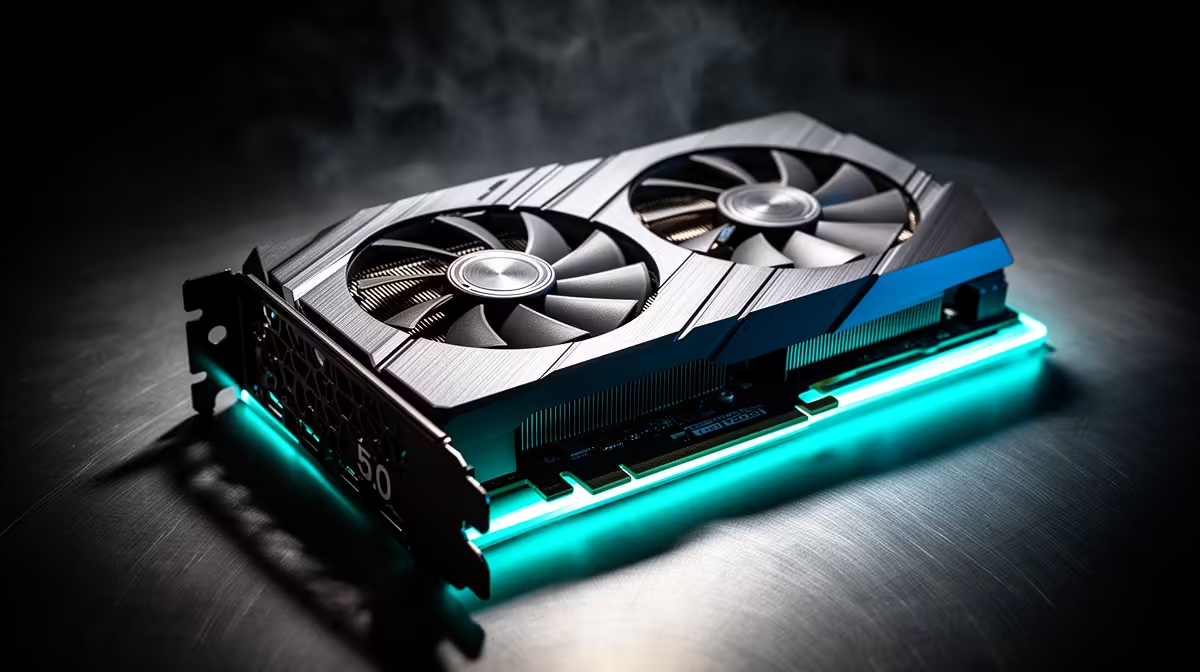
PCIe 5.0 graphics cards like the RTX 5080 and RTX 5090 are significantly heavier and longer than previous-generation cards, with triple-fan designs measuring over 33 cm in length. Lower the card squarely into the x16 slot rather than at an angle: angled insertion bends the slot contacts and can damage the motherboard. Press firmly until the retention latch clicks closed. GPU sag under this weight will stress the PCIe slot over time. Use a vertical GPU support bracket, available for R150 to R400 at Evetech, to support the card once installed.
Connector and Power Cable Management 🔌
The 16-pin 12VHPWR connector used by RTX 50-series cards requires careful handling. Inspect the connector and cable for bent pins before insertion; do not force a misaligned connector. Route the power cables so they do not curve sharply at the connector head, as a 90-degree bend at the 12VHPWR joint has caused connector failures on earlier RTX 40-series installations. If your PSU does not include a native 12VHPWR cable, use the adapter that ships with the card, routing all adapter tails into the cable management channel at the back of the case to keep them away from GPU fan intakes. A 850W or higher PSU is recommended for RTX 5080 builds; the RTX 5090 should be paired with at least a 1,000W 80+ Gold unit.
Optimising Airflow Around the GPU 🌬️
PCIe 5.0 GPUs generate substantial heat under load, with the RTX 5090 rated at a 575W TDP. Position the case so the intake fans face a clear, unobstructed surface: avoid placing the PC on carpet or against a wall. Internally, ensure front case intake fans push air across the GPU cooler fins rather than being blocked by HDD cages or poorly routed cable bundles. A mid-tower case with a mesh front panel and at least three 120 mm intake fans maintains adequate GPU airflow. In Johannesburg where summer ambient temperatures regularly reach 28 to 33 degrees Celsius indoors, this becomes critical: high ambient temperature directly reduces the temperature headroom for GPU boost clocks, so every degree of case airflow improvement translates to sustained higher GPU frequencies.
Check GPU Temps Under Load Before Closing the Case ⚡
After installation, run a 10-minute GPU stress test using a free tool before closing the side panel. Check peak GPU temperature in the monitoring software. If the GPU exceeds 85 degrees Celsius under full load with the side panel off, the closed case will add 5 to 10 degrees more. Adjust fan curves or add case fans before closing to ensure sustained temperatures stay below 85 degrees Celsius.
FAQ
Does a PCIe 5.0 GPU work in a motherboard with a PCIe 4.0 x16 slot?
Yes. PCIe is backward compatible and a PCIe 5.0 GPU will function in a PCIe 4.0 slot at PCIe 4.0 speeds. For current gaming workloads this causes no measurable performance difference, as GPU performance is not bandwidth-limited at PCIe 4.0 x16 speeds.
What motherboard chipsets in South Africa support PCIe 5.0 x16 GPU slots?
Intel Z890 and AMD X870E motherboards offer PCIe 5.0 x16 GPU slots. These boards retail from around R4,500 to R12,000 in South Africa depending on feature set.
Should I use a GPU support bracket in any case, or only in large cases?
Any build using an RTX 50-series or RX 9000-series card benefits from a GPU support bracket regardless of case size. Even in compact mid-towers, the weight of triple-fan flagship cards creates long-term slot stress without support.
Installing a high-end GPU in your next build?
Evetech stocks PCIe 5.0 graphics cards, compatible motherboards, and GPU support accessories with local warranty. Browse the graphics card and PC components categories at Evetech.