Buy a CPU today and the socket it plugs into decides whether you can drop in a faster chip in three years or have to replace the motherboard, RAM and processor all at once. On platform longevity, the picture in 2026 currently favours AMD, because AM5 keeps supporting new Ryzen generations while Intel is moving to a fresh socket again for its next architecture.
Quick Answer
AMD's AM5 socket spans multiple Ryzen generations on the same motherboard, so an AM5 board bought today can usually take a newer Ryzen later with a BIOS update. Intel is transitioning from LGA1851 to LGA1954 for its Nova Lake generation, meaning a current Intel board is unlikely to host that next architecture. For upgrade longevity right now, AMD has the edge.
What platform longevity means and why it matters
Platform longevity is how long a single motherboard socket stays useful across processor generations. A long-lived socket lets you upgrade the CPU alone, keeping your board, RAM and cooler, which is cheaper and far less disruptive than a full rebuild. A short-lived socket forces a platform swap, where a new chip means a new motherboard and often new memory too. For anyone who plans to upgrade mid-life rather than replace the whole machine, the socket roadmap is one of the most important and most overlooked buying factors.
AMD AM5: a deliberately long runway
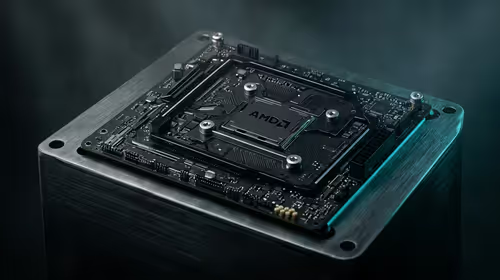
AMD has built a reputation for sticking with a socket across several generations, and AM5 continues that approach. The socket has carried multiple Ryzen generations already, and AMD has publicly committed to supporting AM5 well into the future. In practice this means a motherboard bought today can often accept a newer Ryzen chip later, sometimes after a BIOS update to add support for the new silicon.
The real-world benefit
The value shows up at upgrade time. If you buy a mid-range Ryzen now on a solid AM5 board, you can later step up to a faster Ryzen without touching the motherboard, the DDR5 memory or the cooler. That turns a major rebuild into a fifteen-minute CPU swap, and it protects the money you spent on the surrounding components.
The caveats
Long socket support is not a blank cheque. BIOS support for a new chip depends on the board maker releasing an update, and older budget boards may run out of BIOS flash storage for new microcode. Power delivery on an entry-level board can also limit how high-end a future chip you can sensibly run. The longevity is real, but pairing a long-lived socket with a reasonably specced board makes the most of it.
Intel LGA1851 and the move to LGA1954
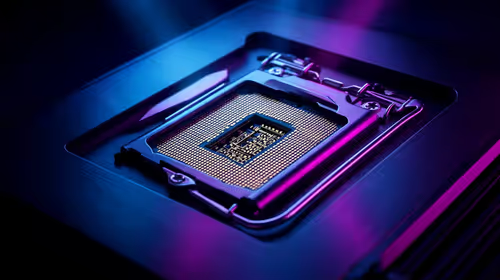
Intel's recent platforms have tended to last fewer generations per socket than AMD's. Current Intel desktop chips use LGA1851, but Intel's next architecture, Nova Lake, is set to move to a new socket, LGA1954. That socket change means a board bought for the current Intel generation is unlikely to host Nova Lake, so an Intel upgrade path in the near term more often involves a new motherboard alongside the new CPU.
What that means for an Intel buyer
It does not make Intel a poor choice, the current chips are strong performers, but it does change how you should think about the purchase. If you buy Intel now, plan around the CPU you buy today rather than counting on a cheap drop-in upgrade later. You are buying performance for this build, not a long upgrade runway on the same board.
Beyond the socket: the rest of the longevity picture
Socket support is the headline, but a few other factors shape how long a platform stays relevant. DDR5 memory is now standard on both AM5 and current Intel, so memory is not the differentiator it once was. PCIe generation matters for future GPUs and SSDs, and both platforms are competitive there. Chipset features, the number of USB ports, M.2 slots and PCIe lanes, age more slowly than the CPU, so a well-featured board stays useful even if you never upgrade the chip. The point is that a long-lived socket is most valuable when the board around it is specced to last too. For a sense of how these CPUs land in complete systems, the pre-built PC best-sellers at Evetech show which platforms are pairing with current GPUs and memory.
Who should pick which
If you are the kind of builder who plans to upgrade the CPU once or twice over the life of a machine, AMD's AM5 is the stronger bet today, because the socket gives you a realistic drop-in path. If you upgrade by replacing the whole platform every few years anyway, the socket roadmap matters less, and you should simply buy the best chip for your budget and workload, Intel included. For most SA builders trying to stretch a build across several years, the longer runway is worth weighting heavily. You can compare current chips directly in the Intel CPU range at Evetech to see how this generation stacks up before you commit to a socket.
Frequently Asked Questions
Does AM5 really support multiple Ryzen generations?
Yes. AMD has carried several Ryzen generations on AM5 already and has committed to supporting the socket into the future, so an AM5 board can often take a newer Ryzen later, sometimes after a BIOS update.
Will my current Intel board support Nova Lake?
Most likely not. Nova Lake is set to use the new LGA1954 socket, while current Intel desktop chips use LGA1851, so a Nova Lake upgrade generally means a new motherboard as well as a new CPU.
Is a long-lived socket always worth paying for?
It is worth it if you plan to upgrade the CPU mid-life without rebuilding the whole machine. If you replace your entire platform every few years regardless, the socket roadmap matters far less than raw performance for your budget.
Do I need a new BIOS to use a newer chip on an old board?
Often yes. Supporting a newer CPU on an existing board usually requires a BIOS update with new microcode, and you should confirm the board maker has released one for the chip you want before buying.
Does Intel or AMD perform better right now?
Performance is competitive and depends on the specific chips and workload, gaming, content creation or productivity. Longevity and performance are separate questions, so weigh the upgrade path against raw speed for what you actually do.
Choosing your next platform? Compare current Intel processors in the CPU range at Evetech and weigh raw performance against the upgrade runway before you pick a socket.