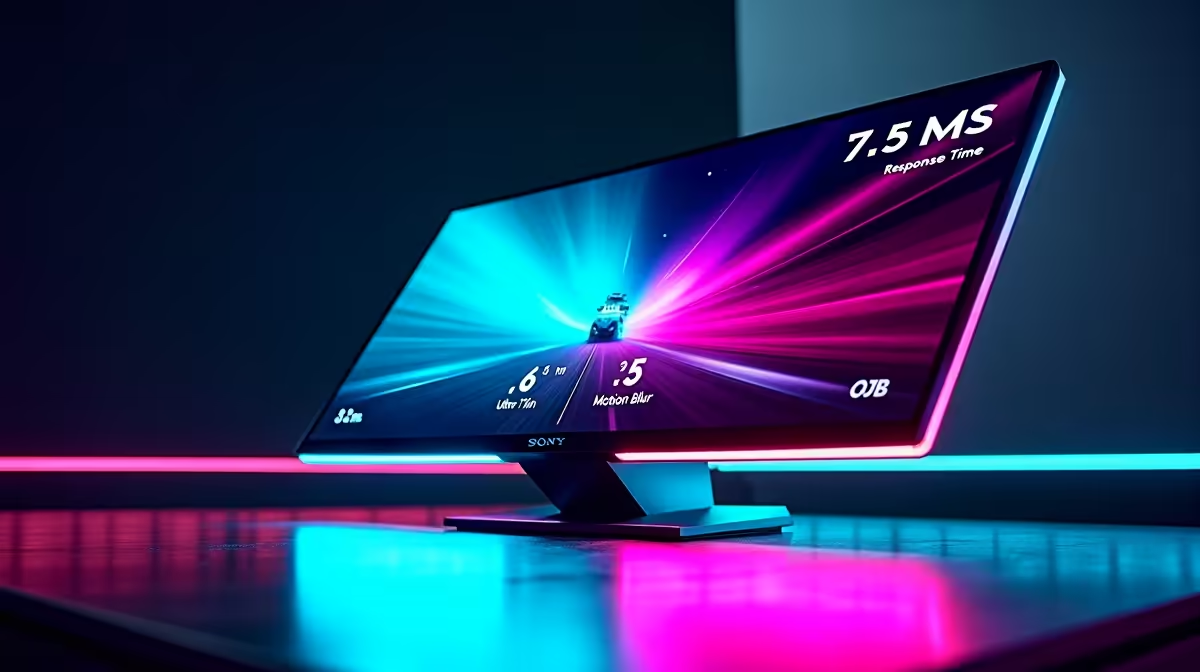
A ghost trailing behind a fast-moving enemy is not a network problem or a settings oversight -- it is the display itself failing to keep up. Panel technology is the factor most monitor reviews bury under refresh rate headlines, but for fast-paced shooters it determines whether that enemy has a crisp, trackable edge or a smeared halo that masks the target's actual position. IPS versus VA panels is the choice that settles this question, and 0.5ms grey-to-grey response is the spec that explains why it matters.
Quick Answer
IPS panels generally achieve quicker grey-to-grey transitions, often hitting the 0.5ms spec that keeps moving targets sharp. VA panels offer deeper native contrast but can lag behind IPS in dark-tone transitions, leaving ghost trails in shadowy scenes. For competitive shooter play, IPS usually wins on speed.
⚡ What Response Time Actually Measures
Every pixel on an LCD panel transitions between shades rather than switching instantly. Response time is the duration of that transition, measured from one grey level to another. The grey-to-grey (GtG) figure on a spec sheet reflects the average speed across the panel's range of shade shifts.
A panel rated at 0.5ms GtG completes most transitions in under a millisecond. A panel at 4ms takes eight times as long. During that transition window the pixel is showing an intermediate shade, not the shade the current frame needs. When a target moves across the screen at speed, slow pixels leave their previous-frame shade visible alongside the new one -- that visible remnant is motion blur generated entirely by the panel, entirely independent of your frame rate.
In a fast shooter this physics plays out as an enemy that appears to drag a faint copy behind it while strafing. The width of that ghost corresponds directly to how many pixels have not yet settled into their target shade as the eye tracks the movement.
Overdrive and Its Complications
Panel manufacturers push response times lower using overdrive circuits that briefly overshoot a transition before correcting. This is why advertised 0.5ms figures are achievable at all. The risk is overshoot artefacts: a bright trail ahead of dark-on-dark movement, which trades one type of smearing for another. A well-tuned overdrive setting is the sweet spot between a sluggish native response and visible inverse ghosting.
🔆 IPS Performance in Shooter Scenarios
IPS panels have historically led on response because their liquid crystal alignment switches relatively uniformly across the greyscale. A quality IPS gaming panel with good overdrive can reach and sustain that 0.5ms figure across most transitions, including mid-grey shifts that are the most common in on-screen movement.
The practical outcome in shooters is that fast targets, muzzle flashes, and rapid camera motion all render without trailing. Colours remain accurate even under fast overdrive, which matters for distinguishing between environment tones and enemy outlines when playing titles with similar colour palettes.
IPS does carry a contrast limitation. Native contrast ratios typically sit around 1,000:1, which means the black level is noticeably lifted compared to other panel types. In very dark game environments this can slightly flatten the scene, though the effect on competitive play is minor compared to the impact of a faster response.
Pro Tip ⚡
When testing a new IPS gaming monitor for shooters, load a scene with high-contrast diagonal movement -- a player strafe against a bright sky works well. Run the overdrive at its medium setting first. If you see a bright halo ahead of the target, drop one level; if you see smearing behind, raise one. Panel overdrive tuning takes less than five minutes and makes a genuine difference to perceived ghosting.
🌗 Where VA Panels Trade Speed for Contrast
VA panels achieve contrast ratios that IPS cannot come close to. Native contrast in the 3,000:1 to 5,000:1 range delivers black levels deep enough that dark game environments look genuinely dark rather than milky grey. For RPGs, atmospheric horror titles, and any visually cinematic game this is a significant visual advantage.
The cost is response. VA crystals align more slowly, and that slowness is worst in the transitions between dark shades. A VA panel might measure near 1ms for bright-to-mid transitions but stretch to 8 to 12ms when moving between two adjacent dark grey levels. This dark smearing is the characteristic weakness of VA in motion.
In a shooter where shadowy interiors are common -- think urban warfare or indoor corridors -- those slow dark transitions mean targets moving through low-light areas drag a visible blur. This is not a calibration fix; it reflects the physics of the crystal alignment in the technology. Better VA panels and better overdrive circuits have narrowed the gap over successive generations, but fast IPS still generally clears dark transitions more cleanly.
🎯 Making the Call for Your Setup
The choice resolves into a question about your primary use case. If most of your hours go into competitive multiplayer shooters where visibility of fast targets is directly tied to performance, a well-reviewed IPS panel with 0.5ms GtG and a balanced overdrive setting is the straightforward pick.
If your session time is split between competitive play and visually rich single-player games, the decision is less clear-cut. VA's contrast advantage is real and appreciable in cinematic content. Some players accept the occasional dark smear in exchange for the richer visual atmosphere in the games they spend more time in.
Pure competitive players, especially those in a home or koshuis setup where ambient light is controlled and the screen is the primary display, are best served by an IPS panel. The 0.5ms spec aligns with the genre's demands more directly than any contrast advantage VA offers.
Frequently Asked Questions
How does a 0.5ms response time reduce motion blur in shooters?
When each pixel settles into its target shade before the next frame is drawn, fast-moving objects render without a trailing ghost. At 0.5ms the transition window is short enough that human vision does not perceive the residual intermediate shade during normal play. Longer transition times leave that intermediate shade visible, which is the smearing seen behind fast targets.
Does VA smearing only appear in dark scenes?
Mostly, yes. VA's slowest transitions are between adjacent dark shades. In bright outdoor game environments the effect is often undetectable. The problem concentrates in indoor areas, night missions, and any scene with a dark background, where moving objects are transitioning through the exact shade range VA handles least efficiently.
Can a VA panel still work for shooters if the contrast is important to me?
It can. If you play in a controlled environment and your opponents are typically in mid-to-bright environments, VA smearing will affect you less. Check specific model reviews for dark-tone response benchmarks rather than relying on the rated GtG spec alone, since that figure often reflects the panel's best-case transition rather than its dark-scene average.
Is the 0.5ms figure always accurate on the spec sheet?
Not precisely. The 0.5ms rating reflects the best-case grey-to-grey measurement, usually a fast mid-grey transition with overdrive at maximum. The average response across all transitions is higher. A realistic figure for a well-tuned IPS gaming panel is closer to 1 to 2ms average, which is still fast enough for competitive play but more representative of daily performance than the advertised ceiling.
Does IPS glow interfere with identifying targets in competitive play?
Rarely at a level that affects outcomes. IPS glow appears in the corners of the panel when a dark scene is displayed, but it is a static phenomenon rather than a moving one. Unlike VA smearing, which follows moving objects, IPS glow stays in one place and the eye adjusts to it quickly. Players in dark rooms with very dark screen content will notice it more than those gaming with ambient lighting.
Ready to stop losing targets to panel smear?
Browse the IPS gaming monitor range at Evetech and compare models with verified 0.5ms response times built for competitive South African players.