NVIDIA's DGX Spark went from a $3,999 desk toy for AI developers to a $4,699 one in February 2026, after a memory shortage forced an 18 percent price bump. For a South African buyer, that USD figure is only the start, because import duties, shipping and 15 percent VAT all stack on top. So the real question is not whether a petaflop of AI on your desk sounds cool, but whether you get enough for the money to justify the route it takes to get here.
Quick Answer
At $4,699 the DGX Spark gives you a GB10 Grace Blackwell superchip, 128GB of unified memory and up to one petaFLOP of FP4 AI performance in a box the size of a small router. It is genuinely good value for a local model prototyping rig, but poor value if you just want gaming or general compute. For SA buyers, expect the landed cost to climb well past the dollar sticker once duties and VAT are added.
What You Actually Get for $4,699
The Spark is built around NVIDIA's GB10 Grace Blackwell superchip: a Blackwell generation GPU with fifth gen Tensor Cores and FP4 support, tied to a 20 core Arm CPU made up of 10 Cortex-X925 performance cores and 10 Cortex-A725 efficiency cores. That delivers up to one petaFLOP of AI compute at FP4 precision.
The headline spec for AI work is the 128GB of unified memory shared between CPU and GPU, paired with a 4TB NVMe SSD. Connectivity is serious: three 20Gbps USB-C ports with DisplayPort alt mode, HDMI 2.1a, 10Gb Ethernet, and two QSFP ports feeding an onboard ConnectX-7 NIC that runs up to 200Gbps, so two Sparks can be linked to handle even bigger models.
Why the Price Jumped to $4,699
The $700 increase was not a value grab. Worldwide memory supply tightened sharply through late 2025 and into 2026, and the Spark leans heavily on a large pool of fast unified memory, so NVIDIA passed the cost on. The Founders Edition moved from $3,999 to $4,699 in February 2026, an 18 percent rise, and the same shortage has pushed up memory prices across the whole market.
That context matters when you compare it to alternatives. Other unified memory machines aimed at local AI have faced the same pressure, so the Spark is not uniquely expensive for what it does. It just stopped being the bargain it briefly looked like at launch.
Who It Is Actually For
The Spark earns its keep as a development and research tool. If you build, fine tune or prototype large models and want to do that locally rather than renting cloud GPUs, having 128GB of unified memory on your desk is a real workflow advantage. You can hold a large model in memory, iterate fast, and only push to the cloud or a data centre once the work is proven.
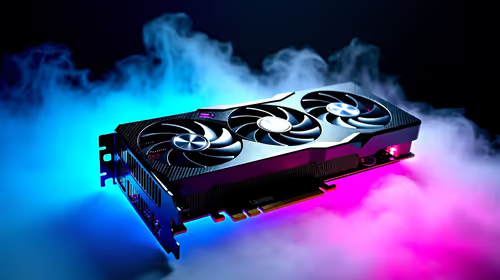
It is the wrong buy for almost everyone else. It is not a gaming machine, it is not a general desktop, and its Arm based software stack is tuned for the NVIDIA AI ecosystem. If your work does not involve training or running big models, the money is better spent elsewhere. For most South African builders, a strong consumer GPU in a conventional PC, like the cards in the GPU best sellers list, covers gaming and lighter AI work for far less outlay.
Spark vs a Consumer GPU Build
The honest comparison is not Spark against a data centre rack, it is Spark against a well chosen desktop. A consumer card with 24GB or 32GB of VRAM runs Stable Diffusion, Flux and quantised language models happily, plays every game at high settings, and serves as a general workstation, all for a fraction of the Spark's landed cost. What it cannot do is hold a very large model in one device, because its VRAM tops out where the Spark's 128GB unified pool is just getting started. So the decision is binary: if your models fit in 24GB or 32GB, a desktop wins on flexibility and price; if they do not, the Spark exists precisely to fill that gap.
Speed Is Not the Point
It is worth being clear about performance. The Spark is built for capacity and developer convenience, not for the fastest possible inference. Token generation on a large model is steady rather than blistering, and a stack of cloud GPUs will out run it on throughput. What you are paying for is the ability to develop against a big model privately, on your own desk, without renting time or shipping data off site. That is a real advantage for research and prototyping, but it is a poor reason to buy one if raw speed is what you are chasing.
The Real SA Cost
The $4,699 price is a US figure, and the Spark is not a mainstream local stock item, so most South African buyers face an import. On top of the dollar price you add international shipping, customs duties and 15 percent VAT, which together can lift the landed cost meaningfully above a simple Rand conversion. Factor in exchange rate movement at the time of purchase and warranty support, since servicing a grey import locally is rarely straightforward. As specialised AI hardware filters into the local market, the AI PC category at Evetech is the place to watch for properly supported options.
Frequently Asked Questions
Is the DGX Spark worth it for hobbyists?
For a casual hobbyist, no. The value is in serious local model development where 128GB of unified memory removes a real bottleneck. If you are experimenting occasionally, cloud GPU time or a consumer card delivers far more flexibility for the money.
Can the DGX Spark run games?
It is not designed to. The Spark runs an Arm based stack built around NVIDIA's AI software, not a gaming oriented Windows setup, and its GPU is tuned for AI throughput rather than frame rates. Buy a conventional gaming PC if that is your goal.
Why does it cost more in South Africa?
The $4,699 is a US price. SA buyers importing one add shipping, customs duties and 15 percent VAT, plus any exchange rate movement, so the landed cost lands well above a direct Rand conversion. Local warranty cover is also harder to arrange on imports.
How much memory does the DGX Spark have?
It carries 128GB of unified memory shared between the GB10 superchip's CPU and GPU, alongside a 4TB NVMe SSD. That large unified pool is the main reason it can hold sizeable models locally that consumer graphics cards cannot fit.
Can I link two DGX Sparks together?
Yes. The onboard ConnectX-7 NIC offers two QSFP ports running up to 200Gbps, which lets you connect two units to work on larger models than a single Spark can hold. That clustering ability is part of its appeal for research teams.
Weighing local AI hardware against a conventional build? Compare what your budget buys in the AI PC range at Evetech and let the team help you size the right machine for your workload.