Quick Answer
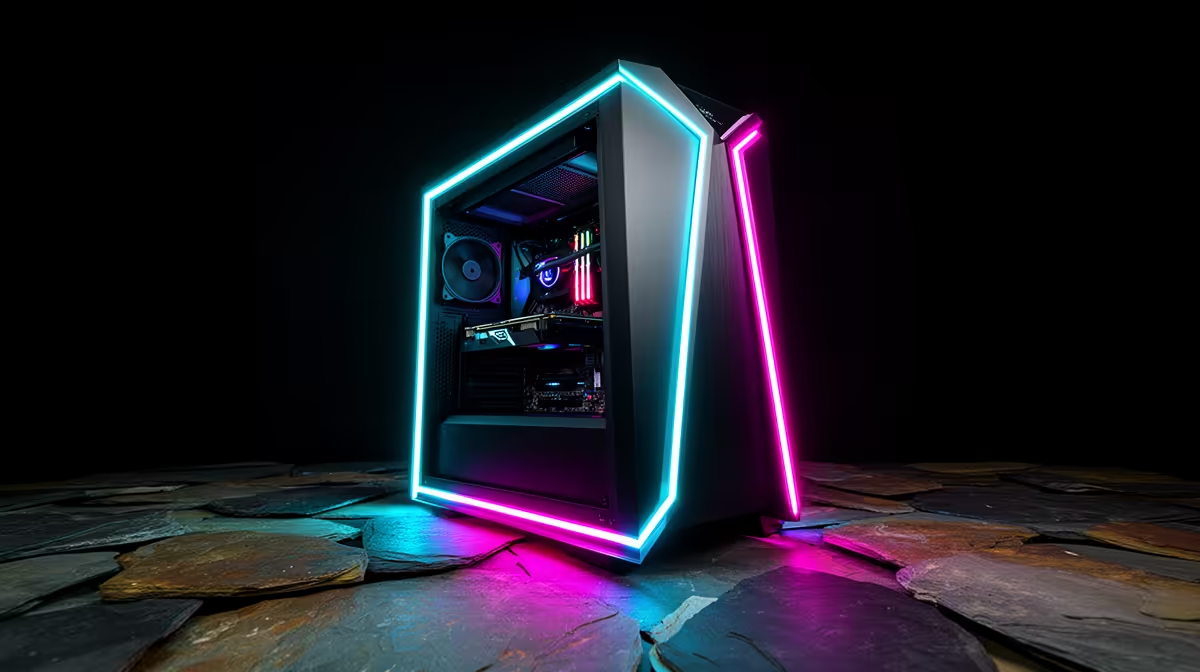
Yes, an EATX mid-tower case is big enough for most high-end gaming PCs, including builds with an RTX 5080, a 360mm AIO, and a Ryzen 9 9950X, provided GPU clearance exceeds 380mm and the case explicitly supports the full EATX motherboard standoff pattern. It is not big enough for dual-GPU setups or triple-radiator extreme cooling configurations.
What EATX Mid-Tower Actually Means in Practice 🖥️
The term EATX mid-tower describes a chassis that fits an extended ATX motherboard (305mm by 330mm) while maintaining roughly mid-tower external dimensions: typically 230mm to 270mm wide, 480mm to 530mm tall, and 470mm to 520mm deep. True EATX support requires the full 9-standoff mounting grid to extend to the 330mm board height, which not all cases labelled EATX-compatible actually provide. Cases that partially support EATX may fit the board physically but not secure the top two rows of standoffs, leaving the board unsupported. At current South African pricing, genuine EATX mid-towers sit between R2,200 and R3,800. Budget EATX claims below R1,600 usually indicate standard ATX clearance with a slightly wider tray.
High-End Component Fitment in an EATX Mid-Tower 🔧
A high-end South African gaming build in the R45,000 to R70,000 range typically uses an EATX board for its additional PCIe slots and memory channels. In an EATX mid-tower with 400mm GPU clearance, an RTX 5080 triple-fan variant at approximately 360mm fits comfortably with room for the 16-pin power connector. A 360mm AIO mounted at the front or top is standard in these cases. The key constraint is top radiator clearance when tall DDR5 memory modules are installed: check that the case provides at least 170mm of CPU cooler height, or that the top radiator mount clears your RAM by 40mm or more. Mid-tower EATX cases typically allow 170mm to 180mm CPU cooler clearance, which accommodates most top air coolers and front-mounted AIOs without conflict.
When an EATX Mid-Tower Is Not Enough 📋
If you plan a dual RTX 5080 NVLink setup, which requires two full-length PCIe slots with significant spacing and two separate power cable runs, an EATX mid-tower becomes cramped. Similarly, enthusiast builders wanting a 420mm front radiator and a separate 240mm or 360mm top radiator simultaneously often exceed mid-tower internal space. For these configurations, a full-tower at R3,500 to R5,000 is the more practical choice. SA builders should also note that full-tower cases fare better for heat dissipation in warm Highveld and summer conditions, offering more fan mounting positions and larger internal volume for air circulation.
Verify Standoff Rows Before Ordering ⚡
Contact Evetech support or check the case manual PDF for the exact EATX standoff row count. A case with only 7 standoffs listed is ATX-only despite marketing claims. True EATX needs 9 standoffs in the full 305x330mm pattern, and this detail is often buried in the manual rather than the product page headline spec.
FAQ
Can an EATX mid-tower fit a 280mm AIO at the top if I have a 360mm front AIO?
Some larger EATX mid-towers do allow both, but it is uncommon. Most mid-towers allow one or the other to maximise airflow. Verify the specific case supports simultaneous front 360mm and top 240mm or 280mm mounting before committing.
Is an EATX mid-tower suitable for water-cooling custom loops?
Custom soft-tube or hard-tube loops need reservoir and pump mounting space that is tight in mid-towers. A pump-reservoir combo under 200mm height typically fits. Hard-tube loops with 90-degree fittings need full-tower space for comfortable bend routing.
Do EATX mid-towers cost significantly more than standard ATX mid-towers?
Expect to pay R400 to R800 more for genuine EATX mid-tower support over a comparable ATX case. That premium covers the wider tray and additional structural bracing needed to support the larger board securely.
Building a high-end rig and need EATX space without full-tower bulk?
Evetech stocks verified EATX mid-tower cases to fit your large board and high-end components without compromise.