Quick Answer
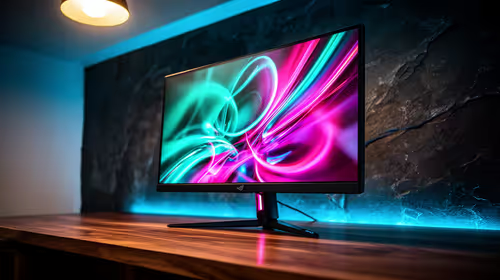
Monitors don't directly connect to storage drives, they receive video signals from your PC's GPU. What does matter is that your storage is fast enough to feed games and apps to the resolution and refresh rate your monitor supports, especially for 1440p and 4K panels in SA setups.
Understanding the Real Question
Most SA shoppers asking about monitor and storage compatibility are actually asking one of two things: will my SSD load games fast enough for my high-Hz monitor, or do I have enough video outputs and ports for my drives + dock + display setup. The answer to both: NVMe Gen4 SSDs eliminate texture pop-in on 1440p+ panels, and modern motherboards have plenty of M.2 slots and DisplayPort/HDMI outputs to handle multi-monitor + multi-drive builds without conflict.
Storage Speeds That Match Your Monitor's Resolution
A 1080p 144Hz panel pairs fine with a basic Gen3 NVMe SSD around 3,500 MB/s. Step up to 1440p 165Hz or 4K 144Hz and you'll feel the benefit of a Gen4 NVMe at 7,000 MB/s, especially in DirectStorage-enabled titles like Forspoken or Ratchet and Clank. The monitor doesn't care about your drive speed, but your eyes will see the difference in level loads and texture streaming. SATA SSDs are fine for game libraries you don't mind waiting on.
SA-Specific Setup Tips
Evetech ships M.2 NVMe drives nationwide, with 1TB Gen4 options sitting around R1,400 to R1,900 in ZAR. If you're running a triple-monitor setup for productivity plus gaming, make sure your GPU has 3+ DisplayPort outputs (RTX 4060 and up, RX 7700 XT and up). Keep a small UPS in line so a loadshedding cut doesn't corrupt an active SSD write, modern drives are fairly resilient but a clean shutdown is always better than a yanked plug.
Frequently Asked Questions
Can a monitor be connected directly to an external SSD?
No. Monitors take video signal via DisplayPort, HDMI or USB-C DP-Alt mode from a host device. External SSDs connect via USB to a PC, laptop or console, never directly to a monitor.
Will a slow SSD cause stutter on a 165Hz monitor?
Loading and texture streaming will stutter, but rendered frame rate is unaffected once a level is loaded. Upgrade to NVMe if you see asset pop-in mid-game on a high-Hz panel.
Do USB-C monitors with built-in hubs support storage?
Some do, USB-C monitors with downstream USB-A hubs can run external SSDs through them, but bandwidth is limited to USB 3.0 speeds typically.
Ready to Find Your Perfect Match?
Find a panel that matches the rest of your build. Browse monitors