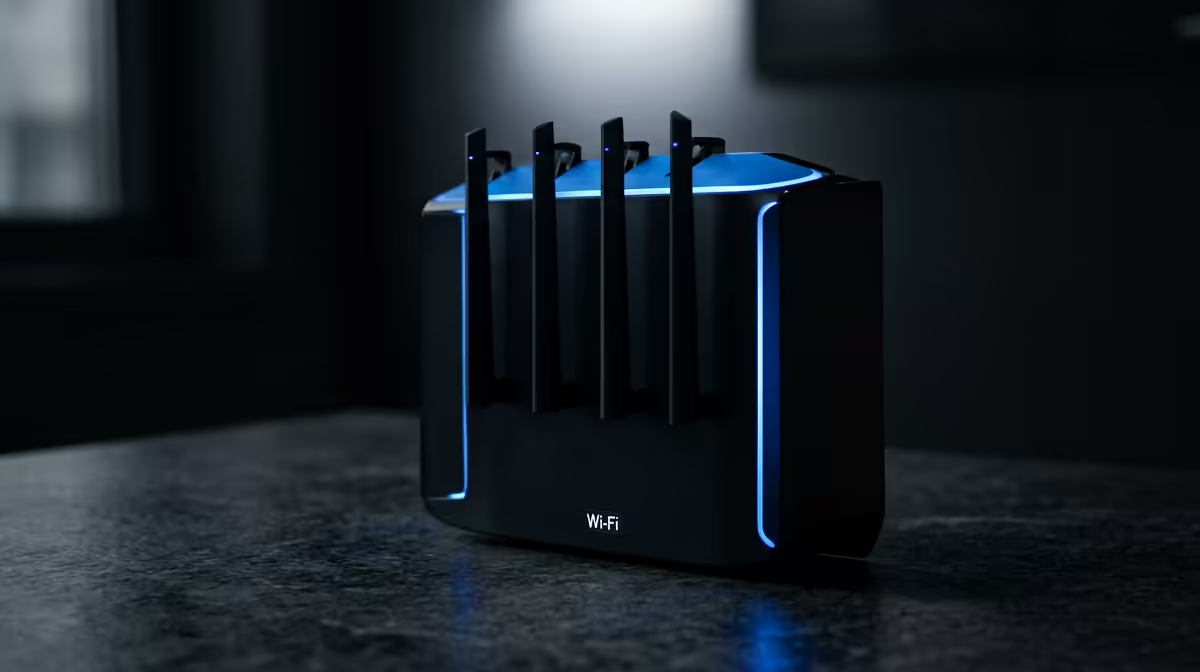
Spend real money on a Wi-Fi 7 router today and the obvious worry is that Wi-Fi 8 lands next year and makes it obsolete. It will not. The headline answer is that Wi-Fi 7 gear is future-proof in every way that matters: Wi-Fi 8 reuses the same radio bands, builds directly on Wi-Fi 7's foundations, and stays fully backward compatible, so your router and devices keep working exactly as they do now after the new standard arrives.
Quick Answer
Yes, your Wi-Fi 7 hardware is safe. Wi-Fi 8 (the 802.11bn standard) shares the same 2.4GHz, 5GHz and 6GHz bands with Wi-Fi 7 and maintains full backward compatibility. Certified Wi-Fi 8 products are not expected in volume until late 2027 or 2028, and your current gear keeps running normally throughout.
Why backward compatibility is guaranteed, not hoped for
Every generation of Wi-Fi since the standard began has stayed backward compatible, and Wi-Fi 8 is no exception. A Wi-Fi 8 router will talk to Wi-Fi 5, Wi-Fi 6 and Wi-Fi 7 devices, and a Wi-Fi 7 router will happily serve Wi-Fi 8 phones and laptops at Wi-Fi 7 speeds. Nothing in your home stops working the day Wi-Fi 8 ships.
The deeper reason is that Wi-Fi 8 does not move to new frequencies. It operates on the same three bands Wi-Fi 7 already uses. There is no equivalent of the jump that opened the 6GHz band, where older hardware genuinely could not reach the new spectrum. Because the bands are shared, the physical link between old and new devices is preserved by design.
What Wi-Fi 8 actually changes, and why it is not a speed war
This is where the future-proofing argument gets stronger, not weaker. Wi-Fi 8 is not chasing a bigger headline speed number. Its focus is reliability, consistency and coordination, making connections more stable in busy, congested real-world conditions rather than faster on a lab bench. The goal is steadier latency and fewer dropouts when many devices and many networks compete for the same air.
That matters for your buying decision in two ways. First, the raw throughput ceiling of Wi-Fi 7 is already extremely high, so you are not missing a meaningful speed jump by buying now. Second, because Wi-Fi 8 builds on the same architecture, the gap between the two is about refinement rather than reinvention.
The MLO connection
Wi-Fi 7's standout feature is Multi-Link Operation, where a device runs across multiple bands simultaneously and shifts away from a degraded one without dropping the connection. Independent field trials have validated MLO as delivering wired-like reliability in homes, roughly halving latency under interference and keeping connections stable as conditions change.
Wi-Fi 8 takes that same multi-link foundation and extends it with coordination between access points. In other words, the new standard is an evolution of the Wi-Fi 7 idea, not a replacement for it. Buying into MLO now means buying into the direction the technology is already heading.
What you will and will not gain by waiting
Be honest about the trade. If you wait for Wi-Fi 8, you will eventually gain its new reliability and multi-access-point coordination features, but only with new hardware, since those features cannot be added to a Wi-Fi 7 router by software. You will also wait until 2027 or 2028 for products to be widely available and affordable.
If you buy Wi-Fi 7 now, you get today's top-tier speed and MLO reliability immediately, and your investment keeps working after Wi-Fi 8 arrives. The only thing you forgo is a set of refinement features that are years from the shelf. For most households, current Wi-Fi 7 hardware in the networking range is the sensible buy, and the routers and mesh nodes that people pair with it often show up in the popular accessory picks.
How long a Wi-Fi 7 router should serve you
Future-proofing is partly about the standard and partly about the device outlasting your needs. A Wi-Fi 7 router has plenty of headroom for years of typical home use, because its throughput ceiling already exceeds what most South African internet lines can deliver. The limiting factor in a home network is usually the incoming connection, not the Wi-Fi standard, so a Wi-Fi 7 router will not become the bottleneck as your line speed grows.
That matters because Wi-Fi hardware tends to be replaced when it can no longer keep up, not when a newer standard exists. A Wi-Fi 5 router from years ago is worth replacing today because it genuinely struggles with a houseful of modern devices. A Wi-Fi 7 router bought now sits at the top of the current tree, so the trigger for its eventual replacement is years away, well after Wi-Fi 8 has launched and matured. You are buying into the standard at the point where it has the longest useful life ahead of it.
Where Wi-Fi 7 already pays off today
The practical gains of Wi-Fi 7 are not theoretical. Multi-Link Operation delivers steadier latency for gaming and video calls by spreading traffic across two bands simultaneously and pulling back from a congested one without losing the connection. The wider channels and improved efficiency help a busy household where many devices compete. These are benefits you feel now, not features waiting for a future standard to activate, which is the strongest argument that buying today is not a gamble.
Who should buy now versus wait
Buy Wi-Fi 7 now if you have a fast fibre or fixed-wireless line, a houseful of devices, or you are replacing ageing Wi-Fi 5 gear that is already a bottleneck. The performance gain is immediate and the longevity is solid.
Consider waiting only if your current Wi-Fi 6 setup already handles everything you throw at it and you specifically want the multi-access-point coordination that defines Wi-Fi 8. Even then, there is no penalty to your existing devices when the new standard lands, so there is no urgency to delay a needed upgrade.
Frequently Asked Questions
Will my Wi-Fi 7 router stop working when Wi-Fi 8 launches?
No. Wi-Fi 8 is fully backward compatible and uses the same bands, so your Wi-Fi 7 router keeps serving every device at its current speeds with no change.
When will Wi-Fi 8 actually be available?
Finalisation is projected for 2028, with certified consumer products arriving in volume from late 2027 onward. Wi-Fi 7 remains the current top tier for the next couple of years.
Does Wi-Fi 8 use new frequency bands?
No. Wi-Fi 8 operates on the same three bands Wi-Fi 7 already covers: 2.4GHz, 5GHz and 6GHz. No new spectrum is introduced, so older hardware is not locked out by frequency, which is precisely why compatibility holds.
What does Wi-Fi 8 improve over Wi-Fi 7?
Reliability and consistency rather than peak speed. It adds coordination between access points and steadier performance in congested conditions, building on Wi-Fi 7's Multi-Link Operation foundation.
Is MLO on Wi-Fi 7 worth having now?
Yes. Field trials show MLO delivers near wired-like stability, roughly halving latency under interference. It is also the foundation Wi-Fi 8 extends, so it is a forward-looking feature today.
Worried a new standard will strand your purchase? It will not, and a strong Wi-Fi 7 setup pays off immediately. Explore current routers and mesh kits in the Evetech networking range to upgrade with confidence.