Quick Answer
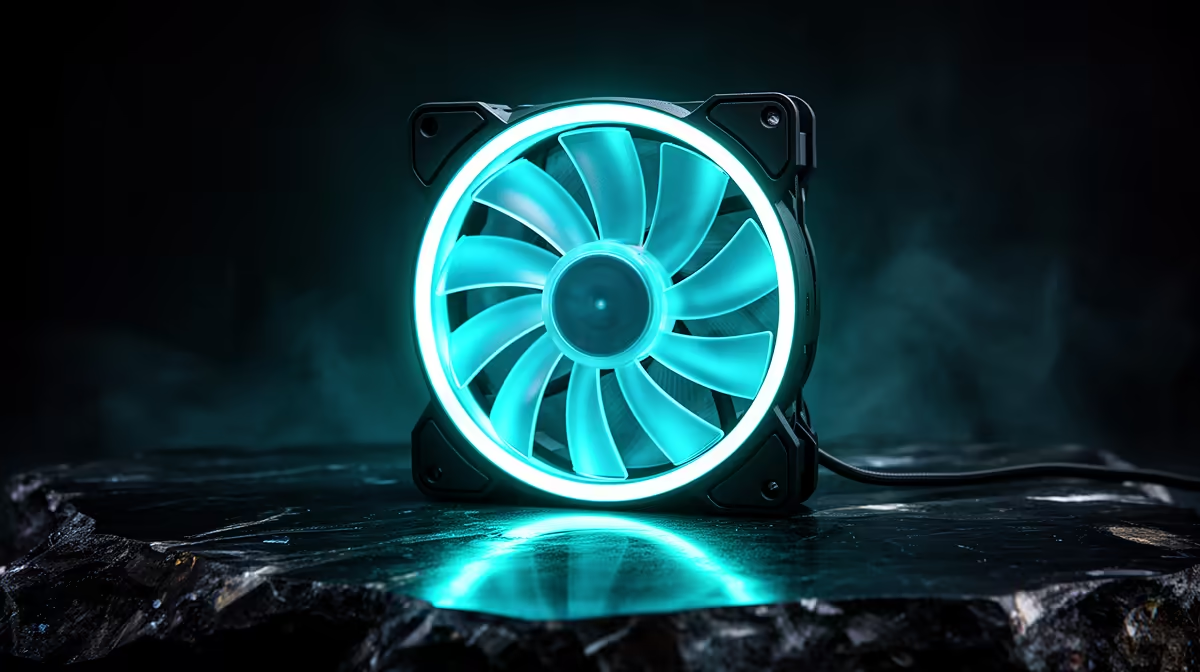
A single 200mm fan at 600 RPM moves more air than three 120mm fans at 900 RPM while producing less noise, measured at 22 to 24 dBA versus 28 to 34 dBA for the smaller fans combined. The trade-off is that 200mm fans are rarer in case fan markets, cost more individually, and fit only in cases specifically designed with 200mm front or top mounts.
The Physics Behind Larger Fan Diameter 🌬️
Fan airflow scales with swept area and rotational speed. A 200mm fan has roughly 2.8 times the swept area of a 120mm fan, which means it can move equivalent air volume at significantly lower RPM. Lower RPM translates directly to lower bearing noise, lower turbulence noise, and less vibration transferred to the case frame. In practical terms, a 200mm front fan in a case like a traditional Cooler Master HAF or similar design pushes 60 to 80 CFM at quiet speeds versus 35 to 50 CFM from a single quality 120mm fan at moderate speed. For South African builds in warm climates where the goal is maximum airflow at minimum noise, a 200mm-capable case is a strong consideration.
Where Smaller Fans Win: Flexibility and Radiator Compatibility 🔧
The 120mm and 140mm fan format dominates radiator design. All AIO coolers and custom loop radiators are built around 120mm or 140mm fan spacing, meaning a 200mm fan offers zero advantage in a radiator-mounted cooling setup. If your build includes a 360mm or 420mm AIO, those radiator fans are 120mm or 140mm units regardless of what case you use. Smaller fans also allow more mounting positions: a case with four 120mm front mounts gives flexible radiator options (120mm, 240mm, 360mm AIOs all fit), while a 200mm front mount is case-fan-only with no AIO compatibility.
Noise Floor Comparison for SA Gaming Rooms 🎮
Quiet gaming environments are important in South African flat and townhouse complexes where shared walls make loud PC noise a neighbour issue. A 200mm front fan at 600 RPM is typically inaudible at desk distance (less than 20 dBA). Three 120mm fans at 1,000 RPM producing a combined 30 dBA are audible in a quiet room. At equivalent airflow volumes, the 200mm fan wins the noise comparison. However, three 120mm fans running at 700 RPM each (barely audible) still provide good airflow coverage across a wider intake area than a single 200mm fan, and at roughly the same total noise output.
Check Fan Availability Before Buying a 200mm Case ⚡
The 200mm fan market is far smaller than 120mm or 140mm. If your 200mm fan fails after a few years, finding a matching replacement locally in South Africa can be difficult. Cases that use a single large fan and have no 120mm or 140mm mount alternative leave you in a poor position at replacement time. Favour cases with 200mm mounts plus additional 120mm positions for future flexibility.
FAQ
Can a 200mm fan be used with an AIO cooler?
No. AIO coolers use standardised 120mm or 140mm fan spacing on their radiators. A 200mm fan cannot mount to any current AIO radiator without a custom adapter, which is not a practical solution for a standard build.
Are 200mm ARGB fans available in South Africa?
The selection is limited compared to 120mm and 140mm ARGB options. A few brands produce 200mm ARGB fans, but local stock can be inconsistent. If RGB synchronisation across all your fans is important, a 140mm fan setup typically offers better ARGB compatibility and local availability than 200mm options.
Do 200mm fans work with standard fan headers?
Yes. A 200mm PWM fan connects to a standard 4-pin PWM fan header on any motherboard. Power draw is slightly higher than smaller fans because of the larger motor, but remains well within the 1A current limit of standard fan headers.
Choosing your case fan strategy for a quiet high-airflow build?
Browse Evetech's case fan range to compare 120mm, 140mm, and larger format options for your next build.