Run an AI model on your own machine and every prompt stays on your hardware, with no monthly bill and no data leaving the room. Local private AI flips the usual cloud arrangement: instead of sending your query to a remote server and paying in US dollars each month, the model lives on your PC and answers offline. For South Africans watching the rand-dollar exchange rate, that shift changes the maths in a real way.
Quick Answer
Local AI keeps every prompt on your own hardware with zero subscription cost, while ChatGPT sends queries to a remote server and bills monthly in USD. Local wins on privacy and long-term cost; ChatGPT still leads on raw answer quality for the hardest tasks. For SA users running everyday work, a capable local model on an AI PC pays for itself by removing the recurring forex subscription.
Privacy: Where Your Data Actually Goes
This is the clearest split. A local model processes your text entirely on-device, so sensitive material, client documents, contracts, personal notes, never touches a third-party server. Nothing is logged remotely, and nothing can be used to train someone else's system.
A cloud service routes every prompt over the internet to be processed elsewhere. Providers have privacy policies and enterprise tiers, but the fundamental fact remains: your data leaves your machine. For anyone handling confidential business information or who simply prefers their queries stay private, local processing is the stronger position.
Cost: Once-Off Hardware vs Forever Subscription
Cloud AI is a recurring expense billed in USD, so the rand price drifts with the exchange rate and quietly climbs over time. Twelve months of a paid tier adds up, and the meter never stops.
Local AI inverts that. You pay once for hardware capable of running the model, then run it as much as you like at no marginal cost beyond electricity. An AI PC with a strong NPU or GPU is an upfront investment, but for heavy daily users the break-even point arrives within a reasonable window, after which every query is effectively free.
The SA Forex Angle
Because cloud subscriptions are dollar-denominated, a weaker rand makes them more expensive without you changing anything. Local hardware is a fixed rand cost you control. For South African users this is the quiet advantage: you are insulated from currency swings on an ongoing service.
Quality: Where Cloud Still Leads
Honesty matters here. The largest cloud models remain ahead on the hardest tasks, complex reasoning, long-context analysis and the broadest general knowledge, because they run on server hardware no home PC can match.
That said, the gap has narrowed sharply. Modern open-weight models running locally handle drafting, summarising, coding help, brainstorming and everyday questions very capably. For the majority of practical work, a good local model is more than enough, and you only feel the difference on the genuinely demanding edge cases.
What Hardware You Actually Need
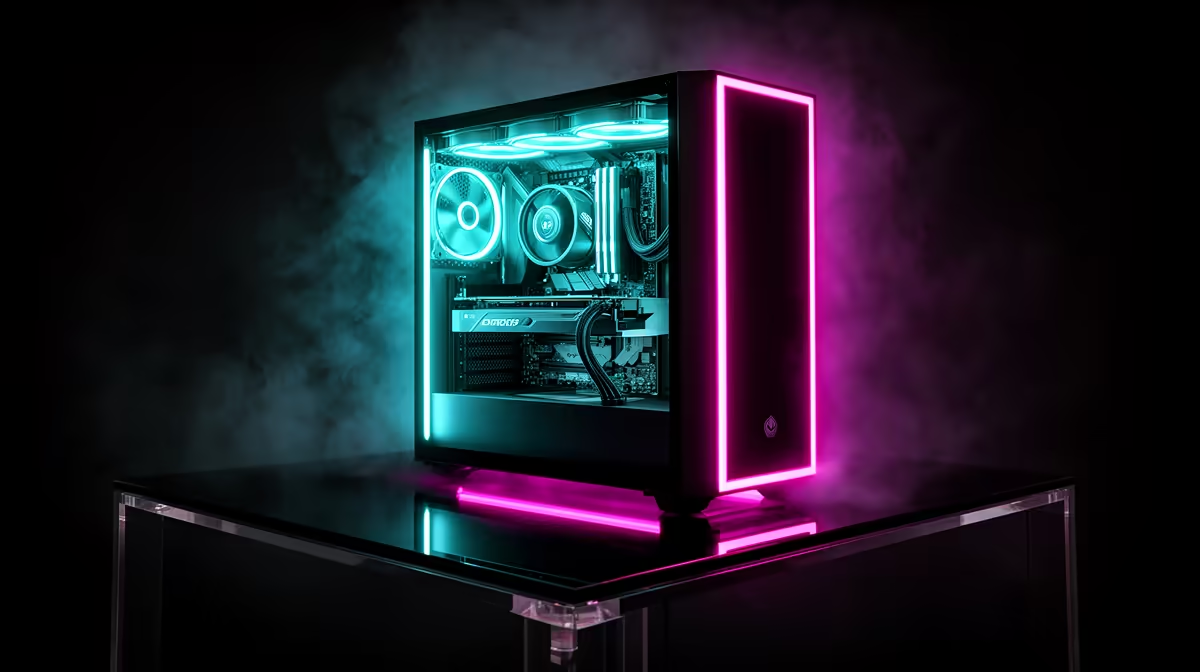
Running a useful local model well comes down to memory and a capable accelerator. A modern NPU or a discrete GPU with generous VRAM lets larger models respond quickly, while system RAM determines how big a model you can load at all.
A purpose-built AI PC bundles these together so the model runs responsively rather than crawling. If you are weighing the jump, the AI PC range at Evetech lays out the configurations built specifically for on-device inference, which saves guessing at whether a given machine can cope.
Speed and Responsiveness in Daily Use
Cost and privacy aside, the experience of using each differs. A cloud service answers from data-centre hardware, so on a good connection responses arrive quickly regardless of your own PC. The trade-off is that a weak or dropped connection stalls it completely.
A local model's speed depends entirely on your hardware. On a well-specified AI PC, a mid-size model responds fast enough to feel conversational, and because it runs offline there is no network round trip and no outage to wait out. On underpowered hardware, larger models crawl, which is exactly why matching the machine to the model size matters so much. The practical lesson is that local AI rewards buying enough hardware up front rather than trying to stretch a model the PC cannot really carry.
Control and Customisation
There is a quieter advantage to running models yourself: control. With a local setup you choose which model to run, swap it for a newer release when one arrives, and keep using a version you like even after a cloud provider would have retired it. You are not subject to a service changing its behaviour, pricing or availability overnight.
For users who tinker, local models also open the door to running specialised variants tuned for coding, writing or a particular language, something a single fixed cloud service does not offer. That flexibility will not matter to everyone, but for power users it is a real reason to keep inference on their own machine.
Which One Fits You
Pick local AI if privacy is a priority, you use AI heavily enough that subscriptions sting, or you want to be free of dollar-billed recurring costs. Pick cloud AI if you need the absolute best quality on hard problems, want zero setup, or only use AI occasionally where a subscription is hard to justify.
Many people end up blending the two: a local model for the bulk of private, everyday work, and an occasional cloud session for the heaviest tasks. To see which machines are built to carry a local model comfortably, the pre-built systems customers buy most often are a practical place to gauge specs and pricing.
Frequently Asked Questions
Does local AI really keep my data private?
Yes. A local model processes everything on your own hardware, so prompts never leave your machine and cannot be logged or used to train a remote system. Privacy is the architecture's core advantage.
Is a local model as good as ChatGPT?
For everyday tasks like writing, summarising and coding help, a strong local model is very close. The largest cloud models still lead on the hardest reasoning and broadest knowledge, so the gap shows only on demanding edge cases.
How much hardware do I need to run AI locally?
You need a capable NPU or a GPU with ample VRAM, plus generous system RAM to load larger models. An AI PC built for inference handles this well and runs models responsively rather than slowly.
Will running AI locally save me money?
If you use AI heavily, yes. You pay once for hardware instead of a recurring dollar-billed subscription, so heavy users reach a break-even point and then run queries at effectively no extra cost.
Can I use local AI offline?
Yes. Once the model is installed it runs without an internet connection, which is part of its privacy benefit and means it keeps working regardless of your connectivity.