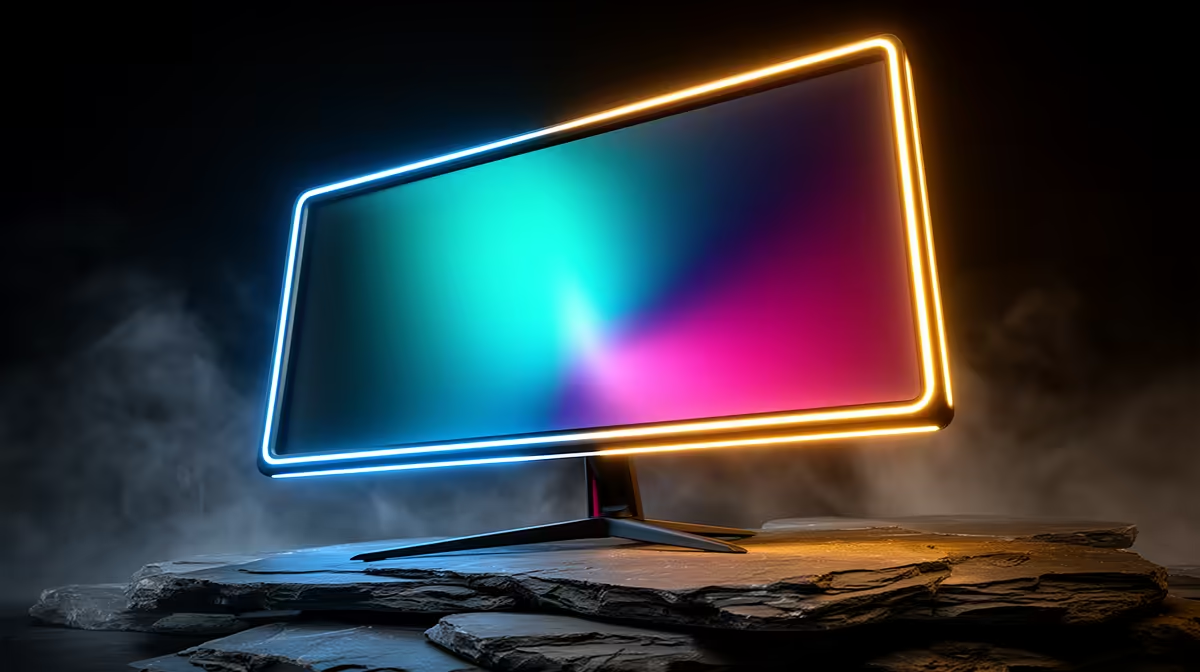
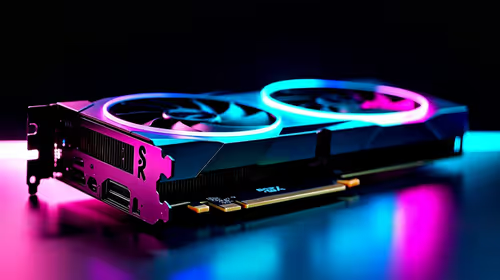
The RTX 4070 Super has a clear home at 1440p. A 165Hz monitor covers the broadest mix of games, while 240Hz suits a competitive player and ultrawide suits someone who wants more world at the edges. A 4K screen remains possible, but it asks you to tune instead of assuming Ultra.
Quick Answer
For a standard desk, start with 1440p on 27 inches and a 165Hz to 180Hz refresh range. Choose 240Hz for esports, 3440x1440 for immersion, or 4K 120Hz to 144Hz when sharp work and visual games matter more than easy high refresh. Evetech's July 2026 snapshot placed the in-stock gaming-monitor category at a R4,499 median, giving South African buyers a dated marker before panel and refresh premiums.
🖼️ Start with 27-inch 1440p at 165Hz
At a normal desk distance, 1440p looks clean on 27 inches and gives the RTX 4070 Super room to produce high frame rates. Text and interfaces are sharper than 1080p without the heavy rendering cost of 4K.
A 165Hz or 180Hz ceiling improves every game above 60fps and leaves a wide variable-refresh window for demanding releases. The card does not need to hold the maximum number in every scene. Stable motion at 85 to 140fps is a strong result.
Browse Evetech's monitor category by resolution and refresh, then compare response behaviour on the exact models.
⚡ Move to 240Hz for competitive play
Shooters, racing and rhythm games can use more refresh when settings and CPU performance allow it. Test one-percent lows in a full match. A peak above 240fps cannot represent the heavier moments where response matters.
At these rates, the CPU may set the pace. Watch per-core load and GPU utilisation together. If lowering resolution brings no frame-rate gain, the monitor decision should consider the processor rather than demanding more from the card.
The panel still needs quick pixels. A slow 240Hz LCD can smear more than a well-tuned 180Hz alternative. Read measurements across several refresh points, not only the fastest overdrive mode.
🌄 Use 3440x1440 for simulation and exploration
A 34-inch ultrawide adds peripheral view while keeping the vertical resolution at 1440p. The extra horizontal pixels cost performance, though the RX 4070 Super has enough headroom to make the format practical with sensible settings.
Check game support. Some competitive titles restrict the field of view, and cutscenes may remain 16:9. A streaming layout also needs to decide whether viewers see bars, a crop or a redesigned canvas.
Measure stand depth and viewing distance. A wide curved monitor can be comfortable when the edges stay within your natural view; placed too close, it turns every menu into neck work.
4️⃣ Choose 4K with a realistic settings plan
The RTX 4070 Super can run 4K games, especially older releases, esports and current titles using quality upscaling. Heavy ray tracing and new AAA presets will need a lower frame target and more tuning.
A 4K 120Hz or 144Hz screen still gives you a sharp desktop and can survive a future GPU upgrade. At 32 inches, its scale and clarity are easy to appreciate. At 27 inches, Windows scaling becomes part of daily ownership.
Start from High, preserve textures within the card's memory budget and reduce costly lighting effects first. Watch frame time through a full route for VRAM pressure and traversal stutter.
🎨 Choose panel type from your weakest scene
Fast IPS provides clear text, consistent colour and broad viewing angles. Dark-room contrast remains its compromise. VA improves black depth at a lower price, but dark smearing varies widely by model.
OLED produces excellent blacks and motion with strong HDR contrast. Its premium can be worthwhile because the monitor may outlast this graphics card. Use its care features on static desktop content and read warranty details.
Mini-LED can deliver brighter HDR and suits a daylight room. Local-dimming quality determines how much blooming appears around stars, cursors and subtitles. Test footage that exposes the weakness before buying from the zone count.
Evetech's monitor best-sellers provide local format and demand context once your panel priorities are clear.
🔄 Configure VRR for the games below the ceiling
Enable Adaptive-Sync on the monitor, compatible G-Sync in the NVIDIA control panel and maximum refresh in Windows. Run a game whose frame rate moves through the range, then inspect tearing, flicker and overshoot.
Choose one frame cap and V-Sync strategy for the test. Stacking an in-game cap, driver cap and overlay limiter makes stutter harder to trace. A steady target below the ceiling can reduce fan noise and keep latency behaviour consistent.
Frame generation can fill more visible refresh in supported games once base response feels good. It does not make a slow base frame rate ideal for competitive play.
🔌 Confirm the monitor's best port and cable
Read the exact input table for native resolution, maximum refresh, HDR and colour depth. The RTX 4070 Super supports DisplayPort 1.4a and HDMI 2.1a output. High-end modes may rely on Display Stream Compression.
Use a rated cable, connect the main screen directly and verify the active mode. If the display flashes black only at its maximum setting, test the cable and another input before removing drivers.
🛒 Keep the desk in the buying decision
Check stand height, swivel, VESA support, USB ports and power-brick placement. A monitor arm can free mouse space, but it needs the correct weight capacity. Keep speakers and a microphone in the layout.
Read dead-pixel and warranty terms for the exact model. Keep the box until the monitor has passed bright pages, dark games, high refresh and repeated sleep-wake cycles.
Frequently Asked Questions
What resolution is the RTX 4070 Super built for?
1440p is its strongest high-refresh match across a wide range of games.
Can this card handle 4K gaming?
Yes with tuned settings and upscaling where needed, though demanding games will target lower frame rates than at 1440p.
What refresh rate should a 1440p monitor have for this GPU?
165Hz to 180Hz is balanced. Choose 240Hz for competitive games that sustain higher output.
Is this card a good match for ultrawide monitors?
Yes. 3440x1440 adds immersion at a pixel load below 4K, with game support to check.
Does the RTX 4070 Super support FreeSync and G-Sync?
It can use compatible Adaptive-Sync displays through NVIDIA's supported variable-refresh path.
What panel size is ideal for this pairing?
27 inches suits standard 1440p, while 34 inches is the common ultrawide step.
Should I wait for 4K instead of buying 1440p now?
Buy 1440p when high-refresh gaming is the goal. Choose 4K when sharp mixed use justifies the settings work today.
Ready to put the RTX 4070 Super behind its natural screen?
Compare 1440p high-refresh and ultrawide monitors at Evetech, then choose from the frame rates and desk you already have.