The RTX 4070 Ti Super sits on a useful monitor fault line. A 1440p 240Hz panel lets it stretch in competitive games, while a 4K 120Hz or 144Hz screen spends the card's performance on detail. Neither choice needs an apology. Your library decides which one you will notice more often.
Quick Answer
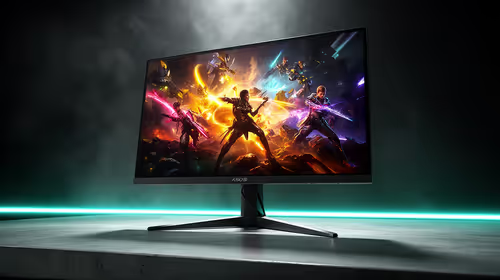
Choose 27-inch 1440p at 240Hz for shooters, racing and consistently high frame rates. Pick 32-inch 4K at 120Hz to 144Hz for visual single-player games and sharp mixed work, using tuned settings and upscaling in demanding titles. A 34-inch 3440x1440 ultrawide splits the difference. Evetech's gaming-monitor category showed a R4,499 median in the July 2026 in-stock snapshot; these premium formats often sit above that broad baseline.
🏎️ Buy 1440p 240Hz for a fast library
At 1440p, the RTX 4070 Ti Super has enough rendering room to push high real frame rates in competitive games. A 240Hz monitor gives those frames somewhere to go while still displaying demanding games smoothly lower in its variable-refresh range.
Test the actual match you play. CPU load, memory and the game engine can limit output before the graphics card reaches full use. One-percent lows through a crowded fight matter more than a peak in a training map.
At 27 inches, 1440p stays sharp at normal desk distance. Check pixel response across 80, 144 and 240Hz because a monitor that looks clean at its ceiling can overshoot when an AAA title runs lower.
Evetech's monitor range lets you compare current 1440p refresh tiers and panel types.
4️⃣ Choose 4K for detail you use outside the benchmark
The RTX 4070 Ti Super's 16GB of video memory makes 4K textures and larger assets more comfortable, though raw rendering load still rises sharply. Start from a High preset, preserve texture quality and reduce expensive ray tracing, shadows or volumetrics where the visual return is small.
A 120Hz or 144Hz 4K panel leaves useful space above 60fps and improves desktop motion. Variable refresh follows the game through scenes that move between 70 and 110fps. Lighter releases can climb higher.
Use DLSS quality modes when native rendering misses the target and judge the result on the monitor. Frame generation can increase visible smoothness once the base frame rate already feels responsive. It does not replace the input response of real base frames.
🌄 Pick ultrawide when width changes your favourite games
A 34-inch 3440x1440 panel carries more pixels than ordinary 1440p and fewer than 4K. Racing, flight, exploration and strategy gain peripheral space, while the RTX 4070 Ti Super keeps more performance headroom than it would at 4K.
Confirm aspect-ratio support. Competitive games may limit field of view, and cutscenes can show bars. Streaming a 21:9 image into a 16:9 layout also needs a plan.
Measure the desk and stand. An ultrawide pushed too close becomes tiring, and a wheelbase or full-size keyboard can compete for the same depth.
🎨 Spend on the panel weakness you can live with
OLED delivers deep blacks, fast pixel transitions and striking HDR contrast. It suits a game-heavy evening desk, with static-content care and model-specific warranty details to consider.
Mini-LED can push bright HDR and hold large bright scenes well. Blooming around small highlights depends on local-dimming control. Fast IPS gives clean text, broad viewing angles and a simpler mixed-use route, with weaker dark-room contrast.
Read proper measurements for response time, brightness and HDR. The words 1ms and HDR on a box do not describe the performance you will see at 90fps in a dark game.
Use Evetech's monitor best-sellers for current local context once resolution and panel type have narrowed the field.
🔄 Let variable refresh cover both sides of the choice
Enable Adaptive-Sync on the monitor and compatible G-Sync in NVIDIA's controls. Select the panel's full refresh in Windows and run a game that moves through the expected frame range.
Look for flicker in dark menus and trailing during camera pans. Choose an overdrive mode that behaves well across the range. A frame cap just inside the ceiling can help some VRR and V-Sync setups, while competitive players may prefer another latency path.
Calibrate HDR only after SDR brightness and colour look right. Check a familiar bright sky, a dark interior and skin tones rather than selecting the most dramatic preset.
🔌 Verify the connection at the full mode
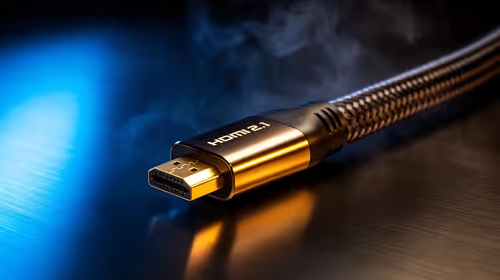
The RTX 4070 Ti Super provides DisplayPort 1.4a and HDMI 2.1a output. The monitor decides which input supports native resolution, maximum refresh, HDR and full colour depth together. High-refresh 4K over DisplayPort can use Display Stream Compression.
Connect the main monitor directly with a correctly rated cable and confirm the active mode in Windows. Add capture devices, docks and extra screens after that path stays stable. Black flashes at maximum refresh deserve a cable and input test before a driver purge.
🛒 Buy for the next GPU without punishing this one
A strong monitor often survives several graphics cards. A 4K 144Hz screen can be a sensible future-facing purchase if you are happy to tune the RTX 4070 Ti Super today. A 1440p 240Hz OLED can remain relevant through a faster card because its motion and contrast are already premium.
Check warranty, dead-pixel policy, stand adjustment and VESA support. Keep the packaging through the first week while the panel passes games, work and sleep-wake cycles.
Frequently Asked Questions
Should I pick 1440p 240Hz or 4K 120Hz for this card?
Choose 1440p for competitive speed and 4K for sharper visual games and desktop work.
Can the RTX 4070 Ti Super hold 4K 120Hz consistently?
Not in every demanding game. VRR, tuned settings and upscaling let the monitor remain useful below its ceiling.
Is 240Hz realistic at 1440p on this GPU?
Yes in esports and lighter titles, provided the CPU and game engine can sustain the frames.
Does this card support ultrawide monitors well?
Yes. 3440x1440 is a strong fit, with game support and aspect ratio still worth checking.
What panel type suits the RTX 4070 Ti Super best?
OLED favours contrast and motion, mini-LED favours bright HDR, and IPS suits mixed work and gaming.
Is HDR worth adding to the monitor choice?
Yes when the exact panel has strong contrast, brightness and local dimming or per-pixel control.
Should I future-proof with a 4K monitor now?
Do so when you value 4K work and visual quality today and accept settings adjustments in heavy games.
Choosing between the two best RTX 4070 Ti Super paths?
Compare 1440p 240Hz, 4K and ultrawide monitors at Evetech, then put the budget behind the games you open first.