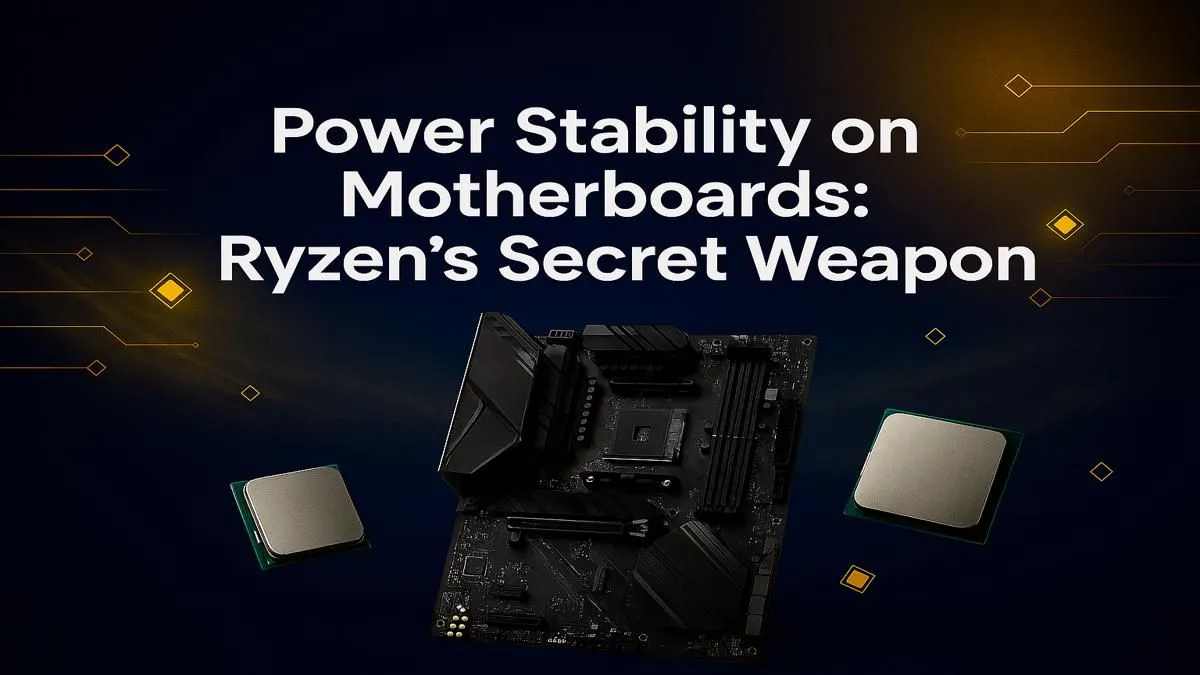
So, you’ve just invested in a powerful new AMD Ryzen processor. Fantastic choice! You’re ready for silky-smooth frame rates and lightning-fast productivity. But hold on… are you actually getting the performance you paid for? Before you blame your GPU or RAM, look closer at your motherboard. The secret to unlocking your CPU’s full potential often lies with a set of tiny components you’ve probably never noticed: the Voltage Regulator Module, or VRM.
What is a Motherboard VRM, Anyway?
Think of the motherboard VRM for your Ryzen CPU as the rig’s power plant manager. It takes the steady 12-volt stream from your power supply and meticulously converts it into the precise, low voltage your processor needs to operate. A good VRM delivers this power cleanly and consistently, even under heavy load. A poor one... well, it can cause all sorts of problems.
A robust VRM is the foundation of a stable system, ensuring your CPU gets the clean power it needs to boost to its maximum clock speeds and stay there. ⚡
Why a Strong VRM is Crucial for Ryzen Performance
Modern Ryzen CPUs, especially the Ryzen 7 and 9 series, are power-hungry beasts. When you’re deep in a Warzone match or rendering a 4K video, they demand a lot of current. This is where a weak VRM shows its true colours.
If the VRM can't handle the load, it starts to overheat. To protect itself, it tells your multi-thousand-Rand Ryzen CPU to slow down. This is called thermal throttling, and it’s a performance killer. You lose frames, your renders take longer, and you're left wondering why your top-tier chip is underperforming. Choosing a board with a capable power delivery system from our full range of AMD motherboards is the first step to avoiding this frustrating bottleneck.
Decoding VRM Specs: Phases and Heatsinks
When you're browsing motherboards, you'll see specs like "12+2+1 phase power design." What does that mean?
Power Phases
In simple terms, more phases mean the workload of delivering power is spread out. This reduces the strain on any single component, leading to lower temperatures and cleaner, more stable power for the CPU. While a higher phase count is generally better, quality matters more than quantity. High-quality components on a 10-phase VRM can easily outperform a cheap 16-phase design.
Heatsinks 🔧
This is the easiest way to visually judge a VRM. A quality motherboard VRM for Ryzen will always have large, chunky metal heatsinks covering the components. These are not just for looks; they are essential for dissipating heat and preventing throttling. If a board has tiny heatsinks or none at all, it's not designed for high-performance CPUs. Many of our proven B550 motherboards set a great standard for effective VRM cooling in their price bracket.
Check Your Temps! 🌡️
Want to see how your VRM is holding up? Download a free tool like HWiNFO64. Run a demanding game or a benchmark like Cinebench and look for the "VRM MOS" or "MOSFET" temperature sensor reading in the motherboard section. If it's creeping towards 100°C or higher, your VRM is likely throttling your CPU's performance.
Matching the Right Board to Your Ryzen CPU
Not every CPU needs a monstrous VRM. The key is to match the motherboard to the processor you intend to use.
- For Ryzen 5: A solid B-series motherboard with decent heatsinks is more than enough. You don’t need the most expensive board, but avoid the absolute bottom-of-the-barrel models. As new platforms arrive, options like the upcoming B850 motherboards will offer great mid-range performance.
- For Ryzen 7: Now we’re in performance territory. A mid-to-high-end B-series or an entry-level X-series board is recommended. You need a VRM that can comfortably handle sustained loads, especially if you enable Precision Boost Overdrive (PBO).
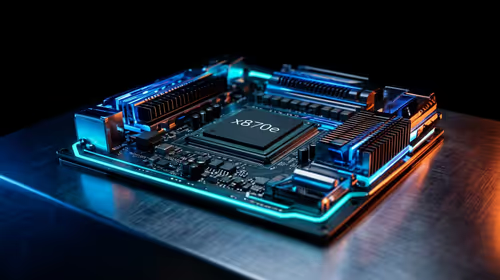
- For Ryzen 9: Don't compromise. Pairing a flagship Ryzen 9 with a weak motherboard is like putting scooter tyres on a Ferrari. You need a premium motherboard with a top-tier VRM to feed the beast. For maximum overclocking potential and stability, only the power delivery on enthusiast-grade X870 motherboards will truly suffice. 🚀
Ultimately, investing in a motherboard with a quality VRM isn't an expense; it's insurance for your CPU's performance.
Ready to Unleash Your Ryzen?
The motherboard VRM is the foundation of a stable, high-performance PC. Don't let a weak link throttle your expensive CPU. Explore our huge range of AMD motherboards and find the perfect board to power your build.