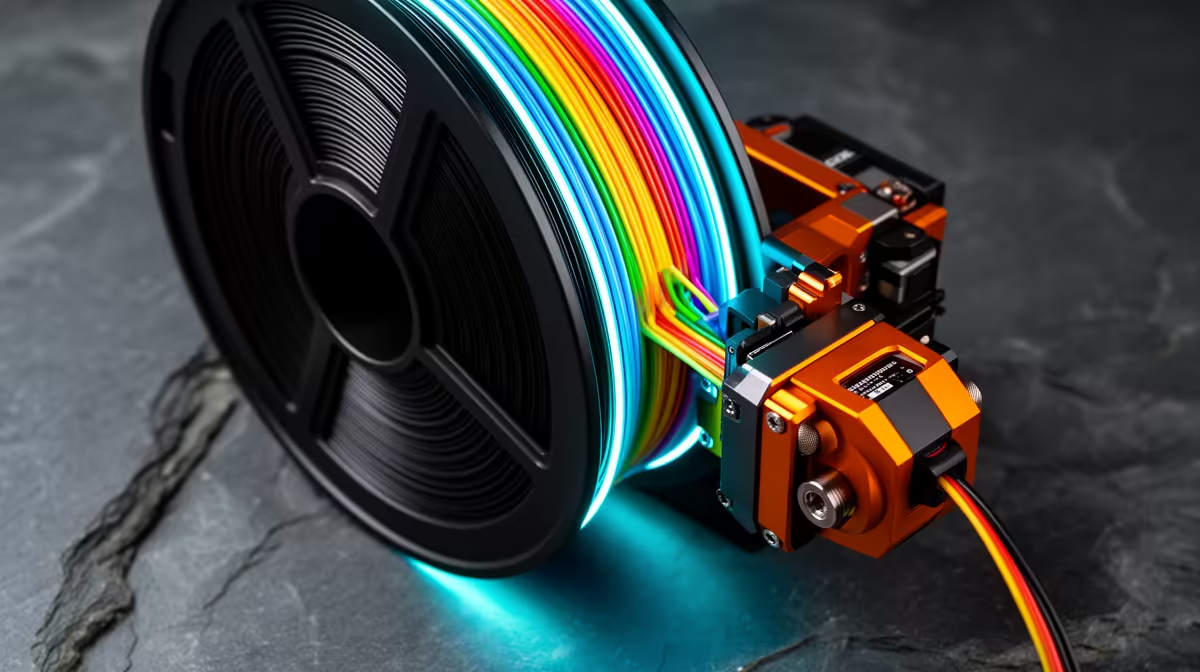
Run a colour-heavy model through a Bambu AMS and you will end up with a small mountain of stiff little filament blocks next to the print. That pile is the cost of clean colour separation, and multi-colour printing waste is one of the most misunderstood numbers in FDM. The waste does not come from the print itself. It comes from flushing the old colour out of the hotend every time the AMS swaps spools, and on a model with dozens of transitions per layer it can rival the weight of the part itself.
Quick Answer
Every AMS colour change purges roughly the full melt volume of the nozzle, which on a typical Bambu setup means somewhere between 0.3g and 1.5g of filament per swap depending on the colour direction. A model with a few hundred transitions can easily throw away 40g to 90g, which at common SA filament prices is R15 to R35 of plastic per plate. The waste scales with the number of colour changes, not the number of objects.
Why The Purge Happens At All
A single-nozzle FDM printer can only hold one colour in the melt zone at a time. When the slicer reaches a point where the colour must change, the AMS retracts the current filament, loads the next spool, and then pushes fresh material through until the old colour is fully cleared. That flushed material has to go somewhere, so the slicer either parks it in a purge tower, extrudes it as a discardable wipe block (the famous "poop"), or uses it as infill for the part that needs filling anyway.
The melt zone on a standard hotend holds only a fraction of a gram, but you rarely clear a colour in one melt volume. Dark to light transitions are the expensive ones. Pushing a bright yellow through after a deep black or red can take several flush volumes before the streaking disappears, while going from light to dark is far more forgiving because a faint tint of the old colour vanishes under the new one.
What Drives The Number Up Or Down
Colour direction and contrast
The single biggest factor is which colour follows which. The slicer keeps a flushing matrix that sets a different purge volume for each pairing. You can edit those values directly. If your model never goes from black to white, you can trim the worst-case flush figures and reclaim a meaningful chunk of filament.
Transitions per layer
Waste tracks the total count of colour changes across the whole print, so a model that alternates colours on every layer is far more expensive than one with large single-colour regions. Grouping objects of the same colour, or arranging the print so colours change less often, cuts the swap count directly.
Where the flush goes
Sending purge into infill is close to free because that material was going to be laid down anyway. The catch is that infill purging only works while there is a part actively being filled at that moment, so tall single-colour sections still fall back to the wipe tower or discard blocks.
Practical Ways To Cut The Waste
Start by lowering the flushing volumes in the slicer for the colour pairs you actually use, testing on a small plate first so you do not get bleed-through on the real model. Enable "flush into object infill" and "flush into support" so the discarded material does real work. Print multiple copies of a colourful model on one plate: the purge per colour change stays the same whether you print one figurine or nine, so the waste-to-part ratio improves dramatically with quantity. Choosing colour combinations with less contrast also helps, since similar shades clear in fewer flush volumes.
If you want to see the printer side of this, the range of 3D printers stocked at Evetech gives you the hardware context for which AMS-style multi-material systems are available locally. For the spools, nozzles and tools that go with multi-colour work, it is worth scanning what moves fastest in the most popular accessories at Evetech before you commit to a colour-heavy project.
The Flush Volume Settings Worth Knowing
Bambu Studio defaults to 280 cubic millimetres of flush material per colour change, but that is a blanket starting figure rather than an optimised number. The flushing matrix in the slicer lets you set a different value for each colour-to-colour pairing. In practice, many users find they can drop the multiplier to around 0.7 to 0.8 of the default for same-family colour transitions without any visible bleed, which represents a 20 to 30 percent reduction in purge per swap.
There is also an experimental feature in recent Bambu Studio builds called "Long retraction when cut" that improves how cleanly the old filament is pulled back before the new one loads. Enabling it often allows lower flush volumes without streaking, particularly on lighter materials following darker ones. Test it on a cheap test print first -- the setting does not behave identically across all filament brands.
What happens to the physical waste
The poop blocks and purge-tower offcuts are still usable plastic. Some people collect them in a bag and use them as raw material in a filament recycler, others melt them into moulds for filler parts where colour uniformity does not matter. The blocks are consistent in density and actually grind quite cleanly. They are not something you have to bin, which matters a little when you are throwing away 80g a plate on a complex job.
Frequently Asked Questions
How much filament does one AMS colour change actually waste?
Expect roughly 0.3g to 1.5g per swap on a standard hotend, driven mainly by the colour direction. Dark-to-light changes sit at the top of that band, light-to-dark at the bottom.
Does printing more copies waste more filament?
No, and this is the key trick. The purge happens per colour change, not per object, so nine copies on one plate share the same flush events. The waste-to-part ratio drops sharply with quantity.
Can I reuse the purge blocks?
Yes. The discarded blocks are still usable plastic. People grind them down, melt them into moulds, or keep them as filament for a recycler, so they do not have to be binned.
Why does dark to light waste the most?
A trace of dark pigment is highly visible against a light colour, so the slicer flushes more material to clear it completely. Going the other way, a faint light tint disappears under the darker colour and needs far less purging.
Is multi-colour printing worth the waste?
For decorative and presentation prints, the colour separation usually justifies it. For functional parts where colour does not matter, single-colour printing avoids the purge entirely and is the cheaper route.