Deciding which laptop to buy with NSFAS funding in South Africa works best as a simple decision tree built around what you actually study, not a single spec sheet. The R5,200 allowance covers a capable everyday machine, and a modest top-up unlocks more demanding course work.
Quick Answer
Start from your course type: light reading-and-writing degrees are well served by an R5,200 NSFAS-allowance laptop, design and engineering students should stretch to R12,000 to R18,000 for more RAM and a stronger GPU, and only specialist 3D or video work justifies R20,000 and up.
The Decision Tree by Use Case
If your degree is mostly documents, research and lectures (law, commerce, humanities), an entry laptop with a quad-core CPU, 8GB of RAM and a 256GB SSD around the R5,200 allowance is enough. Add RAM to 16GB if you keep many tabs and apps open at once.
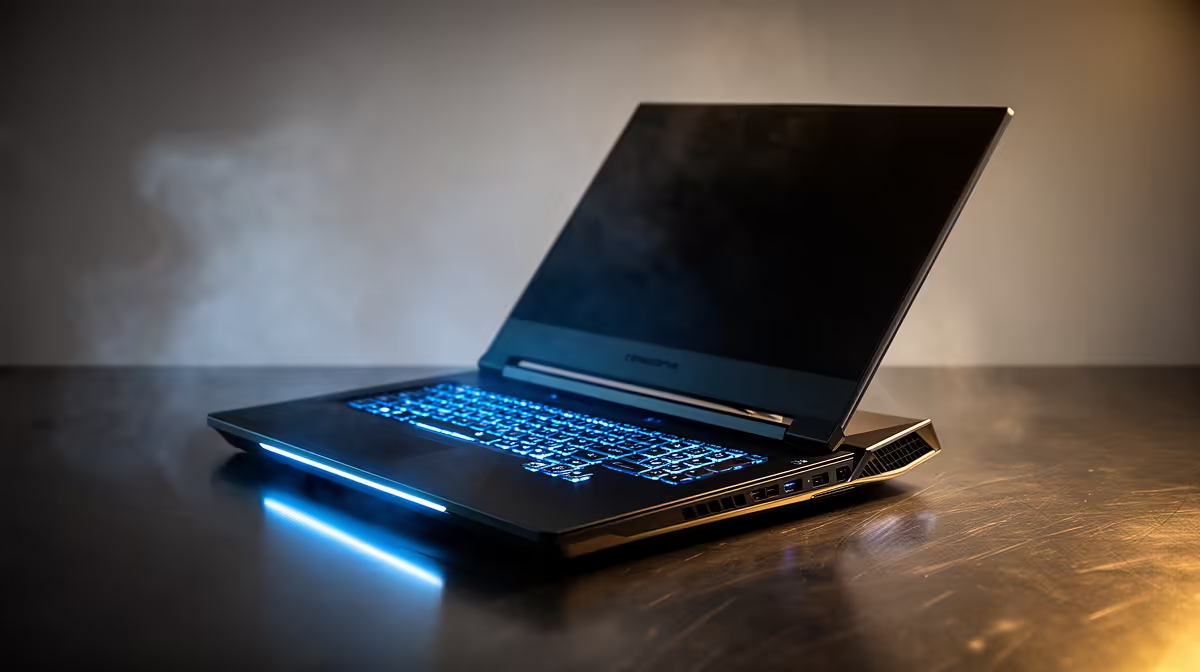
If you run design tools, statistics packages or light coding (architecture, data science, engineering), step up to 16GB of RAM, a faster CPU and ideally a discrete GPU, which lands around R12,000 to R18,000. For heavy 3D rendering, video editing or machine learning, a R20,000-plus laptop with a stronger GPU and 16GB to 32GB of RAM is the realistic floor.
Stretching the NSFAS Allowance
The R5,200 allowance is a solid base, and a small personal top-up changes what you can buy. R8,000 to R12,000 brings a noticeably faster SSD, more RAM and a better screen that will last the full degree. Buy for the years ahead, not just first year, and prioritise build quality and battery life so the machine survives daily campus use. Evetech stocks student laptops across these tiers with SA warranty support.
FAQ
How much does NSFAS give for a laptop?
The NSFAS laptop allowance is R5,200, which covers a capable entry student laptop. A modest personal top-up to around R8,000 to R12,000 buys more RAM, faster storage and a better screen.
What laptop should I buy for a design or engineering degree?
Aim for 16GB of RAM, a strong CPU and ideally a discrete GPU, which usually lands around R12,000 to R18,000. These courses run design and simulation tools that need more headroom than a basic laptop offers.
Is the R5,200 NSFAS laptop enough for university?
For reading-and-writing degrees, yes. It covers documents, research and lectures comfortably. More demanding courses benefit from a top-up to add RAM, a faster CPU and a discrete GPU.
laptop to your degree's heaviest task. Reading degrees thrive on the R5,200 base; design and 3D work justify a top-up for RAM and a discrete GPU.