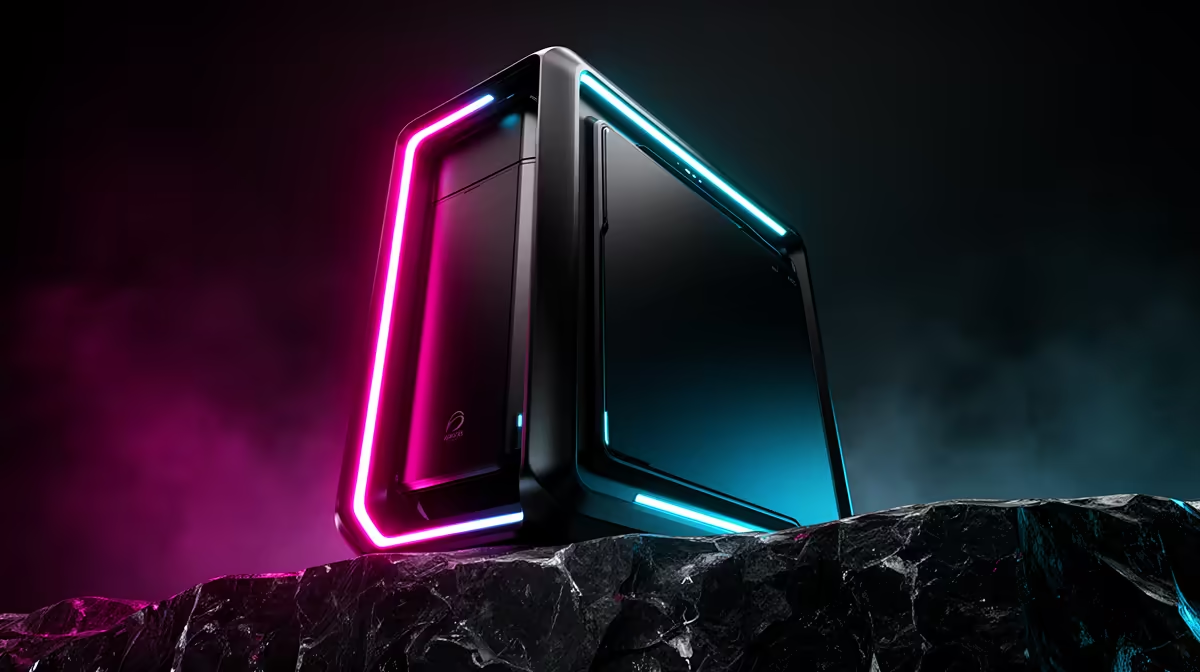
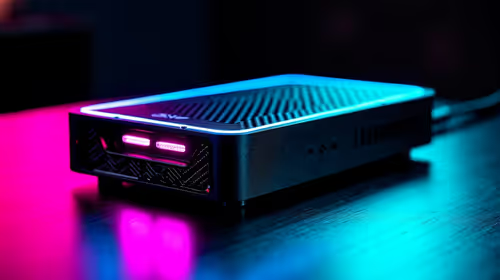
The NVIDIA DGX Spark shrinks a data-centre idea onto a desk. It is a 150mm-square box weighing about 1.2kg, built on the GB10 Superchip that marries a 20-core Grace Arm CPU to a Blackwell GPU on a single package, with 128GB of unified memory and a claimed petaFLOP of FP4 AI compute. NVIDIA pitches it as a personal AI supercomputer for developers who want to prototype, fine-tune and run large models locally rather than renting cloud time, and it went on sale on 15 October 2025.
Quick Answer
The DGX Spark is a mini desktop AI computer with the GB10 Superchip, 128GB of unified LPDDR5x memory and a 4TB NVMe SSD, starting around 3,999 US dollars before tax and import costs. It is built for running and fine-tuning large local models, not for gaming, and only makes sense if your work genuinely needs that much on-device AI memory.
What is inside the GB10 Superchip
The headline part is the GB10 Superchip, which pairs a Blackwell-generation GPU with a 20-core Arm CPU on one package. The CPU carries 10 high-performance Cortex-X925 cores paired with 10 power-efficient Cortex-A725 cores. NVIDIA's NVLink-C2C interconnect ties the CPU and GPU together so both see the full memory pool at far higher bandwidth than a normal PCIe link.
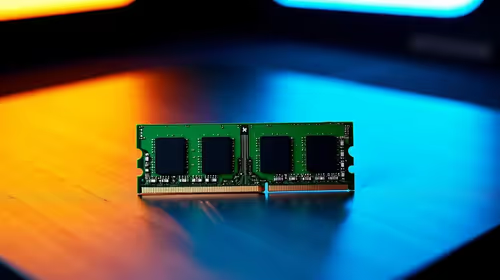
That memory pool is the real story. 128GB of unified LPDDR5x is coherent across CPU and GPU, which means the full model loads into one contiguous pool without being fragmented or shuttled between separate memory domains. For AI work, capacity at this scale is what lets a single desk-side box hold models that would otherwise need multiple high-end graphics cards.
Memory is the point, not raw gaming speed
It helps to be blunt about what this is not. The DGX Spark is not a gaming machine and it is not a general workstation you would buy for video editing on price-performance grounds. Its value is the 128GB unified memory feeding an AI-tuned chip, and FP4 compute measured for AI inference rather than rasterised frames. Judge it on the size of model you can load, not on benchmarks meant for a desktop GPU.
Connectivity and storage
The standard configuration ships with a 4TB NVMe M.2 SSD, which matters because model checkpoints and datasets are large and you do not want to be constantly clearing space. Networking includes 10 Gigabit Ethernet, Wi-Fi 7 and Bluetooth 5.3. The 10GbE port is there for a reason: NVIDIA designed two Spark units to be linked via their ConnectX-7 ports so they can run a model too large for a single 128GB box. That direct peer connection creates a 256GB unified memory pool and enables inference on models that would otherwise need rack-mounted hardware, which is unusual at this size and tier.
Software and ecosystem
The DGX Spark ships with NVIDIA AI Enterprise software, giving access to the same model development frameworks -- NIM microservices, RAPIDS, and the full CUDA toolkit -- that run on large data-centre systems. That software continuity is a genuine advantage for teams: a developer prototypes on the Spark, then deploys to cloud or on-prem infrastructure without rewriting their pipeline. It runs Ubuntu Linux and can also run Windows 11, so integration into an existing developer environment is straightforward.
Who it is actually for
This is a developer and researcher tool. If you are building AI applications, fine-tuning language models that run into the hundreds of billions of parameters, or you need a private on-device environment for sensitive data, the DGX Spark removes the cloud bill and the latency. If you mainly want to run a model or two for personal use, a high-memory desktop with a strong consumer GPU is the more sensible spend -- the AI PC range at Evetech shows what those configurations look like at local Rand pricing. For the graphics-card route to local AI, the GPU best sellers list shows which high-memory cards SA buyers are choosing for the job.
Power and physical setup
The DGX Spark draws up to 170W sustained and ships with an external 240W power brick, so it plugs into a standard wall socket without specialist electrical work. The fan noise is measured at around 38 dB at idle, comparable to a quiet desktop rather than a server. That matters for a desk environment: this is not a rack unit that needs a separate server room. Connectivity on the rear includes multiple USB-C ports, HDMI, the 10GbE port, and the dual QSFP ports for the ConnectX-7 networking. The footprint is smaller than most external hard drives stood upright, so desk real estate is not a constraint.
Buying it in South Africa
International pricing starts near 3,999 US dollars before tax, with retail listings elsewhere ranging higher depending on bundled software and storage. For SA buyers the landed cost includes import duties, VAT and shipping, so treat the dollar figure as a floor rather than a shelf price. Because it is a specialist product rather than mass-market, confirm current availability and lead time before committing, and be honest about whether 128GB of unified memory is something your workload will actually use.
Frequently Asked Questions
What makes the DGX Spark a supercomputer rather than a normal PC?
The combination of the GB10 Superchip with 128GB of unified memory and FP4 AI compute, all in a tiny chassis. It is tuned for running and fine-tuning large AI models on-device, which a standard PC cannot do without multiple high-end cards.
Can the DGX Spark play games?
It is not designed for gaming. The GPU is tuned for AI compute and the software stack targets developers, so a gaming desktop with a consumer GPU is a far better and cheaper choice if games are your goal.
How much memory does the DGX Spark have?
128GB of unified LPDDR5x memory, shared coherently between the 20-core Arm CPU and the Blackwell GPU. That shared pool is what lets it hold large models a typical graphics card cannot fit.
Is one DGX Spark enough or do I need two?
One handles models that fit in 128GB. NVIDIA allows two units to be linked directly via ConnectX-7 to run a single larger model on a combined 256GB pool, which is only worth it for serious research workloads.
Should an SA developer buy one or build a high-memory desktop?
If you regularly fine-tune large models or need a private on-device setup, the Spark is purpose-built. For occasional local model use, a high-memory desktop with a strong consumer GPU usually gives better value once import costs are added.
The DGX Spark is a specialist tool for serious local AI work. If you are weighing it against a GPU-based build, compare your options in the AI PC range at Evetech and match the hardware to the model sizes you actually run.