


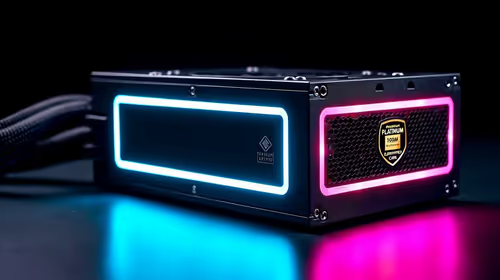
80+ Gold vs 80+ Platinum for Couch co-op gaming in SA
80+ Gold vs 80+ Platinum for couch co-op gaming is about PSU efficiency, heat, fan behaviour, quality, and wattage headroom, not direct FPS. SA buyers should compare the whole build.
Read moreDeciding on NVIDIA vs AMD multiple monitors for your dream setup? This guide breaks down everything from NVIDIA Surround to AMD Eyefinity. 🖥️ Discover the key differences in display support, performance, and features to choose the perfect GPU for your productivity or gaming rig. 🚀
So, you’re ready to expand your digital real estate. Whether you're a streamer needing a second screen for chat, or a productivity wizard building a command centre, your GPU choice is critical. The great NVIDIA vs AMD multiple monitors debate isn't just about raw gaming power; it’s about stability, features, and a seamless experience across all your displays. Let's break down which team is the right fit for your multi-screen setup here in South Africa. 🖥️
Running more than one screen puts a unique strain on a graphics card. It's not just about rendering a game on your main display; the GPU also has to manage different resolutions, refresh rates, and applications simultaneously. A budget card might handle two 1080p office monitors, but what if you want to game at 144Hz on one and watch a 4K video on another?
This is where the battle between an NVIDIA vs AMD multi-monitor setup truly begins. It comes down to driver software, specialised features, and how each brand's architecture handles the load. A smooth experience prevents stuttering, screen tearing, and frustrating glitches. Before you even pick a team, it's wise to see what's available and get a feel for the market by checking out the best graphics card deals currently on offer.
For years, Team Green has built a reputation for rock-solid drivers. For many users, especially professionals and streamers, this "it just works" factor is a massive selling point. When you’re dealing with a complex multi-monitor array, the last thing you want is to troubleshoot a fussy driver.
For those who prioritise a feature-rich ecosystem and proven driver stability, exploring NVIDIA's latest GeForce graphics cards is the logical first step.
Team Red has made enormous strides and is a formidable competitor, especially when it comes to value and flexibility in a multi-monitor setup. AMD often delivers incredible price-to-performance, allowing you to allocate more of your budget towards the monitors themselves.
If getting the most bang for your buck and having flexible display options are your top priorities, you'll want to check out the range of powerful AMD Radeon graphics cards.
When running multiple high-refresh-rate monitors, always prioritise DisplayPort over HDMI where possible. DisplayPort generally offers more bandwidth, which is critical for pushing high resolutions and refresh rates simultaneously without issues. Check your card's outputs before buying your monitors!
So, who wins the NVIDIA vs AMD multiple monitors showdown? The honest answer... it depends entirely on you.
Both brands now offer robust, capable solutions for multi-monitor users. The performance gap for everyday use and gaming is closer than ever, making the decision more about the ecosystem and features that matter most to your specific workflow.
Ready to Expand Your Horizon? The NVIDIA vs AMD multiple monitors debate comes down to your specific needs and budget. Whether you prioritise NVIDIA's feature set or AMD's value, the perfect setup awaits. Explore our massive range of graphics cards and find the engine for your multi-display empire.
Most modern NVIDIA GeForce cards can support up to 4 monitors simultaneously. Professional-grade Quadro cards using NVIDIA Mosaic technology can support many more, often up to 16 displays.
Yes, AMD Eyefinity is excellent for immersive multi-monitor gaming. It allows you to group multiple displays into one large, high-resolution surface for a panoramic gaming experience.
Both technologies merge multiple monitors into one large display. The main difference is in setup and hardware support. NVIDIA Surround often requires identical monitors, while AMD Eyefinity can be more flexible.
For general productivity and browsing, a mid-range GPU is sufficient. For gaming or 4K video editing across 3 monitors, you'll need a high-end GPU to handle the increased pixel load.
Both are excellent for productivity. AMD often wins on value with Eyefinity's flexibility, while NVIDIA's robust drivers and features can be a draw for specific creative workflows.
While technically possible in some niche scenarios, it's not recommended. It can lead to severe driver conflicts, instability, and poor performance. Stick to a single GPU brand.
Connect your monitors to the GPU, then open AMD Software: Adrenalin Edition. Navigate to the 'Gaming' tab, then 'Display', and use the AMD Eyefinity tool to create a new display group.
80+ Gold vs 80+ Platinum for couch co-op gaming is about PSU efficiency, heat, fan behaviour, quality, and wattage headroom, not direct FPS. SA buyers should compare the whole build.
Read more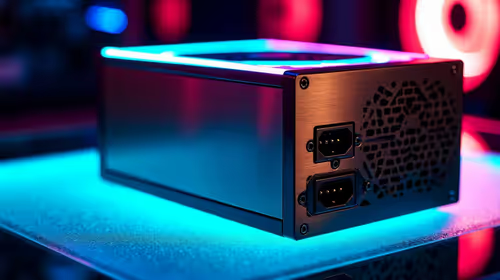
80+ Platinum or 80+ Titanium for competitive should be shortlisted around the job it must do. South African buyers should compare fit, performance, compatibility, and upgrade room, warranty path, and upgrade room before treating any pick as best.
Read more
The real world difference between IPS and OLED for AAA single-player gaming is immersion versus versatility. OLED lifts contrast and dark scenes, while IPS can suit bright rooms, mixed PC use, and SA buyers watching total setup cost.
Read more
HDMI 2.1 vs HDMI 2.0 for SA MMO needs a workload-first comparison. For SA buyers, judge real performance, platform fit, warranty path, power needs, and upgrade timing before choosing either side.
Read more
USB4 and Thunderbolt 4 differ for competitive esports through dock, display, and capture consistency. Use this real world difference between usb4 and thunderbolt 4 for competitive guide to keep SA tournament desks tidy without assuming better ping.
Read more
Magnetic switches vs Mechanical switches depends on Competitive esports needs, platform limits, and budget fit. Compare compatibility, latency, upgrade path, and real setup constraints before choosing for an SA build.
Read more
B850 motherboard FPS drops needs a methodical troubleshooting pass. Review drivers, thermals, power settings, background apps, cables and game settings before replacing parts in an SA gaming setup.

Gaming PC FPS drops in South Africa often come from drivers, thermals, background apps, power plans, or in-game settings. Check one change at a time and use the same scene before buying upgrades for your local setup.

Difference between PCIe 5.0 and PCIe 4.0 explained for PC builders starts with bandwidth, lanes, and support. SA builders should match the motherboard, GPU, NVMe drive, and budget before choosing a platform.
Windows 11 mechanical keyboard setups rarely cause display banding directly. Fix color banding by checking HDR, colour depth, GPU range, monitor profiles, and any new RGB utility conflicts.

Steam Big Art Mode enlarges library artwork in Big Picture Mode and on Steam Deck, while the same beta adds configurable screensavers. Both features are optional and currently require the Steam beta client.
Diablo 4 HDR settings work best after Windows and the display are calibrated, then the game's black point, brightness and white point are adjusted in that order. Use visible shadow detail and controlled highlights, not copied values from another screen.

The best HOTAS for Elite Dangerous is a separate stick-and-throttle set with enough analogue axes for pitch, roll, yaw and thrust, plus local support. Evetech's captured flight-simulation sample lists the complete Logitech X56 at R4,999.
Nintendo Switch 2 docked VRR arrives with system version 23.0.0 and also requires a dock update. The connected TV or monitor and the running software must support VRR before the output can follow changing frame rates.
750W for RTX 5080 Super needs a full-build check, not a simple yes. Review GPU guidance, CPU draw, transient load, connectors, PSU quality, and upgrade plans before deciding.
80+ Gold vs 80+ Platinum for couch co-op gaming is about PSU efficiency, heat, fan behaviour, quality, and wattage headroom, not direct FPS. SA buyers should compare the whole build.
ultrawide monitor FPS drops needs a methodical troubleshooting pass. Review drivers, thermals, power settings, background apps, cables and game settings before replacing parts in an SA gaming setup.
80+ Platinum or 80+ Titanium for competitive should be shortlisted around the job it must do. South African buyers should compare fit, performance, compatibility, and upgrade room, warranty path, and upgrade room before treating any pick as best.