


80+ Gold vs 80+ Platinum for Couch co-op gaming in SA
80+ Gold vs 80+ Platinum for couch co-op gaming is about PSU efficiency, heat, fan behaviour, quality, and wattage headroom, not direct FPS. SA buyers should compare the whole build.
Read moreDeciding on OLED vs QLED for your next display? This guide breaks down the key differences in contrast, brightness, and gaming performance to help you choose the perfect screen. We'll cover everything from burn-in risks to which tech reigns supreme for movies and fast-paced gaming. 🖥️✨
Staring at a screen, deciding between two strange acronyms: OLED and QLED. It’s a classic tech dilemma for any South African gamer or content creator. One promises perfect, inky blacks for those late-night Alan Wake 2 sessions, while the other boasts searing brightness for vibrant, sun-drenched vistas in Forza Horizon. The OLED vs QLED debate isn't just about specs; it's about choosing the perfect window into your digital world. Let's break it down. 🚀
OLED stands for Organic Light-Emitting Diode. The key word here is "emitting". Each individual pixel on an OLED screen creates its own light. When a pixel needs to be black, it simply switches off completely.
This creates what's known as "infinite contrast"—the difference between the brightest white and the darkest black. For gaming, this means no distracting grey haze in dark scenes. You'll see enemies lurking in the shadows exactly as the developers intended. Because pixels can turn on and off almost instantly, OLEDs also have phenomenal response times, which is a massive plus for fast-paced, competitive gaming. When you're browsing the latest high-refresh-rate gaming monitors, you'll see OLEDs praised for their motion clarity.
The trade-offs? They generally aren't as bright as their QLED counterparts, and there's a risk of "burn-in" if a static image (like a game HUD) is left on screen for thousands of hours, though modern panels have many built-in protective features.
QLED, or Quantum Dot Light-Emitting Diode, works differently. It uses a traditional LED backlight to shine light through a layer of tiny semiconductor crystals called "quantum dots". These dots convert the light into exceptionally pure, vibrant colours.
The biggest advantage? Brightness. ✨ QLED monitors can get incredibly bright, making them perfect for gaming in a well-lit room where you need to combat glare. This brightness also makes High Dynamic Range (HDR) content pop, with spectacular highlights that feel incredibly realistic. Because they use a separate backlight, there is zero risk of burn-in. This makes them fantastic for showcasing the detail in modern 4K and 5K monitors, where every pixel counts.
The downside is that they can't achieve the perfect blacks of an OLED. Since the backlight is always on, some light can bleed through, causing dark areas to look slightly grey, an effect known as "IPS glow" or "blooming".
So, when it comes to the QLED vs OLED battle, which one wins for your specific needs?
If you love atmospheric, story-driven games and often play in a dimly lit room, OLED is your champion. The perfect blacks and infinite contrast create a level of depth and immersion that is simply unmatched. The immersion factor is huge, which is why so many gamers are drawn to immersive curved monitors in both technologies.
If your gaming setup is in a bright living room or you want the most impactful HDR experience possible, QLED takes the crown. Its superior peak brightness cuts through ambient light and delivers stunningly bright highlights that make games and movies look spectacular.
Don't just plug and play! Whether you choose OLED or QLED, spend 10 minutes adjusting the settings. Use Windows' built-in "Calibrate display color" tool (just search for it in the Start Menu). It's a simple wizard that helps you set gamma, brightness, and contrast correctly for your room's lighting, ensuring you get the most accurate picture from day one.
This is where it gets tricky. Both are excellent. A QLED is a safer bet if you'll be staring at static interfaces like Adobe Premiere or code editors for hours on end. However, some streamers add a small portable monitor to their setup for managing chat, and choosing the right tech matters there too. Ultimately, the choice between OLED or QLED is just one part of finding the right screen in the vast world of PC monitors.
The best display technology is the one that fits your space, your games, and your budget. There is no single "best" choice in the OLED vs QLED debate... only what's best for you.
Both technologies are brilliant, and you can often find incredible value by checking out the best PC monitor deals in South Africa.
Ready to Upgrade Your View? The OLED vs QLED choice is personal, but getting it right transforms your entire PC experience. From pinpoint accuracy in shooters to breathtaking cinematic worlds, the perfect display is waiting. Explore our massive range of PC monitors and find the screen that will bring your games to life.
The main difference is backlighting. OLED pixels create their own light, offering true blacks and infinite contrast. QLED displays use an LED backlight and a quantum dot layer for vibrant colors.
OLED is often preferred for gaming due to its near-instantaneous response times and perfect black levels, which enhance immersion. However, QLEDs can get brighter, which is better for well-lit rooms.
While modern OLEDs have features to prevent burn-in (pixel shifting, logo dimming), the risk still exists with static images displayed for extended periods. For most users, it's not a major concern.
QLED panels generally have a longer lifespan as their inorganic quantum dots don't degrade like the organic compounds in OLEDs. However, both technologies are built to last for many years of typical use.
Mini LED is a QLED enhancement that offers better contrast and less blooming than standard LED TVs, getting closer to OLED performance. OLED still leads in per-pixel control and true black levels.
OLED manufacturing is more complex and has lower yields, leading to higher production costs. This complexity is what allows each pixel to be individually controlled for superior image quality.
80+ Gold vs 80+ Platinum for couch co-op gaming is about PSU efficiency, heat, fan behaviour, quality, and wattage headroom, not direct FPS. SA buyers should compare the whole build.
Read more
80+ Platinum or 80+ Titanium for competitive should be shortlisted around the job it must do. South African buyers should compare fit, performance, compatibility, and upgrade room, warranty path, and upgrade room before treating any pick as best.
Read more
The real world difference between IPS and OLED for AAA single-player gaming is immersion versus versatility. OLED lifts contrast and dark scenes, while IPS can suit bright rooms, mixed PC use, and SA buyers watching total setup cost.
Read more
HDMI 2.1 vs HDMI 2.0 for SA MMO needs a workload-first comparison. For SA buyers, judge real performance, platform fit, warranty path, power needs, and upgrade timing before choosing either side.
Read more
USB4 and Thunderbolt 4 differ for competitive esports through dock, display, and capture consistency. Use this real world difference between usb4 and thunderbolt 4 for competitive guide to keep SA tournament desks tidy without assuming better ping.
Read more
Magnetic switches vs Mechanical switches depends on Competitive esports needs, platform limits, and budget fit. Compare compatibility, latency, upgrade path, and real setup constraints before choosing for an SA build.
Read more
B850 motherboard FPS drops needs a methodical troubleshooting pass. Review drivers, thermals, power settings, background apps, cables and game settings before replacing parts in an SA gaming setup.

Gaming PC FPS drops in South Africa often come from drivers, thermals, background apps, power plans, or in-game settings. Check one change at a time and use the same scene before buying upgrades for your local setup.

Difference between PCIe 5.0 and PCIe 4.0 explained for PC builders starts with bandwidth, lanes, and support. SA builders should match the motherboard, GPU, NVMe drive, and budget before choosing a platform.
Windows 11 mechanical keyboard setups rarely cause display banding directly. Fix color banding by checking HDR, colour depth, GPU range, monitor profiles, and any new RGB utility conflicts.

Steam Big Art Mode enlarges library artwork in Big Picture Mode and on Steam Deck, while the same beta adds configurable screensavers. Both features are optional and currently require the Steam beta client.
Diablo 4 HDR settings work best after Windows and the display are calibrated, then the game's black point, brightness and white point are adjusted in that order. Use visible shadow detail and controlled highlights, not copied values from another screen.

The best HOTAS for Elite Dangerous is a separate stick-and-throttle set with enough analogue axes for pitch, roll, yaw and thrust, plus local support. Evetech's captured flight-simulation sample lists the complete Logitech X56 at R4,999.
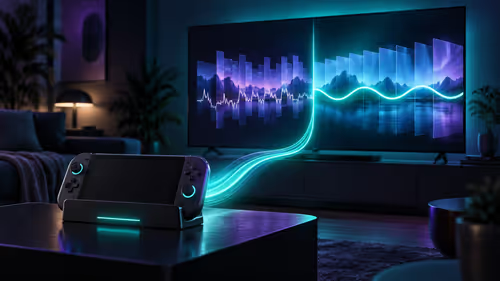
Nintendo Switch 2 docked VRR arrives with system version 23.0.0 and also requires a dock update. The connected TV or monitor and the running software must support VRR before the output can follow changing frame rates.
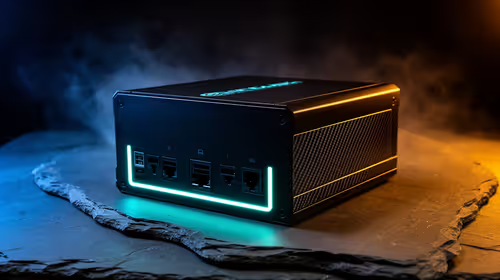
750W for RTX 5080 Super needs a full-build check, not a simple yes. Review GPU guidance, CPU draw, transient load, connectors, PSU quality, and upgrade plans before deciding.
80+ Gold vs 80+ Platinum for couch co-op gaming is about PSU efficiency, heat, fan behaviour, quality, and wattage headroom, not direct FPS. SA buyers should compare the whole build.
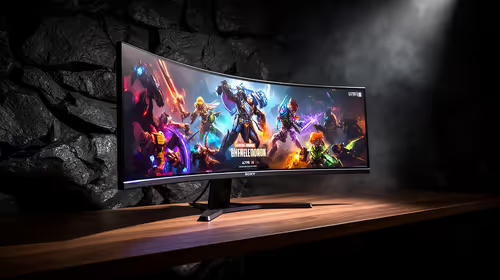
ultrawide monitor FPS drops needs a methodical troubleshooting pass. Review drivers, thermals, power settings, background apps, cables and game settings before replacing parts in an SA gaming setup.
80+ Platinum or 80+ Titanium for competitive should be shortlisted around the job it must do. South African buyers should compare fit, performance, compatibility, and upgrade room, warranty path, and upgrade room before treating any pick as best.