A cloud AI agent versus a local LLM rig is one of those decisions where the monthly number looks tiny and the once-off number looks scary, so the gut answer is usually wrong. At roughly R370 a month for a capable coding subscription, a R50,000 local GPU rig has to absorb more than eleven years of equivalent spend before the maths even pulls level. For most South African developers, the cloud subscription wins on pure cost, and it is not close.
Quick Answer
At about R370 a month, a year of cloud AI costs roughly R4,440. A R50,000 local rig divided by that annual figure is over eleven years to break even, before you add electricity, and well before the GPU is obsolete. Buy local for privacy, control or heavy sustained use, not to save money.
The Rand Maths, Laid Out
Take the headline numbers honestly. A cloud coding or chat subscription at R370 a month is R4,440 a year. A local rig built around a strong consumer GPU, enough system RAM and a quiet case lands around R50,000 once you add it all up. Divide R50,000 by R4,440 and you get just over eleven years of subscription before the rig has paid for itself in fees you would have spent anyway.
The problem is that no consumer GPU stays relevant for eleven years. The break-even point arrives long after the hardware has been superseded twice over, which means the rig, judged purely on saving subscription money, never actually breaks even.
The Electricity Nobody Budgets For
A local rig under load draws real power, and that draw runs every hour you keep a model warm. On a South African tariff, a rig pulling a few hundred watts during active sessions adds a meaningful amount to the monthly bill. It does not flip the conclusion, but it widens the gap: the cloud subscription has no electricity line at all, while the local rig keeps spending after you have bought it.
So Why Does Anyone Build Local?
Because cost is not the only axis. Three reasons make a local rig the right call despite the maths.
Privacy and Data Control
If your prompts contain client code, financial records or anything you are contractually barred from sending to a third party, a local model that never leaves your machine is not a luxury, it is the requirement. No subscription saving outweighs a compliance breach.
Sustained, Heavy Use
The cloud-wins logic depends on light-to-moderate use. A developer running a model almost continuously, all day every day, pushes far enough up the usage curve that owning the hardware starts to make sense, the same way the analysis flips toward on-premise once GPU utilisation stays very high rather than spiking and idling. Most individuals never reach that level; a small team running inference around the clock might.
No Metering, No Limits
A local rig has no per-token meter and no rate limit. For experimentation where you would otherwise watch a usage counter, the freedom to run anything as often as you like has a value that does not show up in the break-even sum. If that is you, the AI PCs range at Evetech carries the hardware sized for always-on local inference workloads.
What the R50,000 Actually Buys
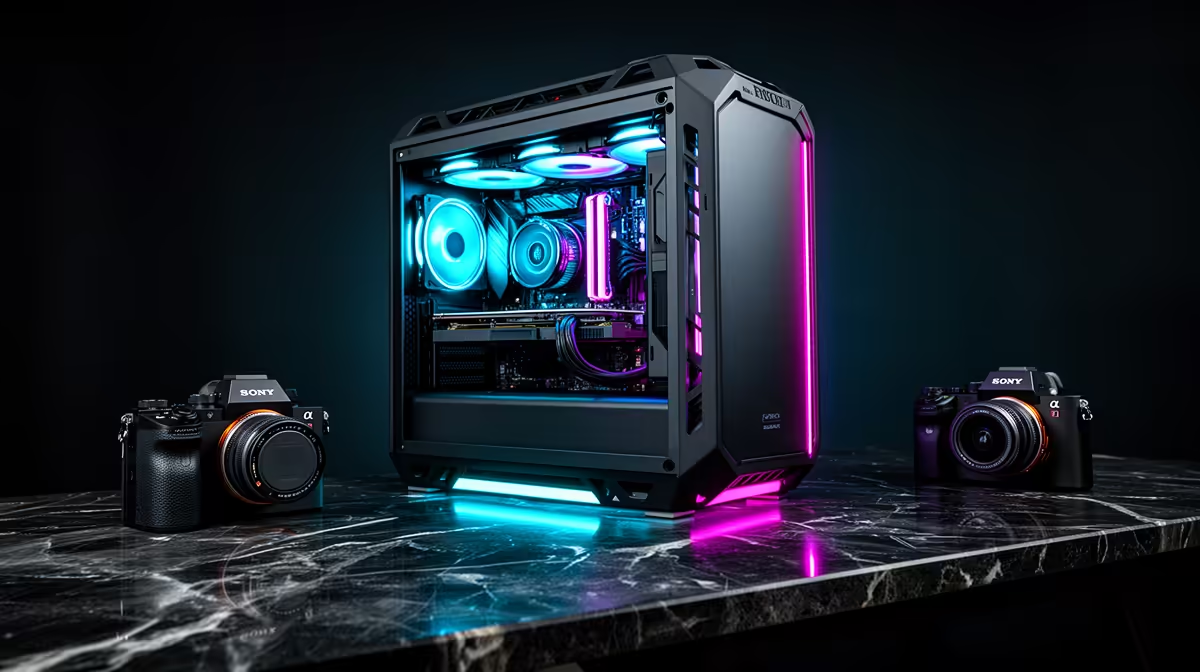
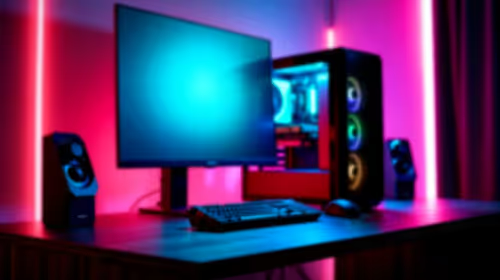
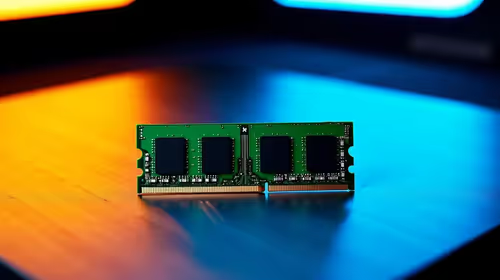
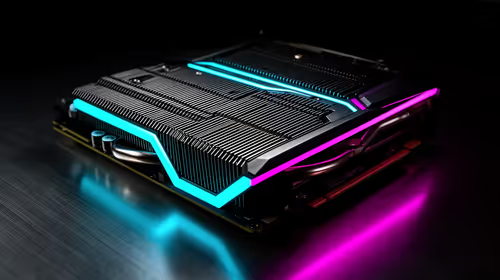
The bulk of a local AI workstation budget goes to the GPU. A card with 24GB of VRAM handles quantised models in the 7B to 14B range at usable speeds for daily coding. If your target models are larger, 32GB cards or a dual-GPU setup push the cost well past R60,000 before the rest of the build is accounted for. Add a capable CPU, 64GB of system RAM, fast NVMe storage and a quality power supply, and the build comes together into a machine that does far more than run AI.
That is the honest framing: a local rig is a capable workstation that also runs local models, not a purpose-built AI appliance that happens to be expensive. Anyone treating it purely as a subscription replacement will be disappointed by the maths; anyone who needed a high-spec desktop anyway and values the privacy benefit on top is getting two things for the price of one.
When the Break-Even Actually Works
The arithmetic shifts meaningfully for teams rather than individuals. A small development team that pushes millions of tokens a day against a premium API plan can reach break-even on shared local hardware inside two to three years, because token costs compound fast at scale. For a solo developer on a standard plan, the crossing point is still measured in years, not months. The honest calculation is not "will this save me money" but "how many tokens a day do I actually push, and is my usage volume heavy enough to matter?"
Picking the Right Path
Start with how you actually work. If you code in bursts, prototype occasionally, or just want a strong assistant on tap, the subscription is cheaper, simpler and always running the latest model. If you handle sensitive data, run inference for hours every day, or want a machine that doubles as a serious workstation, build local and treat the cost as buying capability rather than saving fees. The wrong move is buying a R50,000 rig expecting it to be the frugal choice. It is the powerful choice, which is different.
A middle path exists too. A capable desktop earns its keep as a daily workstation first and a local AI rig second, which spreads the cost across more than one job. Check out the best-selling desktop PCs at Evetech to see what current builds deliver for the money before you commit either way.
Frequently Asked Questions
How was the eleven-year figure calculated?
R50,000 rig cost divided by R4,440 a year in subscription fees, which is what R370 a month adds up to over twelve months. That gives just over eleven years, and the figure ignores electricity, which only lengthens it for the local option.
Will the local rig at least feel faster than cloud?
For interactive use, often not. Cloud models run on data-centre hardware far beyond any home GPU. A local rig wins on privacy and unlimited use, not on raw speed against a current cloud model.
Does a more expensive rig change the answer?
It makes it worse on pure cost. A R80,000 rig pushes break-even past eighteen years of subscription. Spending more on hardware only makes financial sense when your usage is heavy enough to justify it for non-cost reasons.
What if I already own a gaming PC?
Then your maths is different. If the GPU is already paid for, the marginal cost of running a local model is mostly electricity, which can make local genuinely competitive. The eleven-year figure applies to buying a rig specifically for AI.
Decide on how you actually work, not on the headline price. If sustained local inference or data privacy is the goal, the AI PCs range at Evetech is the place to start. If you mainly want a strong daily machine, the PC best sellers are the smarter first stop.