Pull a PETG print off a smooth PEI sheet too soon and you can hear the problem before you see it: a sharp crack as a flake of the gold film tears away with the part. Powder-coated PEI build plates sidestep that failure entirely. Instead of a thin thermoplastic film that bonds chemically to PETG, the powder-coated sheet relies on a baked-on textured layer that grips mechanically, holding the print steady during the job and letting go cleanly once the bed cools.
Quick Answer
Powder-coated PEI survives PETG because its textured coating gives mechanical grip rather than the aggressive chemical bond smooth PEI forms with PETG. That means firm first-layer adhesion during printing and a clean release after, with no torn-off film. The trade-off is a lightly stippled matte underside instead of the glossy mirror finish smooth PEI produces.
Why smooth PEI and PETG fight each other
Smooth PEI is a thin sheet of polyetherimide laminated onto spring steel. With most filaments that smooth film is ideal, because it forms a strong chemical bond as the plastic cools. PETG is the exception. PETG and PEI are chemically similar enough that the bond becomes too strong, and the two effectively want to weld together at the contact layer.
If your first layer is squished in a touch too low, the result is a part that will not come off without a fight. Builders regularly report PETG ripping a chunk of the gold film clean off the steel, leaving a bald patch that never adhered properly again. The usual workaround on smooth PEI is a glue-stick release layer applied as a barrier, so the PETG sticks to the glue rather than the film. It works, but it is an extra step every print, and it admits that the surface itself is wrong for the job.
How the powder coating changes the contact
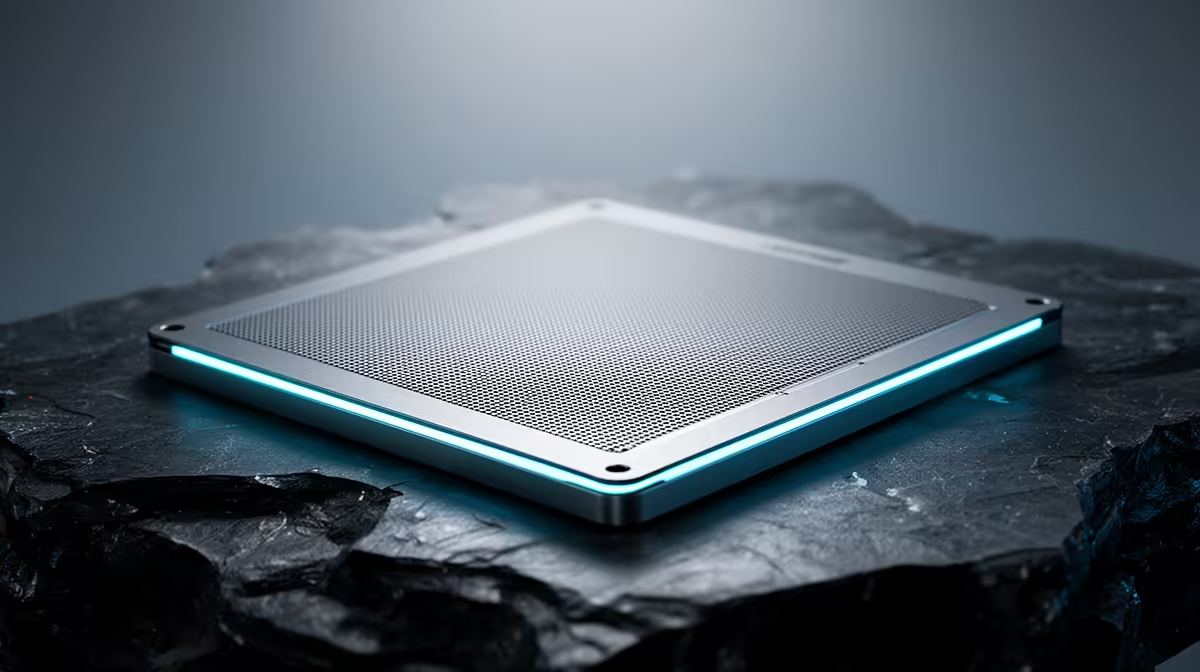
A powder-coated sheet is finished with a polymer powder that is electrostatically applied and then baked so it fuses into a hard, slightly rough surface. Under a printed first layer, that roughness means the molten plastic flows into thousands of tiny pits and locks in by physical interlock rather than by chemical welding. The hold is genuinely strong while the bed is hot, which is exactly what you want mid-print, yet the bond is releasable.
As the plate cools, PETG and the steel contract at different rates. On a textured sheet that mismatch quietly breaks the mechanical grip, and prints often pop loose on their own or lift with a gentle flex of the removed plate. There is no film to tear because the grip was never a chemical weld in the first place. For PETG specifically that is the difference between a consistent surface and a consumable one. If you are weighing up which sheet to add to a printer, the 3D printing range at Evetech is the place to check what coatings ship with each machine.
The visible trade-off
Powder-coated grip leaves its signature on the bottom of the part. Where smooth PEI gives a glassy reflective base, the textured sheet transfers its fine stipple, so the underside reads as an even matte finish. For functional parts, enclosures and most prototypes that texture is a non-issue and many people prefer the look. If a project genuinely needs a mirror-smooth bottom face, that is the one job where smooth PEI still earns its place, with a glue barrier for PETG.
Getting the most life from the sheet
Treat a powder-coated sheet as a long-term tool, not a sticker. Keep finger oils off it, since skin grease is the most common cause of sudden adhesion loss, and wipe it down with isopropyl alcohol rather than scrubbing it. Let PETG cool fully before lifting, or briefly take the bed back up to around 60 degrees if a stubborn part will not release, which relaxes the contraction stresses. A sheet looked after this way stays usable across hundreds of prints, which is why so many builders keep a textured plate dedicated to PETG and a separate surface for finishes that need gloss. Spare sheets and other consumables sit alongside printers in the 3D printing accessories at Evetech.
Bed temperature and first-layer height for PETG on powder-coated PEI
These two settings do more work than any surface choice. A bed between 65C and 75C on a powder-coated plate is the typical window for PETG: hot enough to promote adhesion across the first layer, cool enough that the bond does not become too aggressive. Let the bed cool below 40C before attempting removal. Removing the print while the plate is still warm is the most common cause of a part deforming or sticking on what should be an easy release.
First-layer height also matters more on PETG than on PLA. Printing too close squishes PETG deep into the texture pits and creates a mechanical lock that is genuinely hard to break cleanly. A first layer that is slightly higher than you might use for PLA reduces the contact depth and keeps removal predictable. Run a test tile, adjust in small steps, and the plate will handle PETG reliably for hundreds of prints before it shows any wear.
Frequently Asked Questions
Does PETG need glue on a powder-coated PEI plate?
Usually no. The textured surface holds PETG well on its own and releases it cleanly once cool. A glue-stick barrier is mainly a smooth-PEI workaround to stop PETG bonding too hard, so on powder-coated sheets you can normally skip it.
Can I print PLA and ABS on the same powder-coated sheet?
Yes. Powder-coated PEI is a strong all-rounder for PLA, PETG and ABS. Many users keep one textured sheet for everyday filaments and reserve smooth PEI only for parts that need a glossy bottom face.
Why did my PETG tear my smooth PEI plate?
PETG bonds chemically to PEI, and that bond can exceed the adhesion holding the PEI film to its steel base, so removal lifts the film with the part. Printing the first layer slightly higher, cooling fully before removal, or moving PETG to a textured sheet all prevent it.
What does the matte underside on textured prints mean?
It is the powder coating transferring its fine stipple to the contact face of the print. It is purely cosmetic, has no effect on strength, and many find it more attractive than a glossy base.
How do I restore a sheet that has stopped sticking?
Adhesion loss is almost always finger oil. Wipe the sheet with isopropyl alcohol and avoid touching the print area. Handle the sheet by its edges and the grip generally returns to full strength.
Building out a printer for PETG and beyond? Browse the 3D printers and spare build surfaces in the 3D printing range at Evetech and match the right coating to the way you actually print.