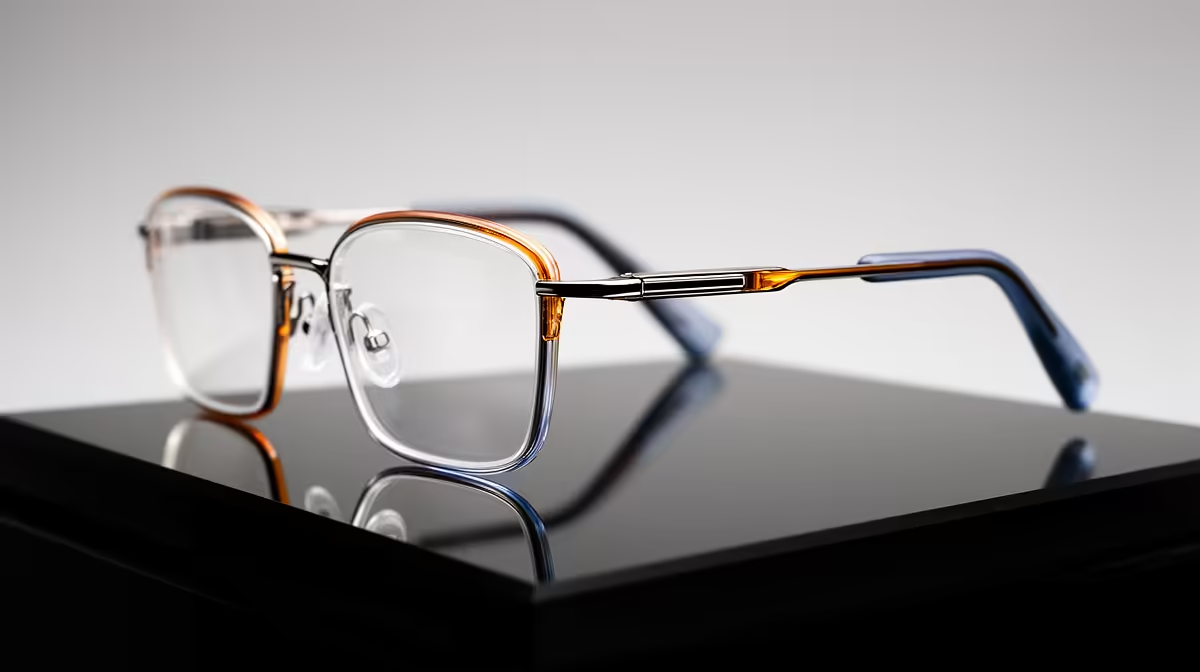
Smart glasses only earn a place on your face if you can actually see through them, which is why the prescription question is the one that stops most spectacle wearers before they buy. The good news for anyone who lives in their glasses: the Ray-Ban Meta Gen 2 supports proper prescription lenses, including single-vision and progressives, so you are not forced to choose between AI features and clear vision.
Quick Answer
Yes. Ray-Ban Meta Gen 2 takes prescription lenses across a wide range, roughly minus 12.00 to plus 6.00 including astigmatism and progressives. The Oakley Meta Vanguard is the awkward one: its wraparound shield does not take prescription optics directly, so it relies on a clip-in Rx insert instead. With no official SA retail stock, buyers supply their script during an overseas order and confirm the numbers with a local optometrist first.
How prescription works on Ray-Ban Meta Gen 2
The Gen 2 Wayfarer and its sibling frames are built like ordinary spectacles in one important respect: the lens is a real corrective lens, not a flat window with electronics bolted on. When ordering through Meta directly you pick the frame, then add your prescription, choosing the lens type that matches how you see.
The supported range is generous. It covers single-vision lenses for straightforward short or long sight, lenses that correct astigmatism, and progressive lenses for people who need different zones for distance and reading. In practice that means most everyday prescriptions fit, which is the whole point if you want one pair to wear all day rather than a novelty you swap in and out.
Single-vision versus progressive: which one fits you
The lens type you order should match the glasses you already wear, not the marketing.
- Single-vision lenses carry one correction across the whole lens. They suit anyone with a single distance need, whether that is short sight, long sight or astigmatism on its own.
- Progressive lenses blend several corrections into one lens, distance at the top, reading at the bottom, with a smooth transition between. They suit people who currently wear varifocals or who juggle distance and close-up vision through the day.
If you are unsure which camp you fall into, your current spectacles already answer the question. The safest move is to read the lens type straight off your existing prescription rather than guessing during an online checkout. For a sense of how this category sits alongside other wearable tech, the AR glasses range is a useful reference point for what is emerging in the space.
Understanding the prescription range in detail
The supported prescription range for Ray-Ban Meta Gen 2 is broad enough to cover most everyday scripts. On Meta's own ordering platform the range currently runs from minus 6.00 to plus 6.00 SPH+CYL combined, which covers the vast majority of short-sighted and long-sighted prescriptions. Third-party lens suppliers who cut lenses for the frames often support a wider band, up to roughly minus 12.00 and plus 6.00, but those numbers depend on the specific lab and the lens material they use.
What this means practically: if your prescription is mild to moderate you will almost certainly be within the standard range and the order is straightforward. If you sit at the stronger end of the scale, check the specific range for the ordering route you are using, whether that is directly through Meta or a lens lab, before you commit. For astigmatism, both the sphere and cylinder values contribute to the total, so have your full written script in front of you when you check.
One detail worth knowing: the cylinder correction for astigmatism is included within that combined range rather than a separate allowance. A script with sphere minus 4.00 and cylinder minus 2.00 sits comfortably within range, while very high cylinder values at the extremes of the sphere range may need individual confirmation.
Why Oakley Meta Vanguard is the harder fit
The Vanguard is a performance, sport-style design with a single wraparound shield lens. That curved shield is excellent for cycling and running but poor for grinding a precise prescription into, because the steep wrap distorts corrective optics. Rather than a true prescription lens, the common route is an Rx insert: a small prescription lens carrier that clips in behind the main shield, often attaching via a replacement nose-pad mount. It works, but it is a two-part solution rather than a single corrective lens, and it is a deliberate compromise for a sport frame.
The takeaway is simple. If clear all-day prescription vision is your priority, the Ray-Ban Meta Gen 2 is the natural pick. If you want a sporty shield for activity and can live with an insert, the Vanguard becomes an option rather than a non-starter.
Frame styles and prescription options
Not every Ray-Ban Meta frame takes prescription lenses in the same way. The Wayfarer-style optics frames are the primary prescription vehicles, designed from the outset to accept corrective lenses as standard. Some of the more angular or fashion-forward styles use a flat lens geometry that is easier to cut a prescription into accurately, while frames with more curve need a lab that can handle the wrap without distorting the correction.
If progressives are on your list, confirm the frame fits the progressive lens corridor. Progressives need a minimum vertical lens height to include the full distance-to-reading transition, and a very shallow or very wide frame may clip the reading zone uncomfortably. A local optometrist who can look at the frame dimensions, even from a product image, can tell you quickly whether your progression will work or whether single-vision is the cleaner fit in that specific style.
The South African buying reality
Meta smart glasses are not officially sold through SA retail channels, so getting a pair almost always means an overseas order. That changes how you should handle the prescription step:
- Get an up-to-date eye test from a local optometrist and ask for your full written prescription, including sphere, cylinder, axis and any reading addition.
- Double-check that your numbers sit inside the supported range before you order, so you are not paying international shipping on lenses that cannot be made.
- Enter the prescription carefully at the overseas checkout, since a transposition error here is expensive to fix from another continent.
- When the glasses arrive, confirm the fit and clarity with your optometrist, who can sanity-check that the lenses match your script.
Because there is no local warranty counter for these frames, that pre-order verification is the difference between a clean purchase and a costly mistake. If you are weighing this against other connected eyewear and wearables to spend on, browsing the accessories best sellers gives a feel for what is readily available with local support behind it.
Frequently Asked Questions
Can I get Ray-Ban Meta Gen 2 in my exact prescription?
Most everyday prescriptions are covered. The Gen 2 supports a wide range, roughly minus 12.00 to plus 6.00 including astigmatism and progressive lenses, so short sight, long sight, astigmatism and varifocal needs are generally catered for. Always confirm your specific numbers fall inside the supported range before ordering.
Does the Oakley Meta Vanguard support prescription lenses?
Not directly. Its wraparound shield does not take ground prescription optics, so it relies on a clip-in Rx insert that sits behind the main lens. That makes it workable for prescription wearers who want a sport frame, but it is a compromise compared with a true corrective lens.
Can I order progressive lenses, or just single-vision?
Both are available for the Ray-Ban Meta Gen 2. Single-vision suits one fixed correction, while progressive lenses combine distance and reading zones in one lens. Match the choice to the type of glasses you already wear.
How do I buy these in South Africa?
There is no official local retail stock, so it generally means an overseas order. Get a current prescription from an SA optometrist, supply it during the order, and verify the finished glasses with your optometrist once they arrive.
Will an SA optometrist check smart glasses for me?
Yes. A local optometrist can read the lenses against your written prescription and confirm the fit, even though the frames were bought abroad. Doing this verification protects you, since there is no local warranty desk for these specific glasses.
Prescription smart glasses only make sense when the vision is right first. Confirm your script with an optometrist, check it against the supported range, and explore the broader connected-eyewear category in the AR glasses range before you commit.