



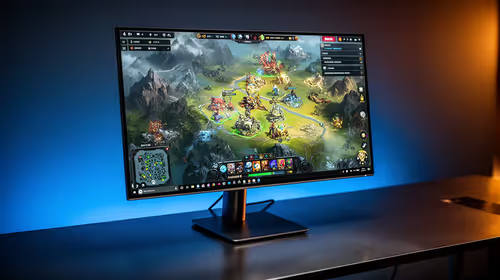
IPS vs VA for Strategy and Sim Games in SA
IPS vs VA for strategy and sim games should be judged by fit, not a single winner. Compare compatibility, latency, capacity, upgrade path, cost planning, and South African setup needs.
Read moreChoosing the right RAM for video editing can dramatically speed up your workflow. Stop battling laggy timelines and slow renders! 🚀 This guide breaks down exactly how much RAM you need for 1080p, 4K, and even 8K projects, explaining speed, capacity, and configurations. Get ready to unlock smoother playback and faster exports. 💻
Staring at a stuttering timeline in Premiere Pro? Or maybe DaVinci Resolve just crashed... again. We’ve all been there, watching a render bar crawl at a snail's pace. In South Africa, where every minute of productivity counts, these delays are beyond frustrating. More often than not, the culprit isn't your CPU or GPU, but a simple lack of sufficient RAM for video editing. Let's cut through the jargon and figure out how much you really need.
Think of RAM (Random Access Memory) as your computer's short-term memory or its active workspace. When you're editing, your PC juggles massive files: 4K video clips, high-res audio, complex effects, and colour grades. RAM is where all this active data lives.
The more RAM you have, the bigger your digital "workbench." This allows your software to:
Simply put, more RAM for video editing means a smoother, faster, and less crash-prone workflow.
The ideal amount of memory for video editing depends entirely on your projects. A quick YouTube vlog has very different needs from a feature film with complex visual effects. Here’s a simple guide to help you decide.
If you're just starting out, editing 1080p footage for social media or YouTube, 16GB is a workable starting point. You'll be able to handle basic projects, but multitasking will be limited. Expect to close your browser and other apps for the best performance. It's a decent entry point, and many of our affordable pre-built PC deals offer a great foundation you can upgrade later.
This is the new standard. With 32GB of RAM, you can comfortably edit 4K footage, multitask with other creative apps, and use more complex effects without your system grinding to a halt. For most YouTubers, streamers, and freelance editors, 32GB provides the best balance of price and performance. It's a perfect match for many of the versatile AMD Ryzen systems that excel at creative workloads.
If your system struggles with 4K or 6K footage, don't rush to upgrade just yet. Most editing software (like Premiere Pro and DaVinci Resolve) can create "proxies"—low-resolution copies of your media. You edit using the smooth, lightweight proxies and then switch back to the original high-res files for the final export. It's a fantastic way to stretch your hardware's capabilities.
Once you get into longer 4K projects, heavy colour grading, motion graphics, or multi-cam editing, 64GB becomes essential. This amount of video editing RAM gives you the headroom to work on demanding timelines without compromise. If you're a serious content creator or professional, this is your target. Many powerful NVIDIA GeForce gaming PCs can be configured with 64GB, making them editing powerhouses thanks to CUDA acceleration. Similarly, high-end AMD Radeon gaming PCs also offer incredible performance for creative tasks.
Working with 8K RAW footage? Doing heavy 3D rendering or complex VFX compositions? This is where you need a beast of a machine. 128GB of RAM or more is reserved for high-end studio work where time is money and performance cannot be a bottleneck. These configurations are typically found in dedicated workstation PCs, which are built from the ground up for maximum stability and power.
While capacity is king, two other factors matter:
Choosing the right RAM for video editing is about matching the hardware to your ambition. Don't let a memory bottleneck hold your creativity hostage.
Ready to Build Your Editing Powerhouse? Don't let insufficient RAM dictate your creative limits. A smooth workflow is just a component away. Explore our wide range of customisable PCs and configure a machine that’s perfectly tailored to your video editing needs today.
For most 4K video editing, 32GB of RAM is a great starting point. It handles complex timelines and moderate effects well, preventing system slowdowns during playback and rendering.
Capacity is generally more critical. Having enough RAM to load your project is the priority. You'll see a bigger jump going from 16GB to 32GB than from 3200MHz to 3600MHz RAM.
Adobe suggests a minimum of 16GB for HD media, but 32GB is recommended for 4K. For complex projects with many effects, 64GB or more will provide the smoothest experience.
Yes, more RAM can make rendering faster, especially if your system is running out of memory. It allows the CPU and GPU to access data quickly without using slower storage drives.
DDR5 offers higher speeds and greater bandwidth than DDR4, which can improve performance in demanding tasks. While DDR4 is still capable, DDR5 is the more future-proof choice.
64GB is not overkill for professionals working with 6K/8K footage, complex visual effects, or multitasking with other demanding apps. It ensures a smooth, bottleneck-free workflow.
IPS vs VA for strategy and sim games should be judged by fit, not a single winner. Compare compatibility, latency, capacity, upgrade path, cost planning, and South African setup needs.
Read more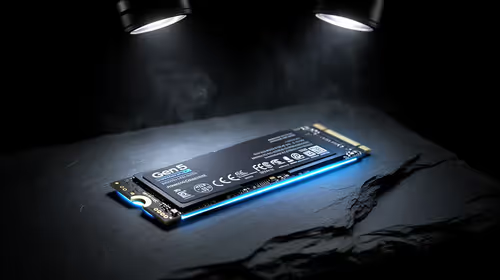
Gen 5 NVMe SSD guide for Bloemfontein gamers should be shortlisted around the job it must do. South African buyers should compare capacity, speed, thermals, and motherboard support, warranty path, and upgrade room before treating any pick as best.
Read more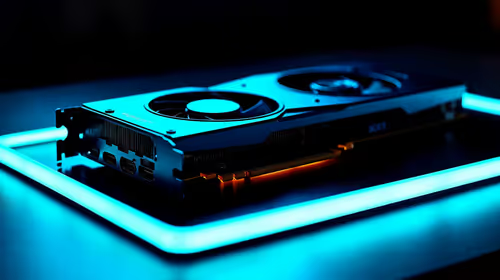
Skip the RTX 5070 if your first-time builder budget needs better balance. Better SA picks can free room for the right CPU, PSU, case, monitor, storage, and cooling while still giving a strong first gaming PC experience this year in South Africa.
Read more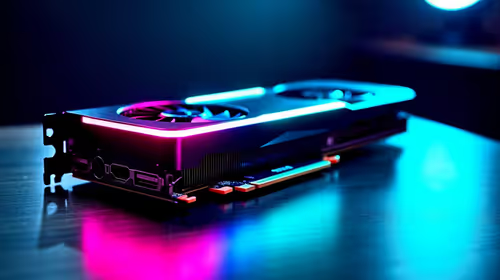
RTX 5080: weighing the pros and cons for SA should be shortlisted around the job it must do. South African buyers should compare GPU tier, VRAM, cooling, and PSU headroom, warranty path, and upgrade room before treating any pick as best.
Read more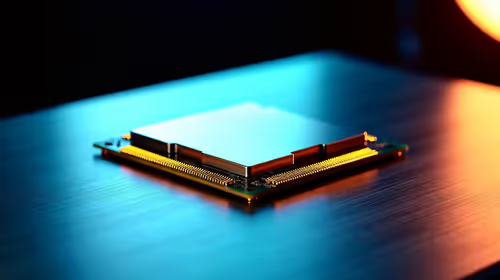
Core i5-13400F gives South African PC builders a capable mid-range CPU choice with clear limits. Check its gaming fit, discrete GPU requirement, LGA1700 platform costs, and upgrade path before locking in your parts list.
Read more
Pros and cons of the Wi-Fi 7 routers for SA should be shortlisted around the job it must do. South African buyers should compare WiFi standard, coverage, latency, and device support, warranty path, and upgrade room before treating any pick as best.
Read more
Steam content servers unreachable needs a download-path check, not an immediate reinstall of every game. Restart the client, inspect download settings and compare another connection when practical. Clearing the download cache is separate from deleting installed games.

Keychron G6 HE has built-in and swappable battery versions with different weights. The product brief lists 42g and 46g respectively, each with a 3g tolerance. Choose by grip and battery preference before treating one headline weight as universal.

Corsair HS80 v2 MAX supports 2.4GHz wireless and Bluetooth. Its maximum battery figures use RGB-off conditions and differ by connection. Check microphone routing, comfort and the exact device support before assuming every wireless mode behaves alike.

Windows taskbar notification badges can be shown or hidden in Taskbar behaviours. This changes the small app indicators, not the underlying messages. Choose a calmer desktop while keeping a deliberate routine for checking important conversations and app updates.
Windows taskbar notification badges can be shown or hidden in Taskbar behaviours. This changes the small app indicators, not the underlying messages. Choose a calmer desktop while keeping a deliberate routine for checking important conversations and app updates.
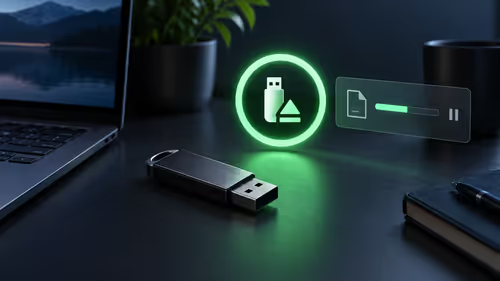
Windows USB device in use can mean a program still has the drive open. Finish transfers and close files before retrying ejection. Better performance caching requires safe removal; a replacement drive is not the first fix for an open-file warning.

Windows Nearby Sharing not working starts with feature, Bluetooth and visibility checks on both PCs. My devices only depends on matching Microsoft accounts. Test a small harmless file before buying networking hardware or changing your home router.
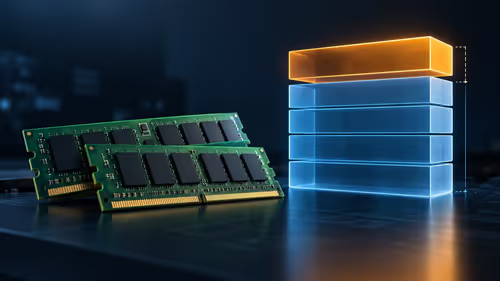
Windows hardware reserved RAM is different from memory used by applications. Compare installed memory with firmware detection and the usable amount before buying modules. Reservations and reporting limits vary by system; no universal setting restores every byte.

Windows title bar window shake can minimise other open windows when you shake the active window by its title bar. Inspect the Multitasking setting and switch it off if that gesture interrupts your work. The preference costs R0 and does not require new hardware.

Windows Print Screen opens Snipping Tool when its keyboard preference is enabled. Change the option under Accessibility, Keyboard to choose another workflow. Test whether you need a clipboard image or a saved file.

Windows desktop icons missing may be a visibility setting. Right-click the desktop, choose View and inspect Show desktop icons. If only system icons are absent, use Desktop icon settings. Check the Desktop folder before assuming files were deleted.

Windows set time zone automatically greyed out calls for a location and device-policy check. Automatic time-zone selection relies on location services. A manual time-zone choice is separate from synchronising the clock; check both before replacing hardware.