Quick Answer
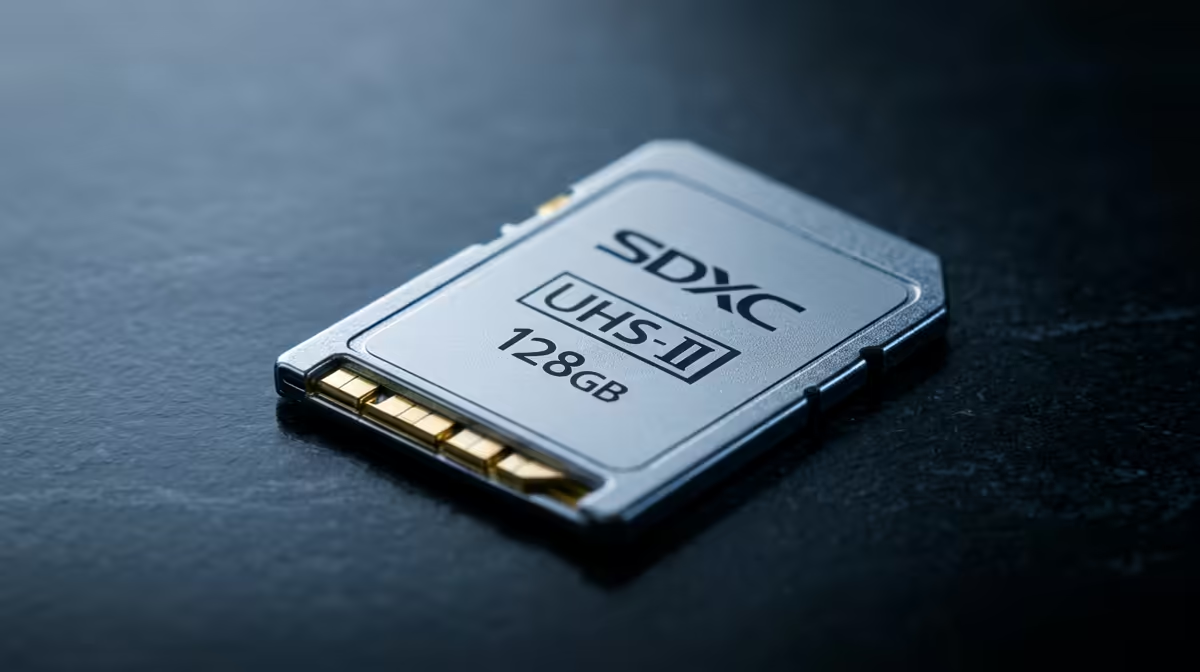
South African photographers shooting 4K video need a minimum V30/U3-rated card, at least 128GB capacity, and a genuine product from a local retailer with warranty support. Quality 128GB V30 cards currently sit between R300 and R550, and 256GB options land between R600 and R950.
Why SA Photographers Face Unique Buying Conditions 🌍
The South African photography market has specific pressures international buying guides do not address. Import duties and a volatile rand mean SD card prices can shift R100 to R200 on the same model within weeks. Counterfeit cards are prevalent at informal markets and some online platforms in Cape Town's CBD and Johannesburg's electronics areas. These fakes often show full stated capacity on initial inspection but fail write-speed tests under sustained 4K recording. Buying from a local retailer with a return policy and South African warranty support is protective as well as convenient. Heat is also real: shooting outdoors in Limpopo or the Northern Cape in summer, where ambient temperatures exceed 35 degrees Celsius, stresses both the camera body and the card. Cards that throttle write speed under thermal load will cause 4K recording to stall.
Speed Class Decisions for 4K Video in the Field 🎬
For 4K at 30fps with H.264 or H.265 at 100Mbps, V30 is the floor and works reliably on Sony ZV-E10, Fujifilm X-S20, and Nikon Z30. If you shoot 4K All-Intra or high-bitrate formats on a Lumix S5 II or Sony FX30, V60 becomes necessary. A useful rule: find your camera's 4K bitrate in megabits per second, divide by 8 to get megabytes per second, then double it for a comfortable margin. At 100Mbps that minimum is 12.5MB/s; V30 at 30MB/s is 2.4 times that floor. At 400Mbps the minimum is 50MB/s; V30 fails, V60 barely passes, V90 at 90MB/s is safe.
Practical Capacity Planning for South African Shoots 📋
Most South African documentary and wedding videographers work 8 to 10 hour days. At 4K/30fps and 100Mbps, 256GB holds around 340 minutes of footage, covering a full wedding ceremony and reception with room to spare. For drone videographers using a DJI Air 3 or Mavic 3, a separate 128GB microSD dedicated to the drone and a 256GB card for the camera is a clean separation. Always carry at least one spare card. The cost of two 128GB V30 cards at R300 to R550 each is modest insurance against losing an entire day's footage to a single card failure on a paid job.
Test Cards at Home Before a Paid Shoot ⚡
Insert the card into your camera and record a continuous 20-minute 4K clip at your full bitrate setting. Review every second for dropped frames or abrupt stops. Do this the moment you unbox a new card, while you still have time to return it. This single test has saved South African videographers from discovering a bad card on a client's wedding day.
FAQ
Should I buy a 32GB card as a budget option?
32GB holds roughly 43 minutes of 4K at 100Mbps. For any paid 4K video work it is too small and creates unnecessary card-swap pressure. The price difference between 32GB and 128GB is small enough in South Africa that 128GB is the sensible minimum buy.
Does shooting in hot South African sun shorten a card's lifespan?
Flash memory is typically rated for operation up to 70 degrees Celsius. Cards already near the end of their write cycle endurance fail earlier under sustained heat stress. Keeping the camera in a bag between shots and avoiding leaving cameras in hot cars extends card life.
Is it worth buying a brand-specific card recommended by the camera manufacturer?
For professional and paid work, using a manufacturer-recommended card removes a variable. Camera manufacturers test and certify specific cards for real in-camera reliability, not just standalone benchmarks, and their approved card lists are the safest buying reference.
Preparing for your next shoot in South Africa?
Evetech stocks SD cards rated for 4K video across multiple capacities. Browse what is currently available to find a card with local warranty backup and the right speed rating for your camera.