Quick Answer
Yes, if your build includes multiple ARGB components and your motherboard has limited ARGB headers. Daisy-chainable ARGB fans allow three 120mm fans to connect through a single 5V 3-pin header instead of three, freeing up two headers for RAM, GPU lighting, or additional case fans. For builds with four or more ARGB devices, this is a practical wiring advantage worth choosing over non-chainable alternatives at the same price.
What Daisy-Chaining Means for Your Build 🔗
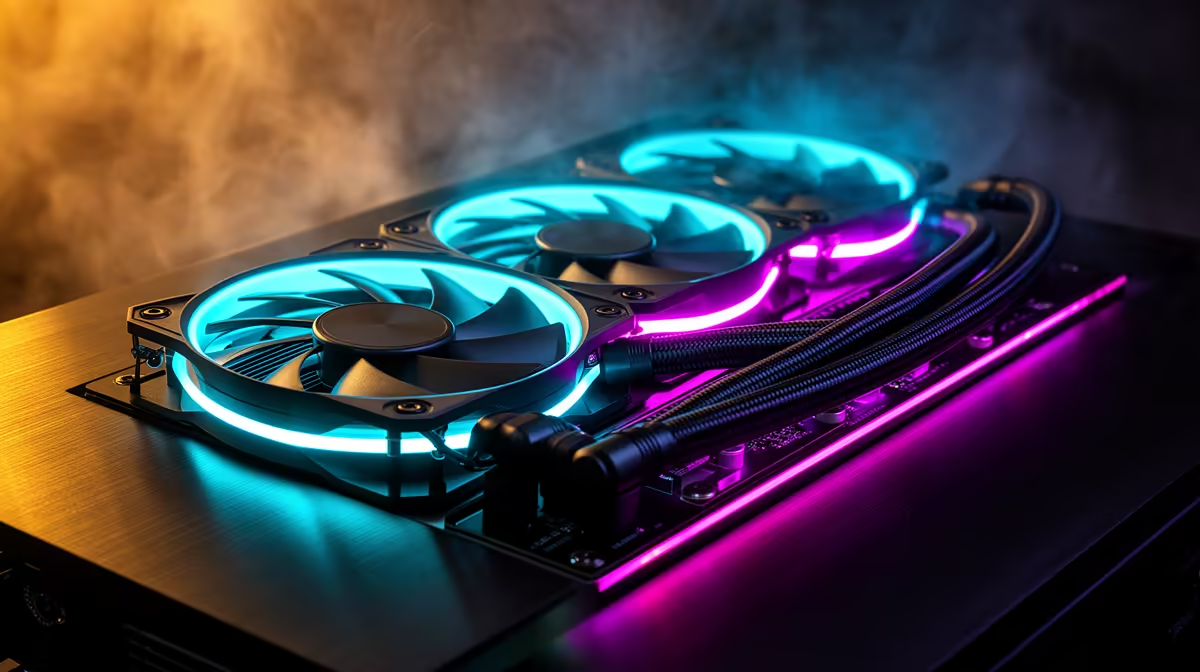
Daisy-chaining passes the ARGB signal from one fan to the next through a secondary connector on the fan body. The first fan connects to the motherboard ARGB header; subsequent fans connect to the outgoing port on the previous fan in the chain. The result is a single-header ARGB chain of two to three fans without any signal degradation or reduction in addressability.
This matters for complex builds. A standard mid-tower with an AIO and three case fans requires five ARGB headers if no fans are chained. Most ASUS B650, MSI B850, and Gigabyte B850 boards provide two to four 5V 3-pin headers onboard. Without daisy-chaining, you run out of headers quickly and need an ARGB hub at R250 to R400, plus another cable to manage. With daisy-chainable AIO fans, three radiator fans occupy one header, halving the header demand from the cooling solution alone.
Comparing Daisy-Chain Models in SA 💰
Among 360mm AIOs stocked at Evetech, the ASUS Prime LC 360 ARGB ships with three daisy-chainable fans all connectable through one ARGB header. Corsair iCUE H150i Elite models use a daisy-chain or hub system reducing header count similarly. Models without this feature require separate header connections or an add-in hub.
The price premium for daisy-chain capability is typically R200 to R500 over a comparable model without it, concentrated in the R2,800 to R3,800 bracket. For a build where cable management and header conservation matter, this premium is worth paying.
When to Skip Daisy-Chaining 🔧
Daisy-chaining is unnecessary if your motherboard has a dedicated ARGB fan hub, if you are using an independent RGB controller hub already, or if your build only includes the AIO fans and no other ARGB components.
For a straightforward gaming build with a Ryzen 7 9700X, a B650 board, and minimal ARGB, a non-daisy-chain AIO is perfectly functional and may allow you to save R300 to R400 toward faster storage or additional RAM instead.
Label ARGB Connectors Before Cable Management ⚡
Before routing and tying cables after installation, label each ARGB connector with a small cable tie tag indicating which device it serves. Daisy-chained fans are particularly easy to confuse with case fan connectors in the tight space behind the motherboard tray. Clear labelling saves time if you ever need to reconfigure or replace a single fan later.
FAQ
Do daisy-chainable fans affect ARGB lighting quality?
No. Each fan in a daisy chain receives the full 5V ARGB signal with complete addressability. The last fan in a three-fan chain shows identical lighting behaviour to the first fan directly connected to the header.
Can I mix daisy-chainable and non-chainable fans in the same build?
Yes. Non-chainable fans connect to their own header or a hub port. You can run a daisy-chained AIO set on one header and individual case fans on separate headers without any conflict.
What if I still run out of ARGB headers even with daisy-chaining?
A 5V ARGB hub at R250 to R400 locally expands a single header into six to eight individual ports. This is the standard solution for complex ARGB builds and works with any vendor's ecosystem as long as the hub uses the standard 5V 3-pin specification.
Building a multi-ARGB gaming PC and need a cooler with smart wiring?
Evetech stocks AIO liquid coolers with daisy-chainable ARGB fans that simplify cable management on builds with multiple lighting zones.