Quick Answer
Yes, if you are pairing a high-TDP processor like a Ryzen 9 9950X, Core Ultra 9 285K, or any Threadripper chip with sustained workloads. A 420mm AIO provides roughly 35% more radiator surface than a 280mm unit, translating to 5 to 10 degrees Celsius lower CPU temperatures at equivalent fan speeds in South Africa's warm ambient conditions.
When 420mm AIO Support Genuinely Matters 🌡️
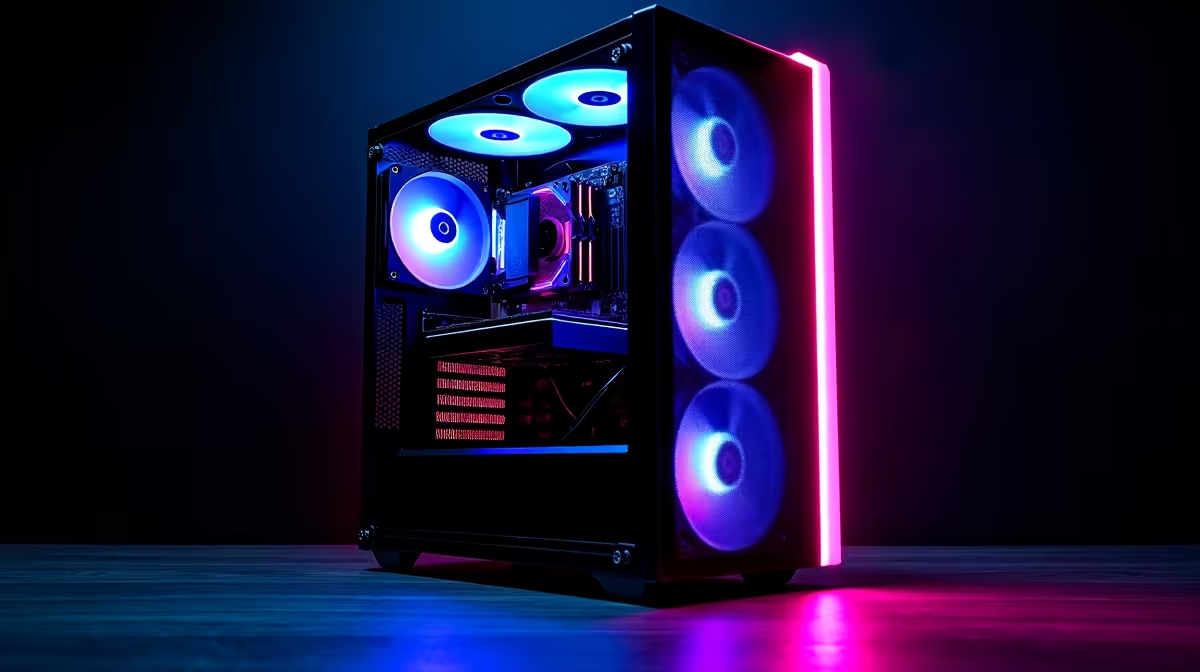
The case feature of 420mm AIO support only matters if you plan to use a 420mm cooler (a 3x140mm radiator configuration). This size is best suited to CPUs with thermal design power above 125W under sustained load. For a Ryzen 7 9800X3D running gaming workloads (bursty rather than sustained), a 360mm or 280mm AIO is adequate. For a Ryzen 9 9950X running Blender renders or video encoding for hours, the 420mm radiator's additional surface area keeps coolant temperatures lower and allows fans to operate at quieter speeds. In SA's summer months, add 8 to 12 degrees to whatever CPU temperature a European reviewer measured, making 420mm support a practical necessity in a hot climate.
Mounting Position Matters as Much as Size 🔧
A case that supports 420mm radiators but only in the top position performs differently from one that accommodates 420mm at the front. Top-mounted radiators exhaust heated coolant upward, efficient for cases with high airflow through the front. Front-mounted 420mm radiators draw fresh room-temperature air directly through the radiator first, generally yielding 3 to 5 degrees Celsius lower CPU temperatures than top mounting. If the case offers both positions, front mounting is thermally superior. The trade-off is that a front-mounted 420mm radiator consumes the entire front intake bay, leaving no room for independent intake fans. For SA builders wanting both radiator intake and GPU airflow, a top-rear-front combination with the 420mm at the top is often the more flexible configuration.
Compatibility Checklist Before Committing 📋
Before selecting a case based on 420mm AIO support, run through: RAM height versus radiator bracket clearance (DDR5 premium sticks can be 52mm tall), VRM heatsink protrusion versus radiator fan depth, tubing routing without sharp bends, and total case depth needed to avoid GPU-radiator conflicts. A build combining a 420mm top AIO and a 440mm GPU in an E-ATX case needs at least 500mm internal depth and 240mm internal width. Cases in the R2,800 to R4,500 range in South Africa generally cover this specification envelope.
Burp Your AIO After Installation ⚡
After mounting a 420mm AIO, power the system on and tilt the case gently from side to side for 30 seconds to dislodge trapped air from radiator channels. Run the pump at 100% speed via BIOS for 15 minutes during the first boot session to eliminate pump gurgling and ensure full cooling performance from day one.
FAQ
Is a 420mm AIO significantly louder than a 360mm unit?
Not meaningfully. Because the 420mm radiator dissipates heat across more surface area, its fans can run at lower RPM for the same thermal output, making it typically quieter than smaller units at comparable CPU temperatures.
Can I use a 420mm AIO in a mid-tower case?
Only in mid-tower cases that explicitly list 420mm radiator support. Most standard mid-towers cap out at 360mm. Cases that do support 420mm in a mid-tower form factor are typically oversized mid-towers and are often the better choice for E-ATX builds.
How much does a good 420mm AIO cost in South Africa?
Quality 420mm AIOs from established brands are stocked at Evetech in the R2,200 to R4,000 range. The cooling performance difference between mid-range and flagship 420mm AIOs is smaller than the price difference, making mid-range options strong value for most SA builders.
Building a high-TDP system and need a case that fits a 420mm AIO?
Evetech stocks a wide selection of AIO-compatible cases and 420mm liquid coolers. Browse the case and cooling ranges to put together a thermally capable build.