Every CPU generation arrives with the same trap: a tempting next-gen part on the horizon, and the nagging feeling that buying today means buying something already half-obsolete. Right now that next part is Intel's Nova Lake, and the honest answer for most builders is that waiting for Nova Lake rarely pays off. Nova Lake is not expected until late 2026, it needs a new platform, and current processors deliver strong performance for gaming and creation today. For the great majority of buyers, the buy-now case is the solid one.
Quick Answer
Buy now. Nova Lake is not due until late 2026 and requires a new motherboard socket, so waiting means months without a working machine and a full platform cost when it lands. Current Intel and AMD CPUs already handle gaming and creative workloads comfortably, making them the sensible choice unless you specifically need a brand-new build in late 2026 anyway.
What Nova Lake Actually Is, and When
Nova Lake is Intel's planned next desktop architecture, the follow-up to the current Core Ultra line. The expectation is a notable jump in core counts and efficiency, but two facts shape the decision more than the performance promise.
First, timing. Nova Lake is not expected on shelves until late 2026 at the earliest. A roadmap slip of a quarter or two is common in this space, so "late 2026" can easily become early 2027 in practice.
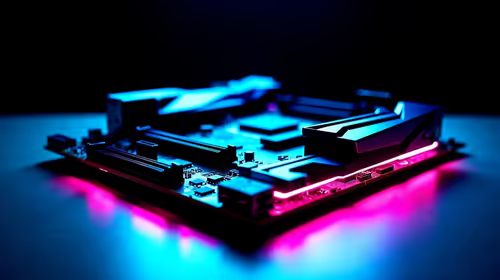
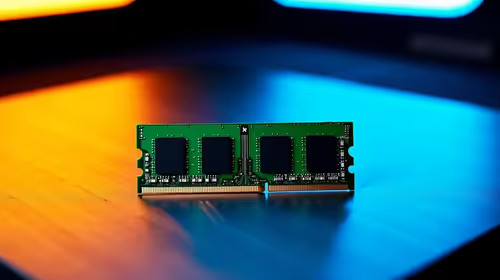
Second, the platform. Nova Lake is expected to use a new socket rather than dropping into today's boards. That means a new motherboard and, very likely, a fresh round of memory, on top of the chip itself.
The processors that are actually in stock and ready to build are gathered in the Intel CPU range at Evetech, and those are what your decision really comes down to.
The Real Cost of Waiting
"Waiting" sounds free, but it carries three concrete costs that the spec headlines hide.
Months Without the Machine
If you need a PC now, for work, study, streaming or gaming, waiting until late 2026 means going without for the better part of a year, or limping along on ageing hardware. That lost time has real value, and no future chip refunds it.
A Full Platform Bill, Not Just a Chip
Because Nova Lake is expected to need a new socket, the upgrade is not a simple drop-in. You are buying the CPU, a new motherboard and quite possibly new memory together. A current-platform build today, by contrast, often leaves a clear upgrade path on the same socket later. That changes the maths considerably.
Early-Adopter Tax
New platforms launch at a premium. Motherboards are expensive at release, memory support is still maturing, and prices ease only months later as supply settles. Buying at launch usually means paying the most for the least-refined version of the platform.
What Current CPUs Already Deliver
The case for buying now rests on a simple truth: today's processors are not a compromise. A current mid-range to high-end CPU handles modern gaming at high frame rates, runs creative tools like video editing and 3D work smoothly, and multitasks heavy workloads without strain.
For gaming specifically, the graphics card matters far more than the CPU once you are past the mid-range. Pairing a current processor with a strong GPU gets you frame rates that a Nova Lake chip would barely improve in most games, because the bottleneck is the GPU, not the CPU. Spending the upgrade budget on graphics rather than waiting for a new CPU socket is the better-value move for a gamer.
Who Should Actually Wait
Waiting is defensible in a few narrow cases. If your current PC is working perfectly well and you have no pressing need, there is no harm in holding out to see what late 2026 brings. If you are a professional running CPU-bound workloads such as heavy code compilation, large simulations or high-core-count rendering, where the extra cores Nova Lake may bring would directly speed up paid work, the wait can justify itself.
And if you happen to be planning a brand-new build for late 2026 anyway, around your own timeline rather than the chip's, then naturally you would build on whatever is current then. The point is to let your need drive the timing, not the roadmap.
How to Decide in Practice
Strip it back to one question: do you need or want a better PC in the next several months? If yes, buy now, because a current CPU serves you well today and waiting only costs you time and money. If you genuinely do not need anything until late 2026, then there is no decision to make, you simply buy what is current when the time comes.
For anyone building today, a complete current-generation machine is often the cleaner choice than sourcing parts piecemeal, and the PC best sellers range is a quick way to see well-balanced builds that pair a strong CPU with the right GPU.
Frequently Asked Questions
When is Intel Nova Lake actually coming out?
Nova Lake is expected in late 2026 at the earliest, and roadmap slips are common, so it could land later. That is a long time to wait if you need a machine now.
Will Nova Lake use my current motherboard?
It is expected to require a new socket, which means a new motherboard and likely new memory rather than a simple chip swap. That makes the upgrade a full platform cost, not just a CPU purchase.
Is a current CPU good enough for gaming in 2026?
Yes. A current mid-range to high-end CPU runs modern games at high frame rates, and for gaming the graphics card matters more than the processor once you are past the mid-range. Spending on a strong GPU beats waiting for a new CPU socket.
Should I wait if I do heavy rendering or compiling?
Possibly. If your paid work is genuinely CPU-bound and would benefit from higher core counts, the wait can be justified. For gaming and general creative use, current chips are already strong, so buying now makes more sense.
Will buying now leave me an upgrade path?
Often, yes. Current platforms frequently support a later CPU upgrade on the same socket, whereas jumping to Nova Lake means a fresh board and memory. That on-socket headroom is part of why buying now is the value play.
Do not put your build on hold for a chip a year away. Compare in-stock processors in the Intel CPU range at Evetech and balanced complete builds in the PC best sellers, then put any spare budget toward a stronger graphics card.