Holding off on a PC purchase because something newer is coming is usually sensible. Waiting for Windows 12 is the exception, because there is nothing concrete to wait for. Microsoft has not announced it, has not confirmed a release date, and has not published system requirements. Meanwhile the clock on Windows 10 security is ticking down to a hard date, which flips the maths: every month spent waiting is a month of exposure with no payoff.
Quick Answer
Do not wait. Windows 12 has no confirmed release date and remains rumour, while Windows 10's Extended Security Updates programme ends on 13 October 2026, after which there are no more security patches. Upgrading to a Windows 11 machine now is the safe call for South African buyers.
The dates that actually matter
Windows 10 reached the end of standard support on 14 October 2025. The only thing keeping it patched since then is the Extended Security Updates (ESU) programme, and that lifeline expires on 13 October 2026. After that date a Windows 10 PC stops receiving critical security fixes entirely, which is exactly when an ageing, internet-connected machine becomes a liability rather than a convenience.
Set that against Windows 12, which Microsoft has not officially announced at all. Credible speculation points to a possible reveal in mid-2026 and a public release somewhere in late 2026 or even 2027, but none of that is confirmed and release windows slip. Planning a purchase around an unannounced product with a moving date is not really planning.
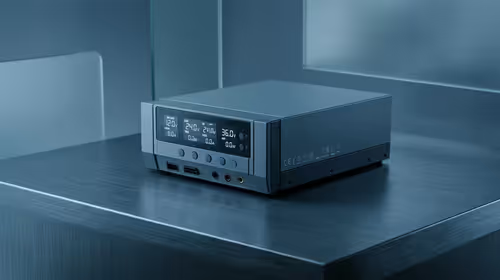
If a compact, low-power machine fits your space, the mini PCs range at Evetech is a tidy way to land on a current, supported Windows 11 setup.
Why Windows 11 is the right destination today
Windows 11 is the mature, supported platform right now, and Microsoft has committed to supporting it until October 2031. That gives you years of patches and feature updates on a machine bought today, with no urgency to leap to Windows 12 the moment it appears.
What about getting Windows 12 free later?
When a major Windows version does land, eligible newer PCs have historically been offered the upgrade at no cost. A Windows 11 machine bought now is far more likely to meet future hardware requirements than a Windows 10 PC limping along on borrowed time. In practice, buying current hardware today is the better position from which to take Windows 12 later, not a worse one.
The hidden cost of waiting
Beyond security, an unsupported OS gradually loses compatibility. New software and drivers stop targeting it, and some services begin refusing to run on it. The slow degradation is easy to ignore until something you rely on breaks.
What Windows 12 rumours actually say
The consistent pattern in credible leaks is that Windows 12 will lean heavily on AI features built around a new class of hardware called NPUs (Neural Processing Units). Chips from Intel, AMD and Qualcomm released from 2023 onward include dedicated NPU blocks specifically for this. If Windows 12 does ship and does tie its best features to NPU-capable silicon, a machine bought now with a current Intel Core Ultra, AMD Ryzen AI or Qualcomm Snapdragon processor is well-positioned to take advantage of it.
An older Windows 10 machine almost certainly lacks an NPU entirely. Waiting on that hardware for a Windows 12 version that might deliver its AI features only to NPU-equipped machines makes the maths even worse: you wait, then buy, and you are still behind the hardware curve.
Microsoft confirmed at Build 2026 that Windows 12 is not being launched at that event, and the company's recent internal focus has been a quality-improvement push under Windows 11 rather than a new version number. The safest summary is that Windows 12 remains unannounced, undated, and may not even arrive as a traditional named release.
What staying on Windows 10 actually costs
ESU is not free by default. The consumer free path requires linking your device to a Microsoft account and meeting certain conditions. For businesses, Microsoft charges per device per year, and the price increases each year of the programme. Small businesses with multiple machines face a meaningful ongoing bill for extended patches on hardware that remains stuck at Windows 10.
More important than the ESU cost is the opportunity cost of delay. Each month on an ageing Windows 10 machine is a month without Windows 11's performance improvements, the refreshed interface, improved gaming features via DirectStorage and Auto HDR on compatible screens, and access to newer AI-assisted features being added progressively under Windows 11. Waiting for a theoretical Windows 12 also means missing roughly 12 to 18 months of Windows 11 maturity improvements that make it a more stable, polished platform than at launch.
Who this applies to
This is most pressing for anyone still on Windows 10 hardware. If your current PC already runs Windows 11 and meets the requirements, you genuinely can sit tight, there is no benefit to early-adopting Windows 12 on day one. The decision only forces itself on machines that cannot move past Windows 10, which is precisely the group most tempted to wait. The best-selling PCs at Evetech gives you a real sense of what current Windows 11 machines cost before the ESU deadline arrives.
Frequently Asked Questions
When is Windows 12 coming out?
Microsoft has not officially announced Windows 12 or given a release date. Speculation suggests a possible reveal in mid-2026 and release in late 2026 or 2027, but this is unconfirmed and subject to change.
When does Windows 10 stop getting security updates?
Standard support ended on 14 October 2025. The Extended Security Updates programme then carries critical patches through to 13 October 2026, after which Windows 10 receives no further security updates.
Should I upgrade to Windows 11 or wait for Windows 12?
Upgrade to Windows 11. It is supported until October 2031, available now, and removes the security risk of an unpatched OS. There is no benefit in waiting for an unannounced version with no confirmed date.
Will my new Windows 11 PC be able to run Windows 12?
A current machine that meets Windows 11 requirements is far better placed for any future Windows 12 requirements than an older Windows 10 PC. Buying current hardware now improves, rather than harms, your position for a later upgrade.
Is it safe to keep using Windows 10 after the deadline?
Once ESU ends on 13 October 2026, no further security patches arrive, so newly discovered vulnerabilities stay open. For an internet-connected PC that is a real risk, which is the core reason not to wait.
Get onto a current, supported platform before the Windows 10 deadline rather than gambling on an unannounced OS. Compare compact, ready-to-run options in the mini PCs range at Evetech.