Quick Answer
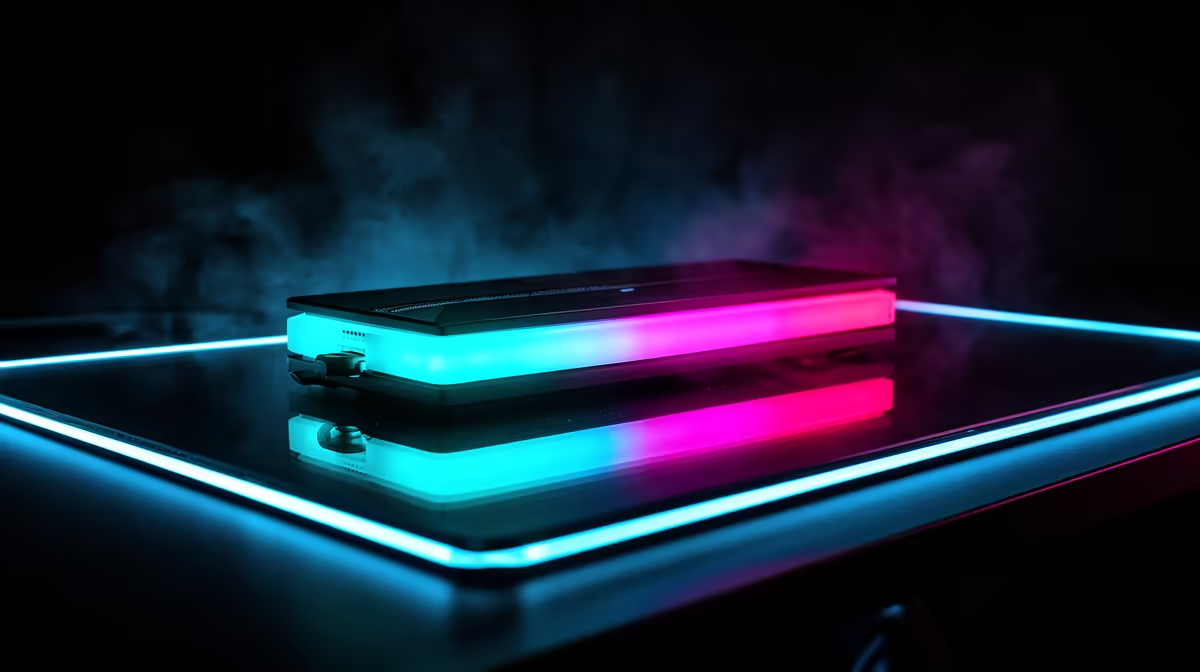
A static white overhead light and a plain desk lamp produce the most boring gaming ambiance possible. Switching to a modular panel system with 70 customisable effects solves this by layering colour, motion, and reactive behaviour across your wall space, transforming a flat-looking gaming corner into an immersive visual environment that complements your setup.
Why Static Lighting Kills Gaming Atmosphere 🎮
Human vision is highly attuned to contrast and motion. A room lit uniformly from above strips all depth from a gaming setup, making even an expensive battlestation look like a work cubicle. The monitor becomes the only source of colour and movement, which increases perceived eye strain during long sessions because your eyes constantly adapt between the bright screen and the flat neutral background. Adding ambient coloured light at eye level reduces this strain by raising the brightness floor of the surrounding environment and adding visual texture that your peripheral vision can relax into. This is why professional streamers and content creators invest in background lighting even before upgrading monitors or chairs.
How 70 Effects Address Different Gaming Scenarios 🌈
A 70-effect library makes sense when you map effects to real gaming use cases. Static deep red or purple for a late-night RPG session, slow ocean-wave blue for a calm exploration game, fast rainbow pulse for a rhythm or racing game, warm amber for a cosy management sim, and music-reactive mode for a high-energy shooter playlist. The 70 number typically includes speed variations and colour palette variants of eight to twelve base effect types. The practical approach is building a shortlist of four to six scenes you actually use and saving them as favourites in the app for one-tap switching rather than cycling through the full list mid-session.
Making the Leap from Boring to Immersive 💡
The upgrade from a dull gaming room to a genuinely immersive one does not require a full room renovation. A five to seven panel hexagon kit in the R500 to R900 range mounted at the wall behind or beside your monitor is the starting point. Set a slow-breathing deep blue or purple as the default scene. Add a second scene for music or gaming reaction. Within one session you will feel the difference. SA gamers in compact rooms find that even a small panel cluster at desk height transforms the perceived size of the room by adding visual depth to a flat wall. Mounting panels on the adjacent side wall creates a wrap-around effect especially effective at low brightness.
Scene Variety Without Overwhelm Tip ⚡
a rotation of three scenes: one for focused work (warm amber, static, 40 percent brightness), one for casual gaming (slow blue or purple wave, 60 percent brightness), and one for high-energy sessions (music sync, full brightness). Three scenes cover 90 percent of actual use cases and are easier to switch between quickly than navigating a 70-item list mid-session.
FAQ
How many effects do most people actually use regularly?
Smart lighting platform usage data suggests most users settle on three to five saved scenes for regular use regardless of the total effect library size. The 70-effect count matters primarily for initial exploration and finding niche effects that suit specific moods or games.
Do more effects mean the controller is more powerful?
Not necessarily. Effect count is a software and firmware feature. What matters more for performance is per-panel colour depth and scene switching latency, not the size of the preset library.
Can I create custom effects beyond the 70 presets?
On most mid-range and premium systems, yes. The custom scene builder allows you to assign per-panel colours and animation settings, effectively creating your own effects saved alongside the preset library in up to 10 to 20 user slots.
Tired of a flat, uninspiring gaming room?
Evetech stocks modular RGB panel systems with extensive effect libraries to transform your gaming space from plain to immersive in under 30 minutes.