You're live. The final circle is closing in, your squad is counting on you, and the chat is buzzing. Then it happens... "Lags!" "Robot voice!" Your stream starts dropping frames, turning your epic win into a pixelated mess. For local creators, this kind of streaming troubleshooting in South Africa is an all-too-common headache. But don't stress, boet. By gear and software settings you can fix right now. 🔧
Diagnosing Common Streaming Issues in SA
Before you blame your ISP, let's look at the three pillars of a smooth stream: your video, your audio, and your connection. A problem in one area can ruin the entire broadcast. Effective streaming troubleshooting starts with isolating the problem. Is your game lagging, or just the stream output? Are viewers complaining about your voice, or the game audio? Pinpointing the source is half the battle. Let's break down the most frequent culprits and how to solve them.
Troubleshooting Your Video Quality
A crisp, clear picture keeps viewers engaged. When it falters, it's usually down to either your camera and lighting, or your PC struggling to keep up.
Fixing Choppy Streams & Dropped Frames
Dropped frames happen when your PC can't render the game and encode your video stream simultaneously. Your CPU is likely taking a beating.
- Lower In-Game Graphics: Shave a bit off shadows or anti-aliasing. This frees up resources for the stream encoder.
- Use a Hardware Encoder: If you have a modern NVIDIA or AMD graphics card, use the NVENC or AMF encoder in OBS/Streamlabs. This takes the load off your CPU.
- Check Your Camera: Sometimes, the issue is a low-quality sensor struggling in less-than-ideal light. Upgrading to a quality HD webcam designed for content creation provides a much cleaner source signal for your software to work with.
Eliminating Grainy & Dark Video
Your R30,000 camera can look like a potato if your lighting is poor. The secret isn't just brightness; it's about control. A simple three-point lighting setup (key, fill, and back light) can make you look like a pro. Even better, investing in dynamic lighting kits from brands like Cololight gives you complete control over the colour and mood of your space, ensuring your camera's sensor has enough light to produce a sharp, noise-free image. ✨
Silencing Annoying Audio Problems 🎤
Bad audio is the number one reason viewers click away. It's more jarring than a few dropped frames. If your audience complains about crackling, static, or robotic sounds, it's time for some serious audio troubleshooting.
Often, the problem is a poorly configured microphone or a cheap headset mic picking up every background hum and keyboard clack. While software can help, nothing beats a solid hardware foundation. Upgrading to professional gear from CORSAIR, like a dedicated USB or XLR microphone, provides the vocal clarity your audience deserves. This is a vital step in your South Africa streaming journey.
OBS Audio Pro Tip ⚡
Use a "Noise Gate" filter on your microphone source in OBS. Set the "Close Threshold" just above your ambient room noise (like your PC fans) and the "Open Threshold" just below your normal speaking voice. This will automatically mute your mic when you aren't talking, cutting out background hiss and keyboard sounds instantly.
Stabilising Your Stream Connection
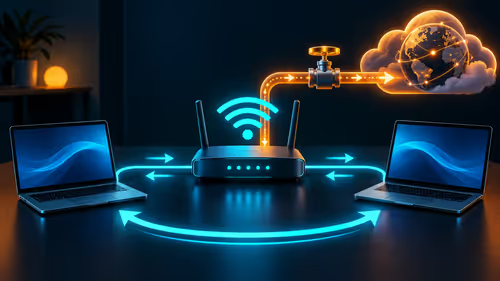
Okay, sometimes it is the connection. But you can still optimise it. The golden rule of streaming troubleshooting in South Africa: never stream on Wi-Fi if you can help it. A physical LAN cable provides a stable, consistent connection that Wi-Fi can't match.
Next, check your bitrate in your streaming software. Don't just copy a top international streamer's settings. Run a speed test to check your upload speed. A good rule of thumb is to set your video bitrate to no more than 75% of your stable upload speed. For Twitch, using the Johannesburg server is also a must for local streamers. A stable stream relies on every part of your setup working in harmony, which is why having a complete setup of streaming essentials is so crucial for success. 🚀
Ready to Go Pro?
Fixing issues is one thing, but upgrading your gear is the best way to prevent them from happening in the first place. Stop troubleshooting and start creating. Explore our massive range of streaming gear and build the reliable, high-quality setup your content deserves.