Quick Answer
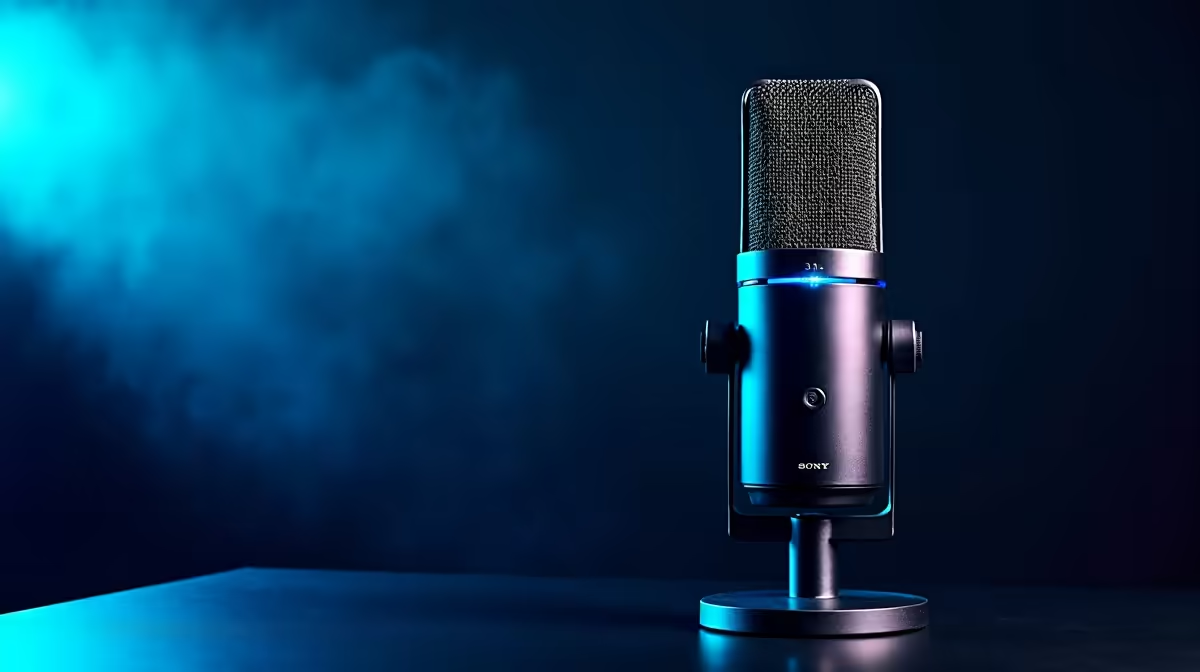
For engineering students recording lab explainers, group project demos and remote vivas, a USB cardioid mic like the RODE NT-USB or HyperX QuadCast S (about R1,800 to R3,500 at Evetech) is the right buy. It delivers intelligible voice capture over technical narration without an XLR rig.
Clear Speech Is The Whole Job
Engineering recordings are usually you explaining a circuit, a MATLAB model or a CAD assembly, so speech clarity is everything. A laptop mic buries your voice in room reflections and fan noise; a cardioid USB mic isolates it. A RODE NT-USB at around R2,500 to R3,500 gives a clean, neutral sound, while a FIFINE A8 at roughly R1,200 is the budget option that still beats the laptop comfortably. All connect over USB, so there is nothing to configure beyond selecting the device.
Setup For Demos And Remote Vivas
Place the mic a fist's width from your mouth, slightly off-axis, with a pop filter to tame plosives on words like 'pressure' and 'power'. Record at 48kHz to match video, and for a remote viva set the mic as your default in Teams or Zoom. A cardioid pattern keeps a noisy lab or shared res out of the recording. The XLR-plus-interface route only makes sense if you also record group panels, which most coursework does not need.
FAQ
What mic suits engineering lab recordings?
A cardioid USB mic such as the RODE NT-USB or HyperX QuadCast S. It captures clear technical narration, rejects room and fan noise, and plugs straight into USB with no interface to manage.
Is the built-in laptop mic good enough for a viva?
Usually not. Laptop mics pick up the room and the laptop's own fans, muddying speech. A cardioid USB mic placed close to your mouth makes you noticeably clearer for examiners on a remote call.
Cardioid or omnidirectional for solo recording?
Cardioid. It captures your voice from the front and rejects the sides and rear, so a noisy lab or shared space stays out of the recording. Omnidirectional only suits capturing a group around a table.
For solo lab explainers and remote vivas, a cardioid USB mic is enough; set it as your default device in Teams or Zoom and record a test clip before submitting.