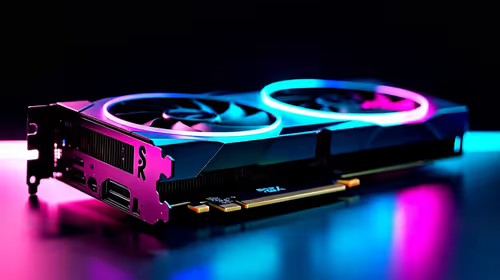
The RTX A1000 uses NVIDIA Ampere architecture with 2304 CUDA cores, 8GB GDDR6 and a 128-bit memory interface. It costs R12,099 in South Africa. A useful NVIDIA RTX A1000 guide explains what each figure means, where it may matter and which questions still require an application test.
Quick Answer
The RTX A1000 is a low-profile single-slot Ampere card with 2,304 CUDA, 18 RT and 72 Tensor cores, 8GB GDDR6, 192GB/sec bandwidth and 50W maximum power.
PNY's RTX A1000 is an Ampere workstation card priced at R12,099. Compute comes from 2304 CUDA cores. The memory subsystem pairs 8GB GDDR6 with a 128-bit interface. CAD, rendering, editing and AI still require their own workload evidence.
🧭 The complete specification in context
The architecture is NVIDIA Ampere. Architecture identifies the GPU design generation and provides context for the resources implemented on the card. It should not be read as a performance result, because applications, settings and the rest of the workstation determine how a task behaves.
The compute count is 2304 CUDA cores. CUDA-capable software may distribute suitable work across these processing elements. The important word is "may": the application and the specific operation need to support the CUDA path. A modelling viewport, a batch render and a video output can exercise hardware differently inside one software suite.
Graphics memory is 8GB GDDR6. Capacity describes the working space available for graphics data, while GDDR6 identifies the memory type. Large geometry, textures, frames and other assets can affect practical demand. Eight gigabytes may fit one production project and constrain another.
A 128-bit figure describes the memory interface. It is not another capacity measurement and cannot be converted into a performance prediction without other information. Keeping capacity, memory type and interface width separate prevents one of the most common specification-reading mistakes.
🧭 How the resources interact
Compute and memory solve related but distinct problems. A supported rendering operation may use the 2304 CUDA cores, yet its scene data still needs practical space in the 8GB memory capacity. Conversely, a project can fit comfortably while the accelerated operation remains compute-limited or waits on another component.
Ampere ties the design together, but the architecture name does not override application support. Confirm that the current software version recognises the GPU and enables the required feature. If the program uses the CPU for a key stage, spare CUDA capacity does not automatically move that work.
The 128-bit interface forms one piece of the memory subsystem. Bus width deserves attention when comparing complete cards, but wider is not a purchasing objective on its own. The relevant goal is a card that completes the required file correctly and within an acceptable time.
Compare complete configurations through Evetech's range of workstation graphics cards. Keep the same project and software requirement beside each option, otherwise the feature review becomes a contest between unrelated numbers.
🧭 Professional use cases need separate tests
For CAD, reproduce the largest regular model and the interaction that affects daily work. Confirm hardware guidance, device selection and the visual mode used in production. A CAD viewport result does not automatically predict renderer behaviour.
For 3D rendering, record the renderer version, selected device, scene, output resolution and settings. Check whether the scene fits within 8GB and whether the chosen mode uses CUDA. Time scene preparation separately from the render so a CPU or storage delay is not attributed to the graphics card.
Video editors should test a normal timeline with the required codec, resolution, effects and final output. Playback and export may use different hardware paths. Observe GPU memory, CPU, system RAM and storage together while keeping quality fixed.
AI-assisted professional tools add another support layer. A model or feature may have specific framework, GPU and capacity needs. Evetech's AI PC collection lets buyers compare complete systems when the project calls for more than a graphics-card change.
🧭 Buying the A1000 at R12,099
The PNY RTX A1000 costs R12,099. Value depends on whether its 8GB capacity, 2304 CUDA cores, Ampere design and 128-bit interface solve a documented requirement.
Before installation, confirm physical dimensions, power needs, connectors and platform compatibility directly. None of those details follows from the compute or memory figures. A card can match the workload on paper and still need a separate fit check.
Build a two-file trial: one typical project and one difficult recurring project. Record the original workstation, application version, settings, elapsed time and output. Run the same trial after the change. A purchase earns its value when the measured task improves without creating instability or compromising deliverables.
A practical evaluation sequence
First, list mandatory software and features. Second, estimate graphics-memory demand from real projects. Third, identify operations that can use CUDA. Fourth, confirm the physical and platform checks. Finally, attach the R12,099 price to the problem being solved.
Reject any conclusion built from one number. A core count without application support, memory without project context or price without a pass condition cannot answer the buying question. The complete configuration and a controlled test belong together. That distinction matters when teams run projects of very different sizes.
Retain the test notes for future upgrades. If software changes or files grow, repeat the same sequence. This keeps the A1000 decision current instead of treating today's result as permanent.
Maintain a card-specific evidence file
Create one team note containing the workstation configuration, software versions, test projects and results used for the A1000 decision. Keep product specifications separate from measured application outcomes so future reviewers can see which results may change with software.
Add physical installation details after they are checked on the actual system. When a driver, application or project changes, rerun only the affected test and date the result. This makes the guide operational for the team instead of a once-off purchase explanation.
If the card moves to another workstation, begin a new platform section. The same GPU can behave differently when CPU, RAM, storage or project mix changes.
Its host connection is PCI Express 4.0 x8, and four Mini DisplayPort 1.4a outputs can operate as many as four 5K displays. Processing is divided among three ceilings: 6.74 TFLOPS on FP32 operations, 13.2 TFLOPS through RT hardware and 53.8 TFLOPS on the Tensor path. Together, these specifications explain why the card targets CAD, 3D design, engineering and content creation while remaining suitable for compact workstations.
For system planning, the display and power figures deserve equal attention. Four high-resolution outputs can replace an added display card, while the 50W limit reduces the graphics share of a compact workstation's power and thermal budget. The single-slot profile also preserves neighbouring expansion space that a wider board would occupy.
Frequently Asked Questions
What are the RTX A1000 core specifications?
The architecture is NVIDIA Ampere and the CUDA total is 2304. PNY pairs an 8GB GDDR6 capacity with a 128-bit interface, pricing the card at R12,099.
What does the 128-bit figure describe?
It describes the width of the card's memory interface. It is separate from the 8GB capacity and does not state performance alone.
Which professional use cases fit this configuration?
Any use case must first support the GPU and fit its memory and compute resources. CAD, rendering, editing and AI tasks should each be tested independently.
Can this guide replace application testing?
No. Project complexity, software version, settings and other workstation components affect practical results beyond architecture, core count, capacity and interface width.
Which checks belong before installation?
Check exact dimensions, slot clearance, connectors, power and platform compatibility for the card and workstation. Those are physical requirements, not CUDA or VRAM properties.
Ready to evaluate the RTX A1000 as a complete workstation component?
Review Evetech's professional GPU options with a typical project, a difficult project and the software support requirements prepared in advance.