Quick Answer
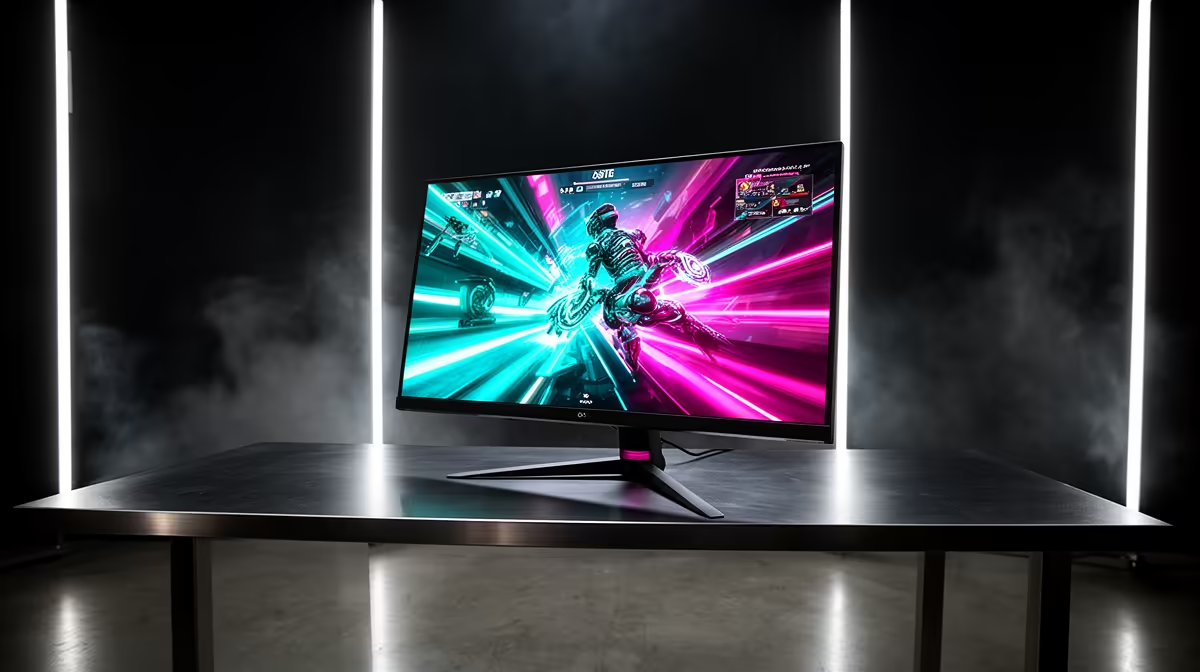
A 300Hz monitor delivers meaningful smoothness improvement over 144Hz for esports, particularly in titles with high frame rates like Valorant, CS2, and Apex Legends. The benefit is most visible during rapid aim movements where reduced motion blur improves crosshair tracking clarity.
The Physics of 300Hz and Why It Helps in Esports 🎮
At 300Hz, the monitor displays a new frame every 3.3 milliseconds. At 144Hz, that interval is 6.9 milliseconds. The shorter frame interval means each image shown to your eye is more recent, reducing the gap between what the game engine computed and what you see.
The improvement is not linear: the step from 60Hz to 144Hz is dramatic, from 144Hz to 240Hz is clearly noticeable, and from 240Hz to 300Hz is real but more subtle. Professional CS2 and Valorant players routinely use 240Hz to 360Hz setups because at their frame rates, typically 300 to 400 fps in those titles, every reduction in frame interval provides a marginal but consistent advantage during high-stakes rounds.
GPU Requirements for Sustained 300Hz Gaming 💻
To use all 300 refreshes per second, your GPU needs to produce at least 300 fps in your target game. In Valorant at 1440p on medium settings, an RTX 5080 comfortably exceeds this. At 1080p, an RTX 5070 Ti does so as well. In CS2 at 1440p on competitive settings, an RTX 5070 or better targets 250 to 300 fps consistently.
For South African builders, the cost equation is relevant: a 300Hz QHD monitor runs R7,000 to R14,000, and the GPU tier needed to drive it properly is R18,000 to R35,000. For a dedicated esports player building a competitive rig, this is a deliberate and worthwhile investment.
Getting the Most from a 300Hz Setup for SA Esports 🏆
Local ping to Johannesburg-based game servers (Riot Games, Valve, EA) matters significantly for the competitive experience. On Vumatel, Frogfoot, or Openserve fibre at 100 Mbps or above, South African players typically see 5ms to 20ms ping to local servers.
In-game settings also matter. Disable V-Sync in the game engine and rely on VRR at the driver level instead.
Reflex or Anti-Lag Before Frame Rate Cap ⚡
In Valorant, enable Nvidia Reflex (or AMD Anti-Lag in supported titles) before worrying about frame rate caps. These technologies reduce render queue depth and cut system latency by 20 to 30 percent in supported games. On a 300Hz setup, the combined effect of Reflex and high refresh rate produces a noticeably snappier feel compared to either feature alone.
FAQ
Do you need 300 fps to benefit from a 300Hz monitor?
No. VRR (G-Sync/FreeSync) means the monitor adapts to your actual frame rate, so 180 fps on a 300Hz panel is still tear-free and smoother than 180 fps on a 144Hz panel with V-Sync. The closer your frame rate is to 300 fps, the more of the monitor's potential you use, but you benefit from VRR at any frame rate within the supported range.
Is 300Hz overkill for most South African gamers?
For casual and RPG-focused gamers, yes. The perceptible difference between 144Hz and 300Hz is most pronounced in fast-paced competitive titles. If you spend more time in open-world or story-driven games where frame rates sit at 60 to 100 fps, a 144Hz or 165Hz monitor is sufficient and leaves budget for a better GPU or higher resolution.
What display technology is best for 300Hz gaming?
Fast IPS at 300Hz offers excellent motion handling and good colour. OLED at 240Hz or 300Hz (where available) offers near-zero response times and better contrast for darker game environments. TN at 360Hz offers the fastest response time but inferior colour and viewing angles.
Ready to step up to a 300Hz competitive setup?
Evetech stocks 300Hz gaming monitors from brands with South African warranty support. Browse the monitors category to find options across 1080p and 1440p at your budget.