Quick Answer
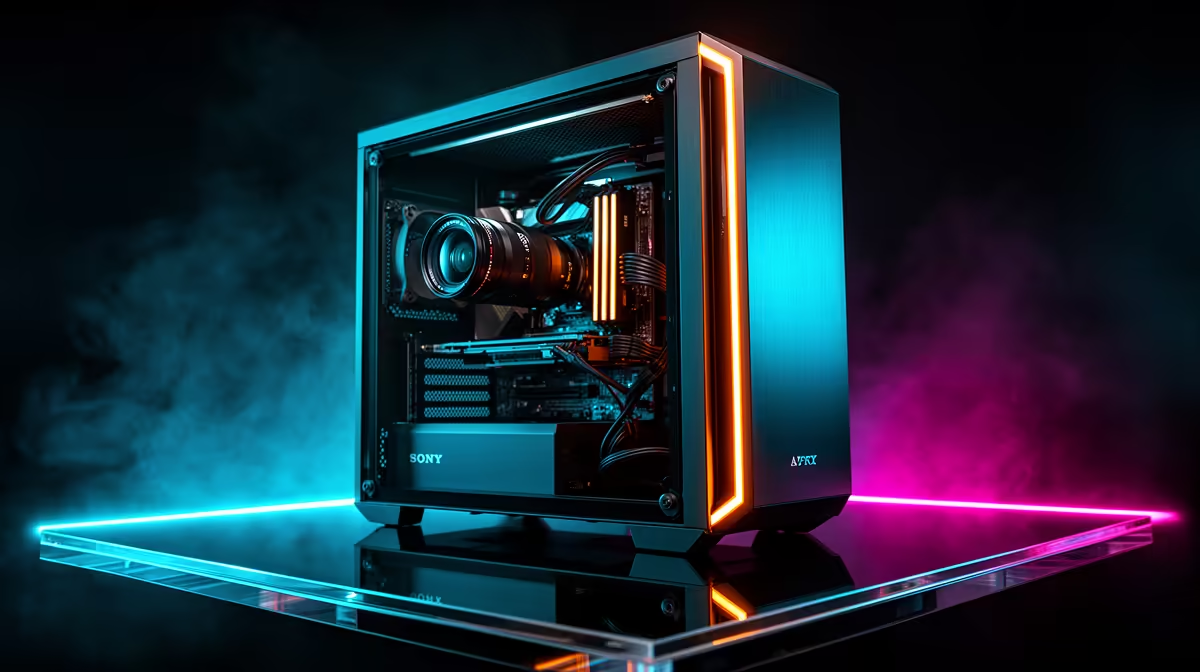
E-ATX cases are full-tower or oversized mid-tower chassis that accommodate motherboards up to 305mm x 330mm, making them the correct choice for HEDT platforms like AMD Threadripper, Intel HEDT, and high-end dual-channel AM5 boards with ten or more VRM phases. Expect to spend R3,500 to R9,000 on a quality E-ATX case locally.
What E-ATX Actually Means and Why It Exists 🖥️
E-ATX (Extended ATX) is not a strict industry standard with one fixed size. Manufacturers loosely define it as any motherboard larger than the 305mm x 244mm ATX specification. Most E-ATX workstation boards run 305mm x 330mm, while some enthusiast designs push to 305mm x 345mm. This extra width accommodates additional PCIe slots, M.2 headers, and wider VRM layouts needed by processors like the AMD Ryzen Threadripper 7970X or Intel Xeon W. If you are pairing an E-ATX board with an RTX 5090 and need PCIe 5.0 bifurcation for multiple NVMe drives, only an E-ATX platform gives you the slot density to do it cleanly.
Key Features to Look for in an E-ATX Gaming Case 🔧
Not every full-tower case supports E-ATX boards. Confirm the motherboard tray width is at least 315mm to clear the extra PCB area. Look for: top radiator support of at least 360mm, front radiator support of 420mm if cooling a Threadripper or extreme GPU stack, at least six fan headers or a built-in PWM fan hub, PSU shroud clearance for modular cables from an 850W to 1,200W unit, and USB-C 20Gbps front I/O for connecting NVMe enclosures and modern peripherals. Cases from Fractal Design (Define 7 XL), Phanteks (Enthoo 719), and Lian Li (PC-011 EVO XL) all meet this bar and are stocked locally.
E-ATX Cases for Workstation Use in South Africa 💡
SA professionals running 3D rendering, video production, or engineering simulation on a HEDT platform often build in the same chassis as gamers but with additional requirements: tool-less drive bays for multiple 3.5-inch HDDs, dust filters on all intakes (Cape Town and Johannesburg construction dust is no joke), and enough internal volume for full cable management when running dual GPU or GPU-plus-compute-card configurations. A well-specced E-ATX workstation case for a Threadripper build landing around R40,000 to R80,000 in total components should have a case budget of at least R5,000 to R7,000 to avoid compromising cooling or expansion options.
Confirm E-ATX Standoff Positions ⚡
Some cases label E-ATX support but only include standoffs for ATX in the box. Before mounting an expensive Threadripper or HEDT board, verify that the extra standoff holes align with your board's mounting pattern. Contact the manufacturer or check user reviews for your exact board model before finalising your case choice.
FAQ
Can I use an ATX case for an E-ATX motherboard if it is a tight fit?
No. Forcing an E-ATX board into an undersized ATX case risks cracking PCB traces near the edge and can block airflow around VRM heatsinks. Always use a case explicitly rated for E-ATX.
What is the weight of a fully built E-ATX system?
A complete E-ATX build with a 420mm radiator, eight drives, and full custom loop can exceed 25 kg. Ensure your desk or rack can handle the load and plan your workspace layout before the system arrives.
Do E-ATX cases cost significantly more than ATX cases in SA?
Yes, typically R1,000 to R3,000 more for equivalent quality. The extra material, wider panels, and larger radiator mounts add manufacturing cost. Budget R4,500 minimum for a quality E-ATX case from a reputable brand stocked locally.
Planning a high-end E-ATX workstation or gaming rig?
Evetech carries a curated range of full-tower E-ATX cases suited for HEDT and workstation builds, with local stock and nationwide delivery.