Quick Answer
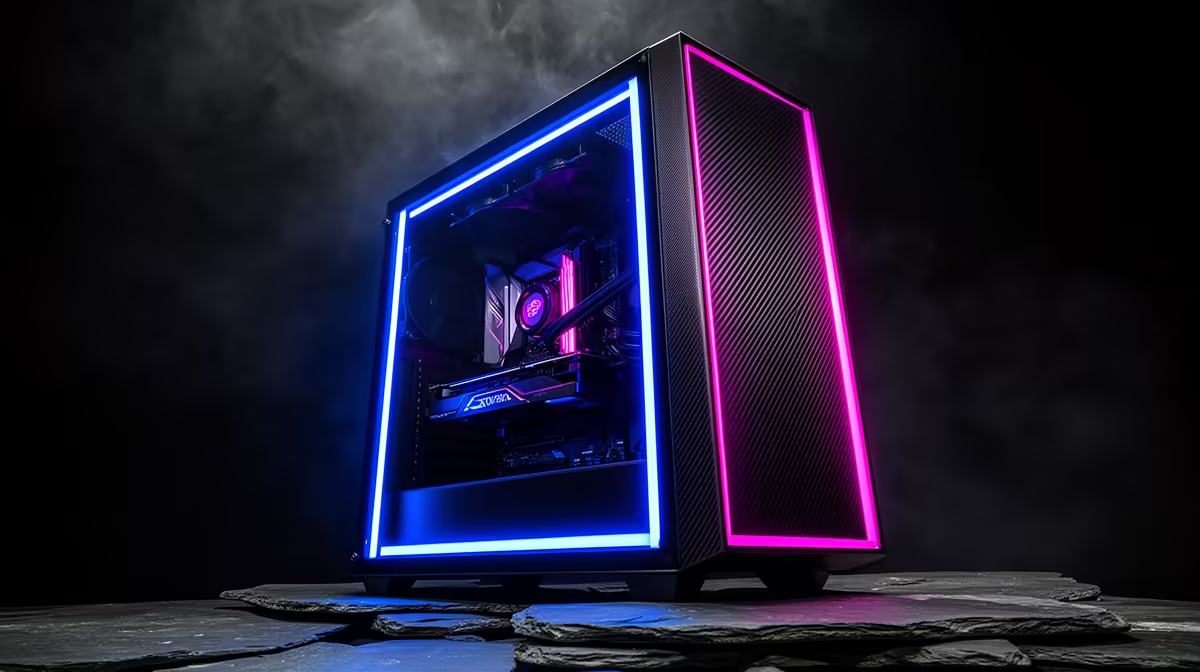
An EATX mid-tower gaming case is the right choice when you are using an extended ATX or XL-ATX motherboard but want a compact chassis that fits on a standard desk. These cases handle 305mm by 330mm boards and typically support 360mm to 420mm radiators and GPUs up to 400mm, making them suitable for flagship builds at R50,000 and above.
What Makes a Genuine EATX Mid-Tower Different 🖥️
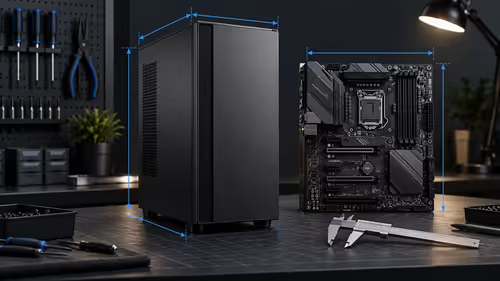
The defining difference between an EATX mid-tower and a standard ATX mid-tower is the motherboard tray width. A standard mid-tower accommodates boards up to 244mm tall (the ATX standard). An EATX tray extends to 330mm or beyond, adding board height that houses additional VRM phases, extra PCIe slots, and more DIMM slots on high-end AM5 or LGA1851 platforms. Despite this extra width, EATX mid-towers maintain external dimensions close to a full-tower: typically 250mm to 280mm wide and 490mm to 540mm tall. In ZAR terms, EATX mid-towers are priced between R2,400 and R4,000, reflecting the structural engineering needed to handle the larger board and extended cable routing.
Cooling Capabilities for High-End Components 🌡️
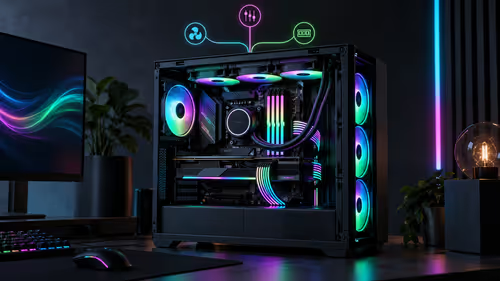
High-end builds using flagship CPUs generate substantial heat. An EATX mid-tower supporting a front 360mm or 420mm radiator keeps CPU temperatures under control even during sustained all-core workloads. Many EATX mid-towers include dual-chamber designs where the PSU and cable management are isolated from the primary airflow path, improving cooling efficiency. GPU clearance sits at 380mm to 420mm, accommodating triple-fan RTX 5080 and RX 9070 XT variants. Fan configuration typically runs three front intake fans plus one rear exhaust pre-installed, with top positions for additional fans when you add a secondary radiator.
Build Quality and Cable Management Standards 🔧
A high-end build with components totalling R50,000 to R90,000 deserves a case that makes assembly and maintenance practical. Quality EATX mid-towers provide at least 30mm of routing space behind the motherboard tray, removable PSU shroud panels, rubber-grommeted cable holes, and a modular drive tray system. Push-latch tempered glass panels, powder-coated interior finishing, and pre-routed Velcro cable management straps indicate genuine build quality. Verify that the case explicitly lists E-ATX or XL-ATX standoff support in its specification table.
Plan Cable Runs Before the Board Goes In ⚡
Route your 24-pin ATX and 8-pin EPS CPU cables through tray grommets before fitting the motherboard. On an EATX board the top EPS connectors sit further from the PSU than on standard ATX. Confirm cable lengths against your EATX board's connector positions; extenders add R150 to R300 if standard lengths fall short.
FAQ
Can I use a standard ATX board in an EATX mid-tower?
Yes. All EATX mid-towers support standard ATX, Micro-ATX, and Mini-ITX boards using the same standoff positions. The extra tray space goes unused but creates no installation problems.
How heavy are EATX mid-tower cases?
Expect 9 kg to 14 kg empty depending on steel thickness and included fans. Full glass and steel construction at the premium end reaches 13 to 15 kg. Factor this into desk placement if your desk has a weight limit.
What is the warranty situation for cases in South Africa?
Most premium case brands stocked at Evetech carry one to two year local warranty through the SA distributor. Keep your proof of purchase and report faults through Evetech's support channel to avoid overseas RMA processes.
Ready to house your high-end platform in a chassis that fits?
Explore Evetech's EATX mid-tower gaming case range and find the right build for your flagship components.