Quick Answer
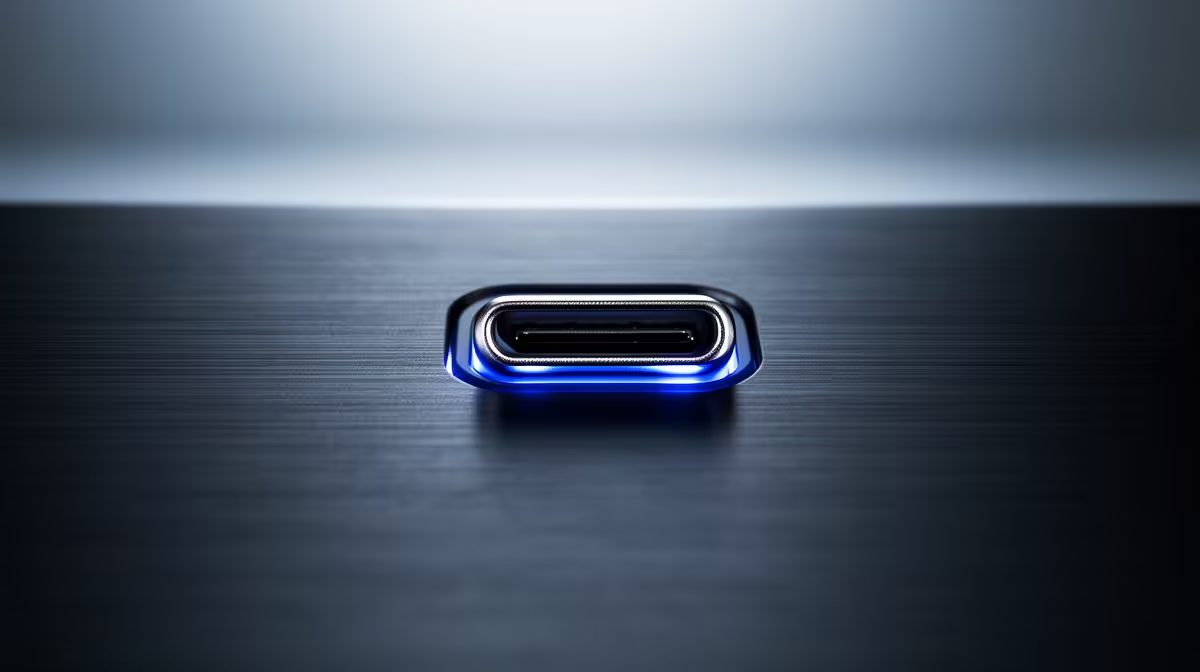
Premium front I/O with USB 20Gbps Type-C means your case's front panel delivers true USB 3.2 Gen 2x2 speeds, capable of 1,800 to 2,000 MB/s transfers with a compatible external NVMe drive. This is the fastest USB specification available on consumer cases today and requires a matching Gen 2x2 internal header on the motherboard plus a 20Gbps-rated external enclosure to fully realise its capability.
Understanding the USB Speed Hierarchy 🚀
USB has accumulated confusing naming across generations. The practical speed tiers relevant to front-panel I/O in 2026 are: USB 3.2 Gen 1 (5Gbps, found on older cases and most budget models), USB 3.2 Gen 2 (10Gbps, common on mid-range cases via a Type-A or Type-C port), and USB 3.2 Gen 2x2 (20Gbps, the premium front I/O spec using two 10Gbps lanes bonded together via a Type-C connector). USB4 at 40Gbps exists but is delivered via Thunderbolt 4 on the motherboard rear panel only; no current case delivers USB4 via a front-panel header. When a case advertises 20Gbps Type-C, it means Gen 2x2, and this is the specification to verify in the product description before purchasing.
The Full Signal Chain: Every Link Matters 🔧
A 20Gbps front-panel transfer relies on four components in series, any one of which can limit the total throughput. First, the external device: an external HDD cannot exceed 120 to 150 MB/s regardless of the port speed. A USB 3.2 Gen 2 NVMe enclosure reads at 850 to 1,000 MB/s; a Gen 2x2 enclosure reaches 1,800 to 2,000 MB/s. Second, the USB-C cable: the cable bundled with most enclosures is rated for 10Gbps; you need a cable explicitly marked 20Gbps or 40Gbps to sustain Gen 2x2 speeds. Third, the case's internal header cable: the cable connecting the front Type-C port to the motherboard must support Gen 2x2. Many cases include only a Gen 2 (10Gbps) internal cable even when the external port is physically Type-C.
Practical Use Cases Worth the Investment 💼
For SA content creators and streamers, the investment in a 20Gbps front-panel case pays back concretely. Transferring a 200GB 4K session to an external NVMe drive takes under 2 minutes at 20Gbps versus 7 minutes at 5Gbps. Daily archiving workflows save 30 to 60 minutes per week depending on volume, which compounds across a year of use. Charging USB-C devices from a 60W-capable front port eliminates a desktop charger. Using a USB-C ARGB hub or capture device on the front panel gives shorter cable runs compared to rear motherboard ports.
Test Your Front-Panel Speed After Building ⚡
After completing your build, plug a USB 3.2 Gen 2x2 rated enclosure into the front Type-C port and run CrystalDiskMark's sequential read test. If you see speeds above 1,500 MB s you have a genuine 20Gbps connection. If speeds plateau at 800 to 950 MB s you are getting 10Gbps. Check the motherboard header assignment and cable rating if the result underperforms.
FAQ
Can I upgrade my existing case to 20Gbps front Type-C?
In most cases, no. The front I/O header cable is a fixed component of the case's front panel assembly. Some cases allow the front I/O cable to be replaced, but this requires sourcing a compatible Gen 2x2 replacement cable, which is not widely available as a spare part.
Does my phone charge faster from a 20Gbps USB-C front port?
Charging speed depends on the power delivery wattage of the port and the phone's USB Power Delivery support, not the data transfer speed. A 20Gbps front port that supports 60W USB-PD will charge a compatible phone faster; a 20Gbps port without PD support charges at the same rate as any USB-A port.
Is 20Gbps front I/O future-proof for the next few years?
Yes, for at least four to five years. USB4 and Thunderbolt 5 are confined to rear motherboard ports for the foreseeable future.
Ready to build with the fastest front-panel I/O available?
Browse Evetech's gaming cases with USB 20Gbps Type-C front I/O and pair them with a compatible motherboard for the full speed benefit.