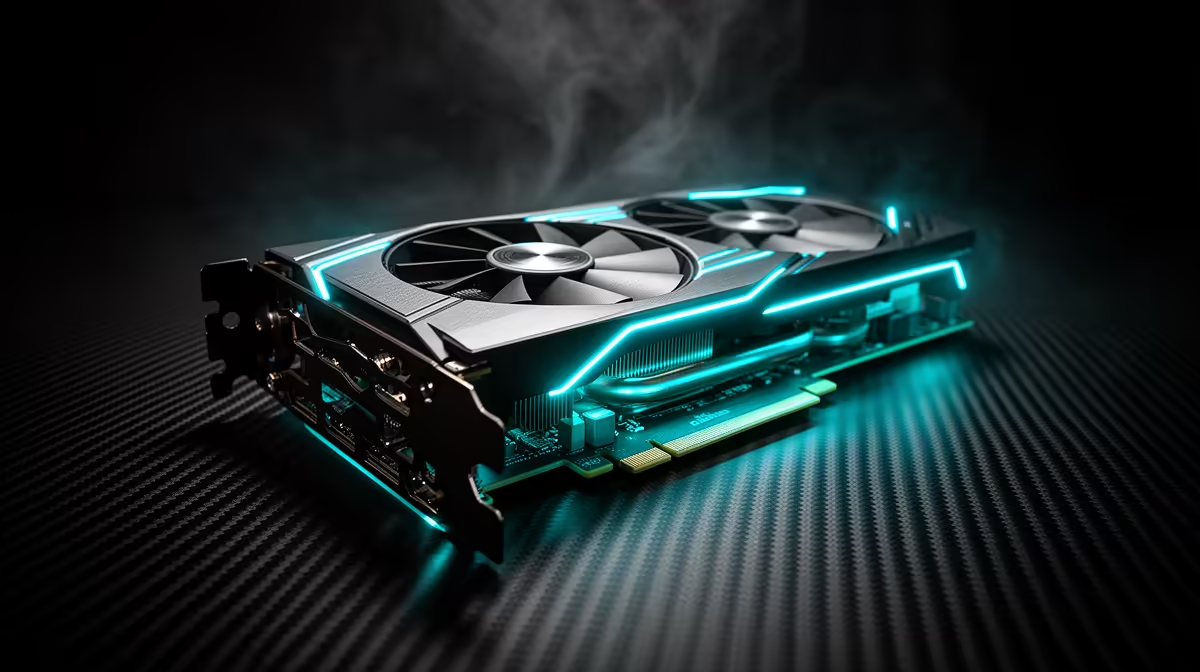
The RTX 3060 Ti remains a good 1080p and entry-1440p card, but its 8GB memory and older ray-tracing hardware can set the limit in new releases. An RTX 5070 gives you a larger performance class, 12GB of GDDR7 and the newest GeForce rendering tools without jumping to the top tier.
Quick Answer
Upgrade when the RTX 3060 Ti misses your 1440p target, forces texture cuts, or struggles with ray tracing you want to use. Keep it for 1080p when frame times remain stable. The RTX 5070 makes the strongest case alongside a new high-refresh 1440p display.
Use the current graphics card catalogue, the popular GPU comparison list, and the RTX 5070 model page to compare exact cards. Live partner-model price and cooler quality matter more than a launch headline.
What Two Generations Buy
NVIDIA specifies 4,864 CUDA cores, 8GB of GDDR6 and 200W graphics-card power for the RTX 3060 Ti reference design. The RTX 5070 moves to 6,144 CUDA cores, 12GB of GDDR7 and a 250W total graphics-power specification.
CUDA counts span Ampere and Blackwell, so use them to identify scale rather than predict a frame-rate gain. The newer card changes shader throughput, ray-tracing and Tensor hardware, clocks and memory. Current benchmark results combine those differences.
The four-gigabyte capacity increase is useful. High-resolution textures and ray-traced assets can press against 8GB at 1440p. Twelve gigabytes gives you more room, though a few demanding workloads can still benefit from 16GB.
Confirm That VRAM Is the Problem
An overlay may show memory allocation rather than true use. Look for stutter, late texture loads or sharp frame-time spikes that improve when texture quality drops. Restart the game after changing the setting if its engine does not release memory cleanly.
Storage streaming and shader compilation can look similar. Check whether the problem repeats in the same route and whether it appears after a driver or game update. A capacity upgrade should solve a measured pattern, rather than a high number alone.
If lower textures change nothing while the GPU sits at full load, processing performance is the stronger reason to move. The RTX 5070 can still be a sound answer; you have identified a different limit.
1440p Is the Natural Target
At 2560 x 1440, the RTX 5070 has enough extra performance to pursue higher refresh rates and stronger settings than the 3060 Ti. Compare native rendering first. Then use DLSS Quality where it preserves the image you want.
Check 1 percent lows in crowded scenes and battles. A smooth benchmark fly-through may miss the CPU and asset-streaming load that affects play. Match the review CPU to your platform as closely as possible.
For a 60Hz monitor, the 3060 Ti may still clear the target with tuned settings. A new 165Hz or 180Hz panel gives the 5070 a bigger window to show its work. Price the monitor and card together if both changes are planned.
Ray Tracing Gets More Practical
The RTX 3060 Ti introduced capable second-generation RT hardware, but heavy modern effects can force low base rates. The RTX 5070's newer RT cores and DLSS stack offer more room for reflections, global illumination and demanding lighting.
Ray Reconstruction can improve supported ray-traced detail. Multi Frame Generation can increase displayed smoothness on RTX 50-series cards. Keep the base-rendered result separate in your test, since generated frames do not provide the same input response as native frames.
Choose the effects that improve the game for you. Maxing every ray-tracing switch can consume performance for a subtle change, while one reflection or lighting setting may deliver most of the visual gain.
Check CPU and PCIe Context
Many 3060 Ti builds use Ryzen 3000 or 5000 and Intel 10th- to 12th-generation processors. Some remain strong partners for a 5070, especially at 1440p. Others can cap high-refresh play in simulation-heavy games.
Lower resolution on the 3060 Ti. A large frame-rate increase points to GPU headroom; little change with lower GPU use suggests a CPU ceiling. Also confirm Resizable BAR support and current motherboard firmware where applicable.
The RTX 5070 uses a PCIe 5.0 x16 interface and remains compatible with older slots. A quality PCIe 4.0 platform is a comfortable fit. Check matching tests before assuming an older link creates a meaningful problem.
Budget for Power and Fit
The reference power class rises from 200W to 250W. Partner cards can differ. Follow the named model's PSU requirement and check available cables, PSU age and case airflow.
Measure more than card length. Slot thickness, height above the bracket and power-cable clearance can matter. A front radiator or drive cage may reduce the room shown in a case specification.
Read noise results for the exact cooler. A card that holds lower fan speed may be worth more to you than a small factory overclock.
Handle the Used RTX 3060 Ti Well
The old card can offset the upgrade when it has a clear history. Keep its invoice, serial, box and accessories. Photograph it working and save a recent stability run before removal.
Install and test the RTX 5070 before parting with the 3060 Ti. Verify every display port, run a long game session and watch temperature, fan speed and driver stability. Your old card remains a useful fallback until the new system is proven.
Recheck Windows display settings after the swap. A port change can return the monitor to a lower refresh rate or different colour format, making a good upgrade look wrong. Load the same game version and saved route, then compare frame times rather than relying on memory.
If the result falls short of matching reviews, inspect CPU load, PCIe link speed, Resizable BAR status and thermal clocks before blaming the card. A loose setting can hide part of the gain, while a consistent CPU ceiling tells you the next upgrade belongs elsewhere.
The move earns its cost when it fixes an 8GB or performance limit and lets your monitor show the gain. If the 3060 Ti still meets your 1080p needs, its best value may be another year of use.
FAQ
Is 12GB enough for an RTX 5070 at 1440p?
It is a useful capacity for current 1440p gaming. Heavy mods, some creative tasks and long ownership can favour 16GB.
Is the RTX 5070 overkill for 1080p?
It can be for a modest-refresh screen. High-refresh games and heavy ray tracing can still use the performance.
Can I reuse a 3060 Ti power supply?
Possibly. Check the exact RTX 5070 requirement, PSU quality and age, connector layout and full system demand.
Recreate the RTX 3060 Ti limit in your hardest game, then match an RTX 5070 and supporting hardware to the measured 1440p target.