Quick Answer
Adding USB-C gaming support to your PC involves either using an existing USB-C port on your motherboard or GPU, or installing a dedicated PCIe USB-C expansion card. Most modern motherboards include at least one USB 3.2 Gen 2x2 Type-C port on the rear IO, which is sufficient for connecting controllers, headsets, and compatible gaming peripherals at full speed.
Understanding USB-C on Your PC: What You Already Have
Before purchasing any additional hardware, check your motherboard's rear IO panel and your GPU's output ports. Most mid-range and high-end motherboards released from 2022 onward include at least one USB-C port on the rear panel. This port is typically USB 3.2 Gen 2 at minimum, delivering up to 10Gbps data transfer, which is more than sufficient for gaming peripherals, controllers, and wired headsets.
High-end motherboards often include a Thunderbolt 4 or USB4 port, which supports 40Gbps throughput and can power connected devices at higher wattage. If your motherboard has a Thunderbolt 4 port, you have the most capable USB-C connection available for gaming peripherals, capture cards, and external storage.
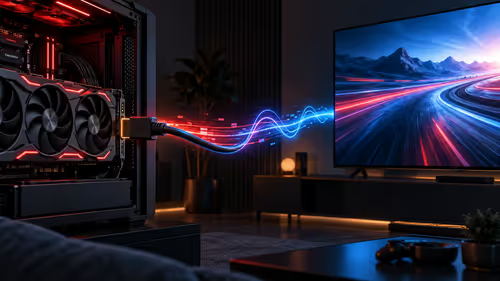
Many modern GPUs also include a USB-C port on their display output section, typically a VirtualLink port designed originally for VR headsets but usable for compatible peripherals. Check your GPU's specification sheet to confirm whether this port carries data, display output, or both.
Installing a PCIe USB-C Expansion Card
If your motherboard has no USB-C ports or you need additional ports, a PCIe expansion card is the most practical solution. These cards fit into a spare PCIe x1 or x4 slot on your motherboard and provide one or two USB-C ports at the rear of your case.
To install a PCIe USB-C card, shut down your PC and disconnect the power cable. Open your case by removing the side panel screws. Identify a free PCIe slot on your motherboard. Remove the corresponding expansion slot cover from your case by unscrewing or pushing out the metal bracket. Insert the USB-C expansion card firmly into the PCIe slot until the retention clip clicks. Some cards require a SATA power connector for additional power delivery; connect this before closing the case. Reinstall the expansion bracket screw to secure the card. Replace the side panel, reconnect power, and boot your PC. Windows will detect the card and install drivers automatically in most cases.
Connecting Gaming Peripherals via USB-C
Once your USB-C port is active, connecting gaming peripherals is straightforward. USB-C gaming controllers, wired headsets, and portable gaming devices like the Steam Deck connect via USB-C cable and are recognised immediately by Windows as standard HID (Human Interface Device) or audio devices. No additional drivers are typically required for major controllers.
For gaming headsets with USB-C connections, the audio output routes through the USB-C port and appears in Windows Sound settings as a separate audio device. Set it as your default audio device in the Windows taskbar audio settings or through the game's audio configuration menu.
Frequently Asked Questions
Do I need a separate USB-C expansion card if my motherboard already has a USB-C port?
No. If your motherboard's rear IO includes a USB-C port at USB 3.2 Gen 2 speed or higher, it is sufficient for gaming controllers, headsets, and other gaming peripherals. An expansion card is only necessary if you have no USB-C ports or need additional ones.
Can I use my GPU's USB-C port for gaming peripherals?
Yes, in most cases. GPU USB-C ports typically carry data and power alongside display output. Connect your peripheral and check if it is recognised in Windows Device Manager. Some older GPU USB-C ports are display-only, so check your GPU's specifications if the device is not detected.
What speed USB-C do I need for gaming peripherals?
For gaming controllers and headsets, USB 3.2 Gen 1 (5Gbps) is more than sufficient. For high-bandwidth peripherals like capture cards or external high-refresh-rate displays, USB 3.2 Gen 2x2 (20Gbps) or Thunderbolt 4 (40Gbps) is recommended.
Ready to Find Your Perfect Match?
Upgrade your PC's connectivity with the right components for gaming and find everything you need from South Africa's leading PC hardware retailer. Browse Components at Evetech