The fastest way to waste money on a creative workstation is to buy the wrong half of it. A video editing and 3D rendering PC lives or dies on whether you spend on the GPU or the CPU, and that choice is decided by the software you spend most of your day in. DaVinci Resolve leans hard on the graphics card; Premiere Pro leans on the processor; Blender and Maya have their own demands again. Build around the wrong component and you pour budget into power your main app cannot use.
Quick Answer
Match the build to your primary app. DaVinci Resolve is heavily GPU-dependent for grading, noise reduction, and effects, so prioritise a strong card with 16GB or more of VRAM. Premiere Pro leans on the CPU for timeline playback and export, so favour a high-core-count, high-clock chip. For both, plan on 64GB DDR5 and a dedicated fast NVMe drive for cache. Blender and Maya viewport and GPU-render work push you back toward the graphics card.
Resolve versus Premiere: the split that decides your budget
These two editors look similar on the surface and stress your hardware very differently underneath. Getting this right is the single most important decision in the build.
DaVinci Resolve is GPU-first
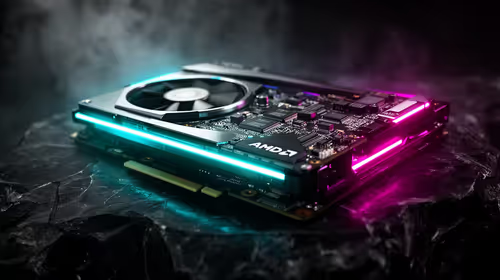
Resolve offloads a great deal to the graphics card. Colour grading, the Fusion compositing page, optical-flow speed changes, and especially AI-based noise reduction all run on the GPU, and they scale with VRAM as much as with raw GPU speed. For 4K work, 12GB of VRAM is the sensible floor; for 6K, 8K, heavy grades, or large Fusion comps, 16GB or more keeps you off the VRAM ceiling where playback stutters and renders crawl. A current-generation card with 16GB is the heart of a Resolve machine, and stepping up to 24GB pays off on the heaviest projects.
Premiere Pro is CPU-first
Premiere flips the priority. Timeline playback, export encoding, and many effects lean on the processor, and the app rewards a chip with both a high boost clock and plenty of cores. Multi-cam sequences and stacked effects in particular spread across cores, so a 20-to-24-core modern CPU with strong memory throughput is where Premiere money is best spent. The GPU still helps with accelerated effects and export, but it is the supporting act rather than the lead.
Building for Blender and Maya
3D changes the calculation again, and the two apps within 3D do not behave identically.
Viewport versus final render
Day-to-day modelling and animation in Blender and Maya depend on viewport responsiveness, which is largely GPU-driven, so a capable graphics card keeps your scene smooth as it grows complex. Final rendering then splits by engine. GPU renderers such as Blender's Cycles on the OptiX backend hammer the graphics card and reward more VRAM and more CUDA cores, which is why a strong NVIDIA card doubles as both your viewport and your render engine. CPU-based render paths instead reward core count, so a many-core processor earns its keep there.
Where professional cards fit
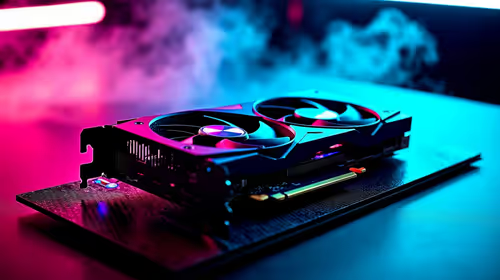
For most creators a high-end consumer GPU is the value sweet spot. Studios working with very large scenes, deep colour pipelines, or applications certified for professional drivers may justify a workstation-class card with far larger VRAM, and Evetech's workstation graphics card range is where those options live. The deciding factor is VRAM headroom and driver certification rather than gaming frame rates.
The parts both workflows share
Whatever your primary app, three components matter across the board.
RAM is the first. For 4K-and-up editing and 3D work, 64GB DDR5 is the practical sweet spot in 2026, giving headroom for large timelines, multiple apps, and big scenes without spilling to the page file. Storage is the second and most underrated: a separate, fast NVMe SSD dedicated to cache, render cache, and project databases makes a dramatic difference to playback smoothness and responsiveness, on top of fast drives for your active footage. The third is simply a CPU and GPU that are not wildly mismatched, so neither bottlenecks the other.
A storage hierarchy that actually helps
It pays to think in tiers rather than one big drive. A fast NVMe boot drive carries the operating system and applications. A second, separate NVMe handles active project files and footage you are currently cutting, so reads do not compete with the system. A third drive, often a dedicated NVMe, holds cache, render cache, and the project database, which editors hammer constantly. Finally, larger spinning or SATA storage archives finished projects and source footage you are not actively touching. Keeping these jobs on separate drives is one of the cheapest, most effective ways to keep a timeline responsive, because no single drive becomes the bottleneck for everything at once.
Prefer to buy a complete machine rather than spec every part yourself? Browsing current builds at Evetech gives you a real-world price and configuration baseline to measure your shortlist against.
A sensible spending order
For a Resolve-first or GPU-render creator: GPU and VRAM first, then 64GB RAM, then a fast cache NVMe, then a solid mid-to-high core CPU. For a Premiere-first editor: a high-core, high-clock CPU first, then a 12-16GB GPU, then RAM and cache storage. Decide which app pays your bills, spend there first, and everything else in the build clicks into alignment without wasted Rand.
One last point worth stressing: the order only works if you are honest about your primary app. Many creators split time across editors and 3D tools, and the temptation is to over-spec everything to cover all bases, which is how budgets balloon. Pick the single application you spend the most hours in, build for that, and accept that the others will run perfectly well rather than optimally. A machine tuned for your most-used workflow beats a jack-of-all-trades build at the same price every time.
Frequently Asked Questions
Should I prioritise the CPU or GPU for video editing?
It depends on your main editor. DaVinci Resolve is GPU-heavy, so the graphics card and its VRAM come first. Premiere Pro is more CPU-dependent for playback and export, so the processor leads. Identify your primary app before you allocate budget.
How much VRAM do I need for 4K and 8K editing?
For 4K work in Resolve, 12GB of VRAM is the sensible minimum. For 6K, 8K, heavy grading, noise reduction, or large Fusion compositions, 16GB or more prevents the VRAM bottleneck that causes stuttering playback and slow renders.
Is 32GB of RAM enough for video editing and 3D?
It can work for lighter 1080p editing, but for 4K-and-up footage and serious 3D scenes, 64GB DDR5 is the practical sweet spot in 2026. It keeps large timelines and complex scenes from spilling into slow page-file memory.
Do I need a professional workstation GPU for Blender or Maya?
Usually not. A high-end consumer NVIDIA card handles viewport and GPU rendering well for most creators. Professional cards earn their place mainly for very large scenes, bigger VRAM needs, or applications that require certified drivers.
Why is a separate cache drive so important?
Editors and 3D apps constantly read and write cache, render cache, and database files. A dedicated fast NVMe SSD for those tasks, separate from your footage and system drives, removes a major source of stutter and keeps the timeline responsive.