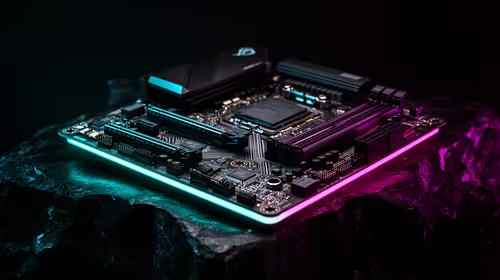
One physical machine, half a dozen isolated systems running side by side, all managed from a single browser tab. That is the appeal of virtualization for a home lab, and Proxmox VE is the platform most people land on once they outgrow running one operating system at a time. It bundles a serious type-1 hypervisor with a clean web interface and does not ask for a licence fee, and those three qualities together explain why self-hosters across South Africa and the rest of the world keep landing on it as their first choice.
Quick Answer
Proxmox VE is a free, open-source type-1 hypervisor that installs directly on your hardware. A single web UI manages KVM virtual machines, which give you full isolated operating systems, alongside LXC containers, which run lightweight Linux services on a fraction of the resources. Both technologies under one roof, at no licence cost, with solid documentation, makes it the practical first pick for most home labs.
What virtualization gives a home lab
Virtualization lets one capable machine pretend to be many. Instead of buying a separate box for your media server, your network-wide ad blocker, and your test environment, you carve one machine into isolated slices. Each slice behaves like its own computer, so a crash or a bad update in one does not touch the others. You can snapshot a system before a risky change and roll back in seconds if it breaks.
For a home lab that means freedom to experiment. You spin up a virtual machine, try something, and delete it without leaving a mess on your real system. That low cost of failure is what makes a lab a lab rather than a fragile production box you are afraid to touch.
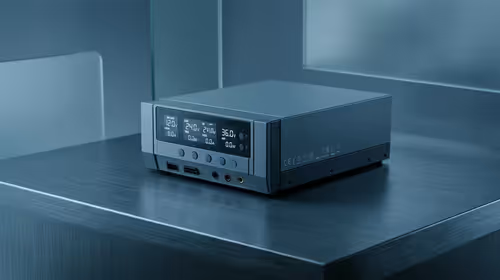
The hardware underneath matters, and a compact, low-power mini PC is a popular host because it runs quietly all day on modest electricity. The mini PCs stocked at Evetech are a practical starting point for picking a first lab machine locally.
Why Proxmox specifically
Type-1 means it runs on the metal
A type-1 hypervisor installs directly onto the hardware rather than running inside another operating system. That gives your virtual machines closer-to-native performance and better isolation than running a hypervisor on top of Windows. Proxmox is Debian-based underneath, so it is familiar to anyone who has used Linux, but it presents everything through its own management layer.
VMs and containers in one place
Proxmox handles two kinds of guest. KVM virtual machines emulate a full computer, so you can run any operating system inside them, ideal when you need a complete and separate environment. LXC containers are far lighter, sharing the host kernel and booting almost instantly, which suits simple services that do not need their own kernel. Having both under one interface means you pick the right tool per workload without juggling separate platforms.
A web UI that does the heavy lifting
Everything happens in the browser: creating guests, allocating memory and storage, taking snapshots, viewing console output, and managing backups. You do not need to memorise command-line incantations for routine tasks, though the shell is there when you want it. That accessibility is a large part of why newcomers stick with it.
Sizing the hardware
The two specs that matter most for a virtualization host are memory and storage. Each virtual machine reserves RAM, so a lab running several VMs wants generous memory, with 16GB a comfortable starting point and 32GB giving real breathing room. Storage should favour an NVMe SSD, because multiple guests reading and writing at once will punish a slow drive. CPU cores help when running many guests at once, but memory is usually the first wall you hit.
A mini PC with room for adequate RAM and an NVMe drive covers most starter labs, and you can scale up later. When you are weighing a mini PC host against a small tower for more expansion room, the best-selling desktops at Evetech give a feel for what each form factor costs at the memory levels a lab needs.
A realistic first build
Start with one mini PC, install Proxmox VE, and create a single VM to learn the interface. Add an LXC container for a lightweight service to see the difference in resource use. Once you are comfortable, layer on backups and snapshots so experiments stay safe. Grow the lab as your needs and your hardware allow rather than over-buying on day one. The platform scales from a single quiet box to a clustered setup, so there is plenty of room to expand when you are ready.
Backups and Snapshots
One of Proxmox's underrated strengths for a home lab is how friction-free it makes protecting your work.
Snapshots before risky changes
Before a major update, a configuration change, or anything that might break something, take a snapshot. Proxmox captures the full state of the guest in seconds, and rolling back is equally fast. That low cost of failure is what makes experimenting feel safe rather than nerve-racking. Snapshots live on the same storage as the guest, so they are instant but not a substitute for a proper backup off the machine.
Proxmox Backup Server
For a home lab that holds data you care about, Proxmox Backup Server (PBS) is free, purpose-built backup software that integrates natively with Proxmox VE. It deduplicates backup data, so successive backups take far less space than a full copy each time, and it handles both VMs and containers. Running PBS on a second machine, or even a separate storage pool, gives you genuine off-host protection. Scheduled nightly backups via the Proxmox web UI plus PBS is the standard pattern that home labbers rely on to keep months of configuration safe with almost no manual effort.
Retention and verification
Set a retention policy so old backups roll off automatically and storage does not silently fill up. Proxmox lets you verify backup integrity, confirming the data is readable before you ever need to restore. Testing a restore at least once after initial setup is time well spent; knowing the process works means a hardware failure is inconvenient rather than catastrophic.
Frequently Asked Questions
Is Proxmox VE really free?
Yes. Proxmox VE is open source and free to use, including for home labs. There is an optional paid subscription for enterprise support and a tested update repository, but it is not required to run a lab.
What is the difference between a VM and an LXC container in Proxmox?
A KVM virtual machine emulates a complete computer and can run any operating system, at a higher resource cost. An LXC container shares the host kernel, so it is far lighter and faster to start but limited to Linux guests.
How much RAM do I need for a Proxmox home lab?
16GB is a comfortable starting point for a few guests, while 32GB gives real headroom for more VMs or memory-hungry services. Memory is usually the first limit you reach, so favour it when speccing.
Can I run Proxmox on a mini PC?
Yes, and many people do. A mini PC with enough RAM and an NVMe SSD makes an excellent low-power, always-on host for a starter lab, with the option to scale up later.
Is Proxmox a good alternative to other hypervisors?
For home labs it is one of the strongest choices because it is free, manages both VMs and containers, and is well documented. It compares favourably with paid enterprise platforms for the scale a home user needs.
A capable, quiet host is the foundation of a good home lab, and the rest is software you can add for free. Browse mini PCs and desktops suited to virtualization at https://www.evetech.co.za/PC-Components/mini-pcs-194 and build a lab you are not afraid to experiment on.