Shoppers comparing the M5 Air, M5 Pro, and M5 Max almost always assume the dearer chip unlocks more AI. For Apple Intelligence, that assumption is wrong. Every M5 tier runs the same on-device AI feature set, in South African English, with no feature gated behind the pricier silicon. What actually separates the three is sustained performance headroom, which is a different question entirely, and the one your money is really buying.
Quick Answer
Apple Intelligence features are identical across the M5 Air, M5 Pro, and M5 Max. All three unlock the same writing tools, image features, and Siri capabilities, and all run in South African English. The chip you pick should come down to how hard and how long you push the machine, not which AI tools you get.
Apple Intelligence Is the Same on Every M5
Apple Intelligence is the on-device AI layer across Apple's platforms, covering writing tools that rewrite, proofread, and summarise text, image features, notification summaries, and a more capable Siri. The crucial point for buyers is that Apple ties these features to the chip generation, not the chip tier. If a Mac has an M5-class processor, it gets the full Apple Intelligence set.
That means the base M5 Air opens the same AI toolbox as a maxed-out M5 Max. There is no hidden tier of features that only the expensive chip can run. The Neural Engine that powers on-device inference is present and capable across all three, so a student writing essays on an Air and a studio professional on a Max use the identical AI functionality.
This reframes the whole comparison. Once AI access is off the table as a differentiator, the decision becomes about raw and sustained performance, which is where the M5 tiers genuinely diverge.
South African English, Confirmed
A fair worry for local buyers is whether AI features respect South African English rather than forcing American spelling and phrasing. Apple Intelligence supports South African English, so the writing tools optimise, colour, and centre the way you do, instead of correcting your spelling to a different standard. For anyone drafting emails, reports, or study notes, that local-language support removes a real friction point. It applies equally across the Air, Pro, and Max, so language handling is never a reason to step up a tier. You can compare the current MacBook line-up in the Evetech MacBook range to see which chassis carries which chip.
Where the M5 Tiers Actually Differ
If AI is constant, what does the extra spend buy? Sustained performance, thermal headroom, memory bandwidth, and GPU power. These shape how the machine behaves under prolonged, heavy load rather than what it can do.
M5 Air: light, fanless, everyday
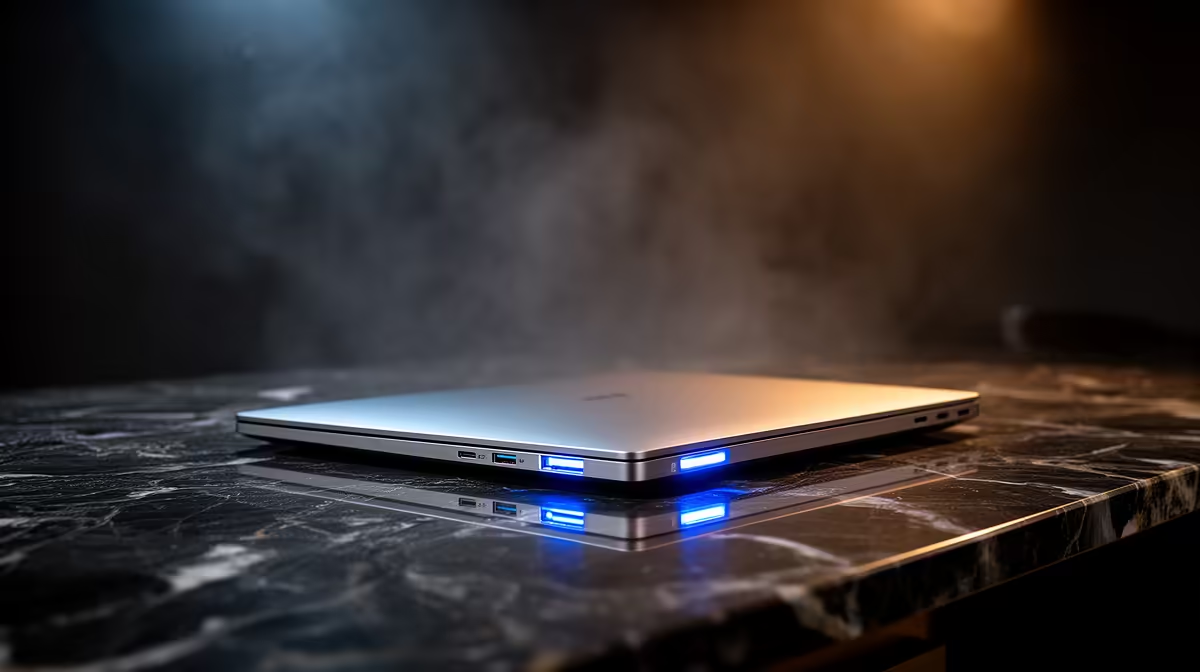
The M5 Air is the entry point and typically runs fanless, which keeps it silent and slim. For web work, writing, study, light photo editing, and everyday multitasking, it is more than capable, and it runs every Apple Intelligence feature without compromise. Its limit shows under sustained heavy load: without a fan, a long render or export will eventually throttle to manage heat. For the buyer whose work is bursty rather than marathon, that ceiling rarely bites.
There is a subtlety worth naming here. On-device AI tasks like summarising a long document or generating an image are short, intense bursts rather than hours-long grinds, so even the fanless Air handles them without breaking a sweat. That is part of why Apple felt comfortable enabling the full feature set across the range: the AI workloads themselves do not demand the thermal headroom that, say, a four-hour video export does. The Air's throttling only matters for the marathon creative tasks, not the AI features people often assume drove the price up.
M5 Pro: sustained workloads
The M5 Pro adds more performance cores, a stronger GPU, greater memory bandwidth, and active cooling. The payoff is consistency. Where the Air ramps down during a long task, the Pro holds its speed because it can shed heat. Video editors, developers compiling large projects, and creatives juggling demanding applications feel this most. The AI features are the same, but the machine keeps its composure when you lean on it for hours.
M5 Max: maximum headroom
The M5 Max sits at the top with the most GPU cores, the highest memory bandwidth, and support for the largest memory configurations. It targets professionals running heavy 3D, high-resolution video, and large datasets where every minute of render time counts. You are paying for the ability to push the hardest workloads sustained, not for any exclusive AI capability.
How to Choose Without Overspending
Because Apple Intelligence is not a factor, the honest way to choose is to match the tier to your heaviest regular task, not your occasional one.
If your day is browsing, documents, study, communication, and light creative work, the M5 Air delivers the full AI experience and ample speed. Paying for a Pro or Max to get better AI would be wasted money, because there is no better AI to get.
If you routinely run sustained heavy workloads, long video exports, large compiles, demanding 3D, the Pro or Max earns its premium through consistent performance and thermal headroom. Choose the Pro for serious sustained work and the Max only if you genuinely push the most demanding professional tasks.
A practical SA tip is to weight your budget toward memory rather than chasing the top chip. Sufficient unified memory keeps multitasking and larger AI and creative tasks smooth, and it often does more for everyday feel than a tier jump. To weigh portability against power across the full laptop selection, the Evetech laptop best-sellers put the alternatives side by side.
Frequently Asked Questions
Does the M5 Air get fewer AI features than the M5 Pro or Max?
No. All three tiers run the identical Apple Intelligence feature set, including writing tools, image features, and Siri capabilities. The chip tier changes sustained performance, not AI access.
Does Apple Intelligence work in South African English?
Yes. Apple Intelligence supports South African English, so the writing and proofreading tools follow local spelling and phrasing rather than forcing a different standard. This is the same across the Air, Pro, and Max.
If AI is the same, why buy a Pro or Max?
For sustained performance. The Pro and Max add cores, GPU power, memory bandwidth, and active cooling, so they hold their speed during long, heavy tasks where the fanless Air would eventually throttle.
Is the M5 Air enough for a student?
For most students, yes. It runs the full Apple Intelligence set and handles study, writing, research, and light creative work comfortably, all while staying silent and portable.
Should I prioritise the chip tier or more memory?
For many buyers, memory matters more day to day than a higher tier. Enough unified memory keeps multitasking and larger tasks smooth, so weight your budget there before chasing the top chip, unless your work is genuinely render-heavy.
Pick the M5 Mac that matches how hard you actually work, not which AI you think you are unlocking, because the AI is the same everywhere. Compare chips and configurations across the Evetech MacBook range and laptop best-sellers to find the right fit.