Quick Answer
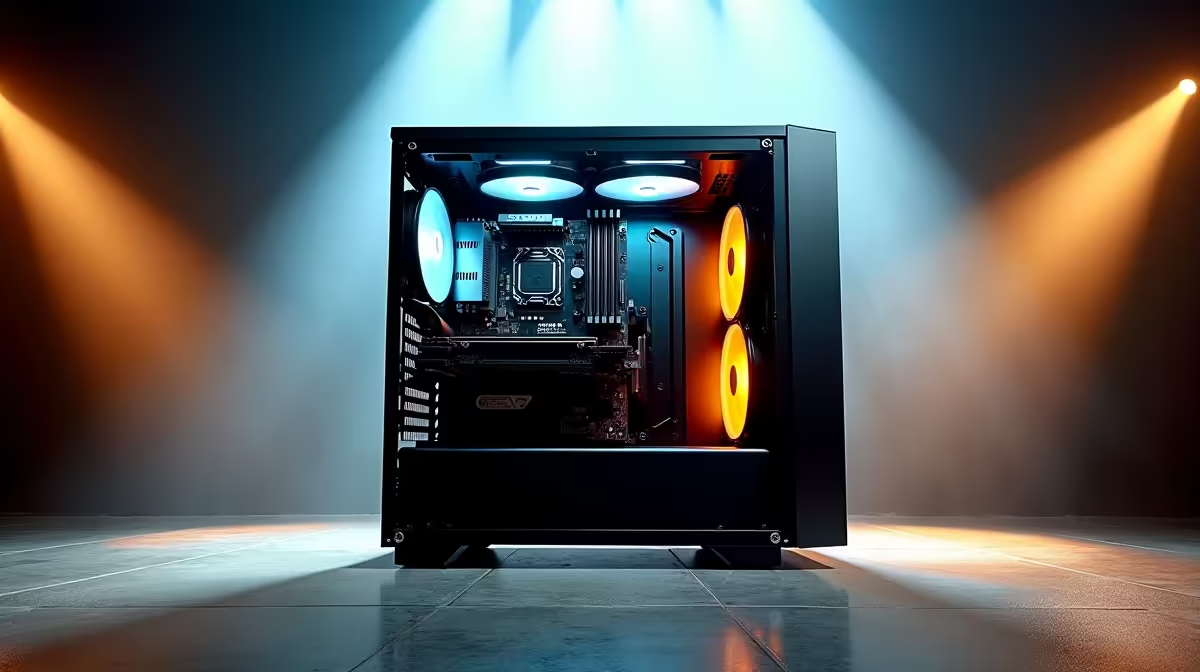
You need a full-tower or E-ATX-rated large mid-tower case that explicitly lists 440mm or greater GPU clearance AND E-ATX motherboard support (305mm x 330mm). Most standard ATX mid-towers top out at 390mm GPU clearance and do not have E-ATX standoff positions, so they will not work for this combination.
Understanding the Physical Requirements 📐
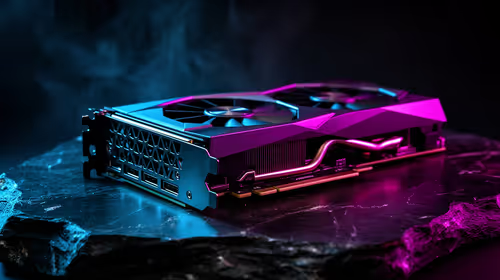
An E-ATX motherboard at 305mm x 330mm is roughly 30mm wider and 30mm taller than a standard ATX board. The case needs a wider motherboard tray and standoff holes at E-ATX specification corners. Simultaneously, a 440mm GPU sits in the PCIe slot and extends toward the front panel: the distance from the back of the PCIe slot to the front panel interior must be at least 440mm. Many cases quote GPU clearance with drive cages removed, so verify the clearance you get with cages installed if you need front-bay storage. A case supporting both an E-ATX board and 440mm GPU clearance typically has full-tower internal volume: usually 500mm or taller and 220 to 260mm wide.
Checking the Right Specifications Before You Buy 🔍
Case marketing can be misleading. Some cases are marketed as E-ATX compatible but only accommodate smaller E-ATX boards (305mm x 264mm) rather than the full 305mm x 330mm spec used by ASUS ProArt and Gigabyte AORUS Master boards. Always cross-check stated motherboard compatibility against your exact board dimensions. For GPU clearance, check whether the measurement is given with the front drive cage installed or removed. If the case lists 440mm with cages removed but only 380mm with cages, you must choose between GPU fitment and drive bay storage. At full-tower pricing of R2,500 to R5,000 in South Africa, cases in this range should accommodate the full 330mm E-ATX height and 440mm GPU length simultaneously.
Airflow and Cooling Headroom for Large Builds 🌬️
A build combining an E-ATX board and a 440mm GPU is almost certainly a high-end system drawing 500 to 700W or more at full load. At those thermal loads, a case with at least a 360mm top radiator mount and a 360mm or 420mm front radiator mount is strongly recommended. The internal volume of a full tower creates thermal zones: the GPU exhausts heat toward the rear, the CPU AIO routes heat through the top or front radiator, and the VRM zone benefits from front intake airflow directed upward. Choosing a case allowing six or more 140mm fan positions gives headroom to manage those zones independently during SA's warm ambient summer conditions.
Measure Your Space Before Buying Full Tower ⚡
Before ordering a full-tower case, measure your desk alcove or floor space and add 50mm clearance on each side for airflow and cable access. A full tower listed as 560mm tall with feet can reach 580 to 600mm, and many SA homes have desk shelves or cabinets sitting exactly at that height.
FAQ
Can I use a mid-tower case with a riser bracket to fit an E-ATX board?
No. Riser brackets for GPU mounting do not change the motherboard tray dimensions. If the case does not have standoffs at the E-ATX positions (305mm x 330mm), the board will overhang the tray and cannot be safely secured.
Does 440mm GPU clearance mean the GPU is exactly 440mm long?
No. 440mm GPU clearance means the case can accommodate a GPU up to 440mm in length. Your actual GPU might measure 336mm or 380mm and fit comfortably. Always compare the clearance figure against your GPU's actual length.
How do I confirm E-ATX support for a specific case before buying in SA?
Check the case manufacturer's specifications page for both the stated motherboard form factors (it should list E-ATX explicitly) and the maximum board dimensions in millimetres. Cross-reference those against your motherboard's published size.
Need a case that genuinely fits a 440mm GPU and an E-ATX board?
Evetech stocks full-tower and large mid-tower cases with verified E-ATX support and 440mm-plus GPU clearance. Browse the case range and confirm your fit before you build.