


Complete Guide: Setting Up Monitor Light
Setting Up Monitor Light. Tested & verified settings for best FPS and visual quality on SA hardware budgets.
Read moreEver wondered what is polling rate and why it matters for your gaming mouse? This guide breaks down everything from 125Hz to 8000Hz, helping South African gamers understand how report rates impact aiming precision and reaction time. Get the competitive edge you need! 🖱️⚡
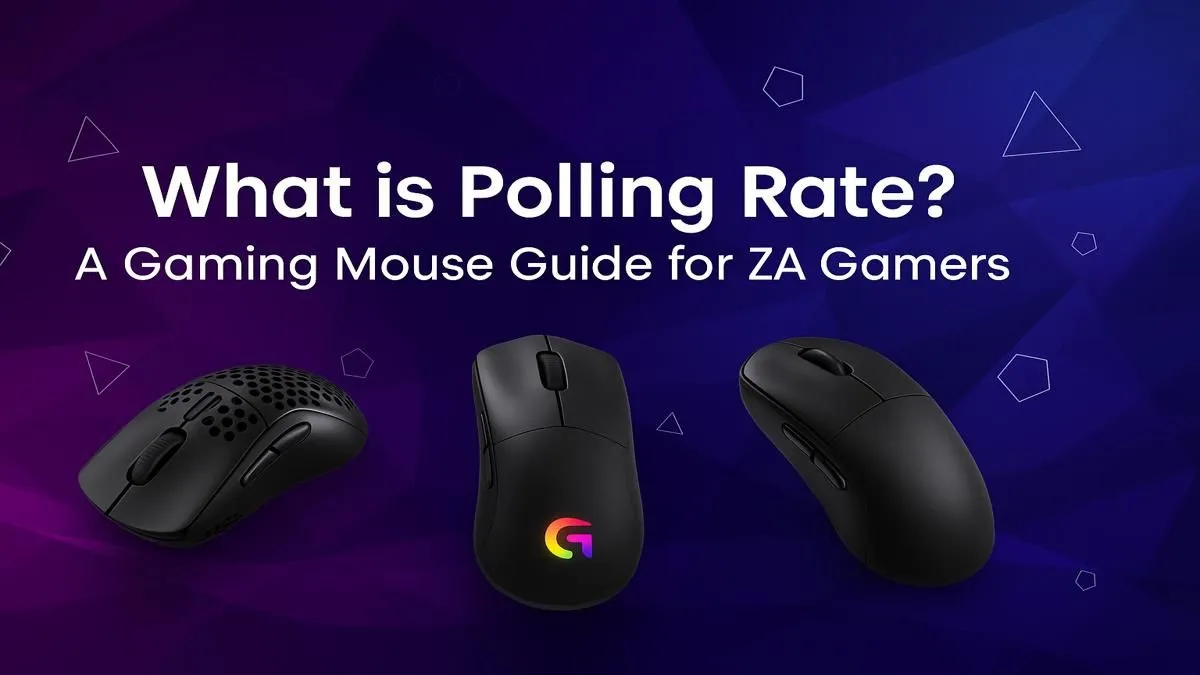
Ever felt like you shot first but still lost the duel? In South Africa, we're quick to blame high ping... and often, we're right. But what if a hidden setting on your mouse is also holding you back? We're talking about polling rate, a tiny spec with a massive impact on your in-game accuracy. Understanding what polling rate is could be the key to turning those frustrating "how?!" moments into clean, satisfying headshots. 🚀
Think of polling rate as your mouse's "refresh rate." Measured in Hertz (Hz), it tells you how many times per second your mouse reports its position to your computer. A mouse with a 125Hz polling rate updates its position 125 times every second. A mouse with a 1000Hz polling rate? A massive 1000 times per second.
This means a higher polling rate results in a smoother, more responsive cursor movement on your screen because the gap between each update is much smaller. It's the difference between a choppy stream and a fluid, high-framerate video.
For years, 1000Hz has been the gold standard for competitive gaming, and it's a feature you'll find on most modern wired gaming mice. Here’s a quick breakdown of what you'll typically see:
A super-high polling rate (4000Hz+) can use more CPU resources. If you're running an older processor, sticking to 1000Hz is often the smarter choice to ensure your in-game FPS remains stable. You can check CPU usage in the Windows Task Manager (Ctrl+Shift+Esc) while moving your mouse quickly to see the impact.
For competitive gaming in titles like Valorant, Apex Legends, or Warzone... absolutely. A higher polling rate reduces the time between you moving your hand and the action appearing on screen. While we're talking milliseconds, that tiny delay can be the difference between landing a flick shot or hitting the wall behind your opponent.
The good news is that technology has caught up. Worries about high polling rates on wireless mice causing battery drain are a thing of the past, with many of today's wireless gaming mice offering 1000Hz+ rates with incredible battery life. ✨
Most gaming mice don't run at their maximum polling rate out of the box. You'll usually need to install the manufacturer's software to tweak it:
Inside the software, you'll find a setting for "Polling Rate" or "Report Rate." For gaming, we recommend setting this to 1000Hz. If you have a high-end PC and a compatible mouse, feel free to experiment with higher settings to see if you can feel the difference. You can find great gaming mouse deals that support these features right here in South Africa.
Choosing the right mouse polling rate is about balancing performance and price. While an 8000Hz mouse is impressive, a solid 1000Hz mouse will serve 99% of gamers perfectly. The best part is that this feature is no longer reserved for the most expensive gear.
You can find mice with a 1000Hz polling rate across all budgets. There are excellent options under R1000 that deliver pro-grade tracking. If you're looking for more features like customisable weights or more buttons, the range of mice in the R1000-R2000 bracket is fantastic. For those who want the absolute best sensor technology and lightest designs, exploring the premium mice over R2000 will give you that ultimate competitive edge.
Ultimately, understanding what polling rate is helps you make a smarter choice for your next upgrade.
Ready to Feel the Difference? A high polling rate can be the edge you need to climb the ranks. Stop letting input lag hold you back. Explore our entire range of gaming mice and find the perfect upgrade for your setup.
Generally, yes. A higher polling rate (like 1000Hz or more) provides smoother cursor movement and faster response times, which is crucial for competitive gaming. However, very high rates (8000Hz) require a powerful CPU to see benefits.
Polling rate (Hz) is how often your mouse reports its position to the PC. DPI (dots per inch) is the mouse's sensitivity to movement. Polling rate affects smoothness and responsiveness, while DPI affects cursor speed.
For casual gaming and daily tasks, a standard polling rate of 500Hz or 1000Hz is more than sufficient. The benefits of ultra-high polling rates are most noticeable in fast-paced, competitive esports titles.
You can check your mouse polling rate using dedicated software from the manufacturer (e.g., Razer Synapse, Logitech G HUB) or with free online testing tools that measure the report rate as you move your mouse.
For FPS games, a polling rate of 1000Hz is the competitive standard, offering a great balance of responsiveness and system performance. Rates above this, like 4000Hz or 8000Hz, can provide a slight edge if your PC can handle it.
Yes, a higher polling rate uses more CPU resources. While 1000Hz has a negligible impact on modern PCs, rates of 4000Hz and 8000Hz can cause performance issues or stuttering in some games if you have an older or mid-range CPU.
Setting Up Monitor Light. Tested & verified settings for best FPS and visual quality on SA hardware budgets.
Read more
Assassins Creed Shadows Ultrawide Support: 21:9. Clear setup instructions with SA-specific considerations, troubleshooting tips & recommended components.
Read more
Complete Gaming Setup Guide for the Collector. Clear setup instructions with SA-specific considerations, troubleshooting tips & recommended components.
Read more
Will the Steam Deck 2 Have an OLED Screen? Leaked. Plain-English explanation of what it means, why it matters & how it affects your buying decisions in SA.
Read more
Setting Up Ultrawide 144Hz. Tested & verified settings for best FPS and visual quality on SA hardware budgets.
Read more
Kingdom Come: Deliverance 2 Ultrawide Support. Clear setup instructions with SA-specific considerations, troubleshooting tips & recommended components.
Read more
When Will the RTX 6090 Launch in South Africa Detailed answer with SA data, expert analysis & practical recommendations for local buyers.
Top Valorant Settings for RTX 5070: FPS Optimisation picks evaluated on performance, value & SA availability with current Rand pricing from Evetech.
RDNA 3.5 Graphics in Ryzen AI 400? Can You Game. Plain-English explanation of what it means, why it matters & how it affects your buying decisions in SA.

GPU Price Index : December Report. Current stock data & price tracking for SA buyers. See what is available and where prices are heading.
Core i5-14600K + B760 + RTX 5060 Build Under. Full parts list, Rand pricing & expected performance. Build confidently with SA-available components.
RX 7600 Apex Legends at 4K: FPS Benchmark. Real-world benchmark data, FPS numbers & performance analysis. What SA gamers can actually expect.
RX 7900 XTX GTA 6 at 4K: FPS Benchmark & Optimal. Real-world benchmark data, FPS numbers & performance analysis. What SA gamers can actually expect.
Head-to-head comparison of RTX 5070 vs RX 9070 XT: Gaming Performance for SA gamers. Performance benchmarks, Rand pricing & which delivers better value.
Starfield Max Settings on RTX 5070. Tested & verified settings for best FPS and visual quality on SA hardware budgets.
Top RX 7800 XT Model Under R8,000 picks evaluated on performance, value & SA availability with current Rand pricing from Evetech.
RTX 5070 Valorant Optimised Settings: Graphics. Real-world benchmark data, FPS numbers & performance analysis. What SA gamers can actually expect.
Top Laptop with Core i7 + RX 7700S: Picks picks evaluated on performance, value & SA availability with current Rand pricing from Evetech.