Quick Answer
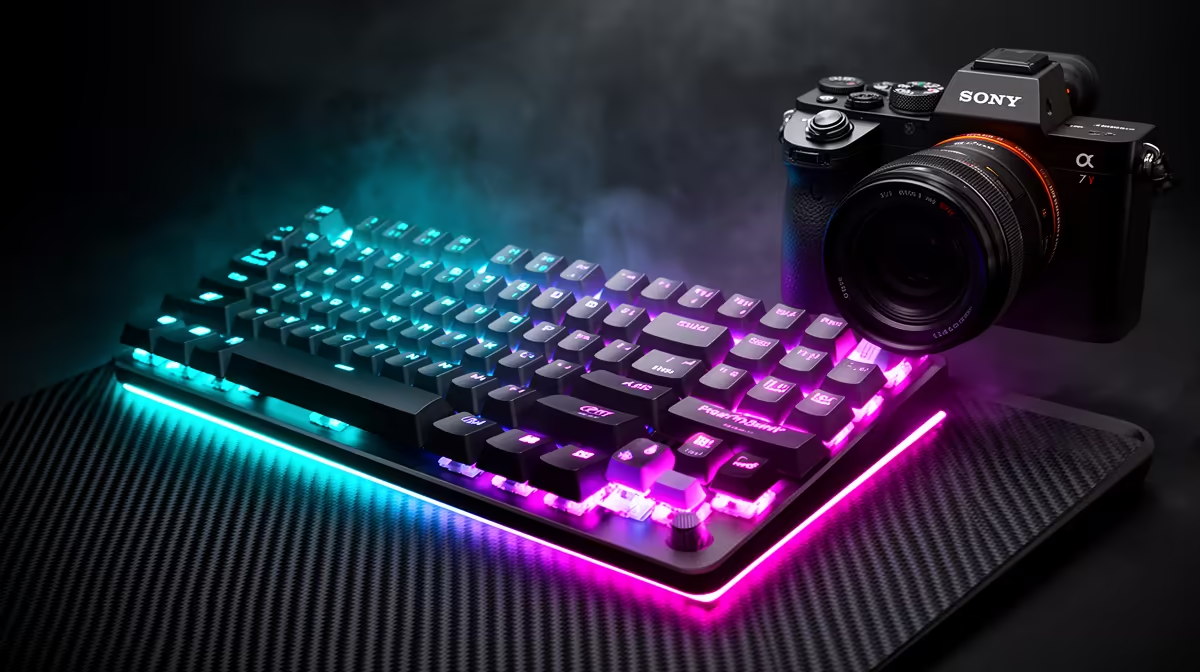
Fully programmable keys are essential for complex macros because every key on the device can be independently assigned any action, sequence, or script without conflicting with OS or application shortcuts. Unlike partial-programmability systems where only designated macro keys can store sequences, fully programmable layouts let you build layered command libraries across every button on the device.
What Full Programmability Unlocks for Macro Users 🔧
A macro is a recorded sequence of inputs executed from a single keypress. Simple macros play back three to five keystrokes; complex macros chain dozens of inputs with timed delays, conditional logic, and application-switching commands. The critical bottleneck in standard keyboard macro setups is key conflict: assigning a macro to F1 or Ctrl combos risks collisions with Windows shortcuts, in-game bindings, or voice chat keys. Fully programmable gaming keypads sidestep this entirely. Every key is a blank slate with no fixed OS function. A 32-key keypad becomes 32 individually programmable command slots, each capable of storing unlimited-length macros.
Macro Complexity Tiers: What Each Level Achieves 🎮
Basic macros (3 to 10 keystrokes with 50 ms delays) handle ability rotations, quick-buy sequences, and chat shortcuts. Intermediate macros (10 to 50 steps with variable delays) cover crafting sequences in survival games, trading routes in strategy titles, and multi-stage skill chains in MMO titles. Advanced macros (50-plus steps with conditional delays) are used for streamer overlay triggers, auto-looting scripts, and competitive practice tools that replay positioning drills.
Organising Macros Across Game Profiles 📁
The most efficient approach is one profile per game title, with keys grouped by function: movement on the thumb cluster, abilities on the primary finger keys, and utility or macro-heavy actions on the top row. For South African players who rotate between multiple game genres, driver software that auto-detects the active game window and switches profiles automatically removes the friction of manual profile swapping. Some drivers also support profile chaining: completing a boss fight sequence can trigger a loot-phase profile that remaps keys to inventory management macros.
Use Delays Strategically in Long Macros ⚡
When recording macros for ability rotations, insert a 20 to 50 ms delay between each keystroke rather than zero delay. Games running at 60 to 165 fps may miss back-to-back inputs fired faster than one frame, causing the macro to skip steps. A short delay ensures every command registers correctly even on variable-framerate connections.
FAQ
Is there a limit to how many macros I can store on a gaming keypad?
Onboard memory keypads typically store 5 to 10 full profiles in hardware. Driver-based storage is practically unlimited, but requires the software to be running. For LAN events where you cannot install driver software, onboard memory profiles are essential.
Can complex macros get you banned in competitive games?
In-game anti-cheat systems generally flag macros that execute actions faster than humanly possible or that perform actions on game objects without player input. Standard ability rotation macros within normal human timing ranges are not typically flagged. Always check a game's terms of service before using macros in ranked modes.
What is the difference between a macro and a script on a gaming keypad?
A macro plays back a fixed recorded sequence. A script uses conditional logic and variables, allowing dynamic responses to game states. Most competitive players use macros; scripts are more common in MMO utility and productivity automation contexts.
Ready to build macros that give you a genuine edge?
Evetech carries fully programmable gaming keypads with onboard memory and cloud profile support. Browse the keypad category to find the layout and switch type that fits your game library.