Quick Answer
For South Africa, prioritise PSUs with 105-degree-Celsius Japanese capacitors, conformal PCB coating, a dust filter on the fan intake, full rated output at 40 degrees Celsius ambient, and a local warranty path. These factors address SA's specific challenges of dust, humidity variation, heat, and slow international RMA.
Temperature Derating and Full-Load Ratings 🌡️
Many budget PSUs advertise wattage at 25 degrees Celsius ambient but derate significantly at 40 to 50 degrees Celsius, which is realistic inside a PC case during a Johannesburg or Durban summer. A PSU rated at 850W at 25 degrees Celsius may only safely deliver 720 to 750W at 40 degrees Celsius ambient. Quality PSUs specify their full wattage rating at 40 or even 50 degrees Celsius ambient. When evaluating an 850W unit at Evetech, check the specification sheet for the temperature rating next to the wattage figure. Reputable brands including Seasonic, Corsair, and be quiet! publish 40-degree-Celsius ratings. For a build drawing 600W sustained, buy a PSU rated 850W at 40 degrees, not just at 25 degrees.
Capacitor Quality and Humidity Resistance 💧
South Africa's coastal regions experience relative humidity often reaching 70 to 85% in summer months. Electrolytic capacitors are the component most vulnerable to humidity-accelerated aging: moisture infiltration increases equivalent series resistance, degrades capacitance, and can cause early failure. Japanese-branded capacitors from Nippon Chemi-Con, Nichicon, or Rubycon use better seal designs than generic alternatives. On an 850W premium PSU, all primary-side bulk capacitors should be Japanese-branded 105-degree-Celsius units. Conformal PCB coating adds another layer of moisture protection, particularly valuable for builders in Durban or Cape Town within a few kilometres of the coast.
Dust Protection and Maintenance 🔧
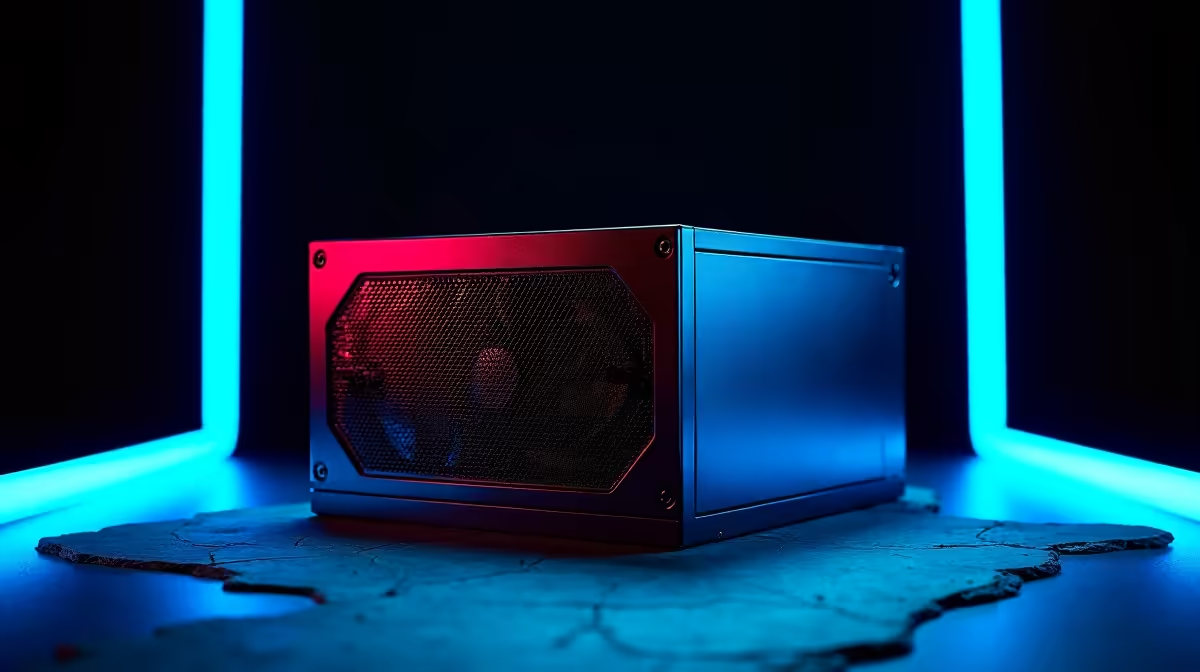
South Africa's interior plateau produces significant ambient dust, particularly in winter when dry conditions increase particulate levels. PSUs with a filtered intake aperture collect far less dust on internal components over a two to three year period between cleaning cycles. Fine dust on capacitors and transformer windings acts as a thermal insulator, raising component temperatures and accelerating aging. Units stocked at Evetech from the be quiet! and Fractal Design ranges include filtered intakes on selected models. Fitting the PC case with filtered front intakes in positive pressure airflow also substantially reduces dust ingress to the PSU.
Blow Out the PSU Every Six Months ⚡
Use a can of compressed air to blow dust out of the PSU through the fan grill every six months, with the unit switched off and unplugged. In Gauteng's dusty winters, monthly checks are sensible. Never use a vacuum cleaner directly on the PSU fan aperture as static discharge can damage components.
FAQ
Does conformal coating cover all PSU components or just the PCB surface?
Conformal coating is sprayed onto the assembled PCB, covering the board surface and the lower portions of component leads. It primarily protects against condensation and humidity reaching solder joints and PCB traces, which are the most common failure points from moisture exposure.
Is a 10-year warranty on a PSU meaningful in the SA market?
A 10-year warranty from a brand with local SA warranty support is genuinely meaningful. Verify that the warranty is serviced locally through the South African distributor, not through European or US RMA only, before treating the warranty length as a selling point.
How often should I check the PSU for dust accumulation in a Gauteng home?
Every three to four months for a case without positive pressure filtration; every six months with good case filtration. A quick visual check of the fan aperture is sufficient to determine if a compressed air blowout is needed.
Shopping for a PSU built for South African conditions?
Evetech stocks 850W PSUs from brands with verified 40-degree-Celsius ratings and quality capacitors suited to SA's heat, dust, and humidity. Browse the power supply section at Evetech.