Quick Answer
A 360mm AIO with an AMOLED pump-head display is worth the extra cost when you are building a showcase PC, streaming, or using software like HWiNFO to display live temps on screen. In South Africa these units typically cost R500 to R1,200 more than equivalent non-display 360mm AIOs, which is justifiable on a build above R40,000 but harder to defend on a budget build.
What an AMOLED Display Actually Does on a Cooler 🖥️
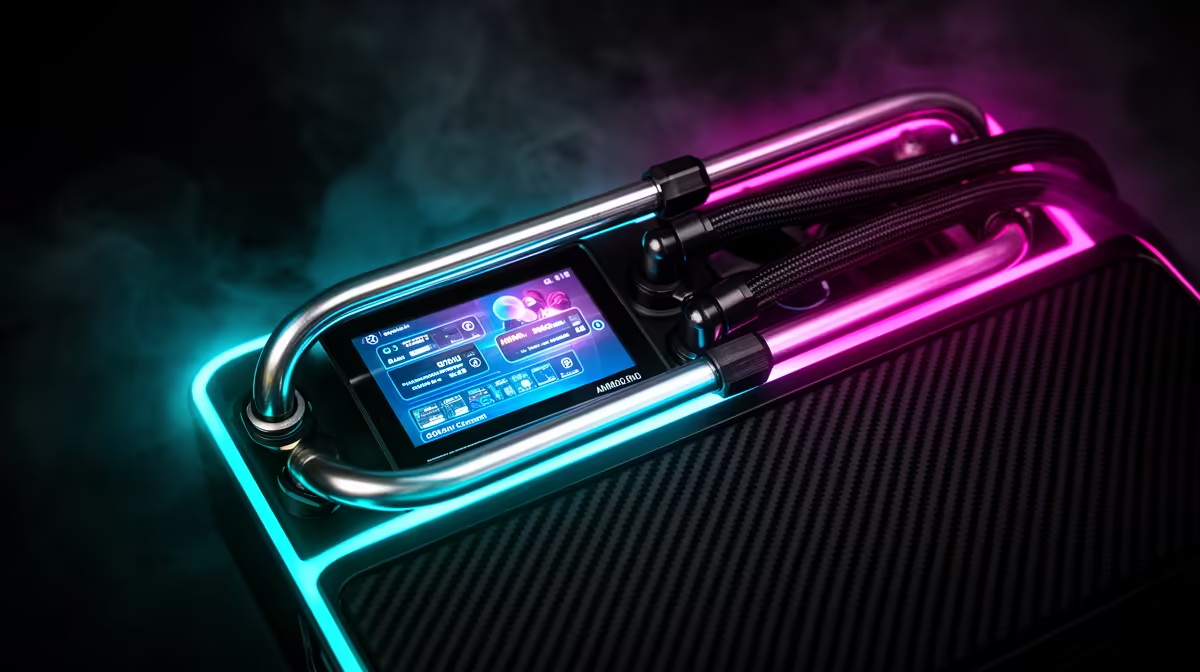
The AMOLED screen on the pump head is a small circular or square display, typically 1.77 to 2.1 inches, that can show CPU temperature, clock speed, custom images, or animated GIFs. Brands like Corsair with the iCUE Link series and similar premium coolers stocked at Evetech allow full customisation through companion software. The AMOLED panel uses significantly less power than LCD alternatives and produces deeper blacks, which matters when the cooler sits inside a dark case with ARGB accents. At resolutions around 480 x 480 pixels, the display is crisp enough for temperature readouts and logos at normal viewing distance through a glass panel.
When the Premium Pays Off for SA Builders 💡
For South African streamers and content creators, a visible pump head display adds production value to face-cam streams, showing real-time stats without a separate overlay. For showcase builds displayed at LAN events like rAge Expo, an AMOLED cooler becomes part of the presentation. The cost premium of R700 to R1,000 is also justified when you are already spending R3,500 to R4,500 on a 360mm AIO, because the percentage increase is modest and you gain a functional monitoring tool that reduces the need for a separate fan controller display. If your case has a tempered glass side panel and your build will be photographed or displayed, the AMOLED display elevates the final result noticeably.
When to Skip the AMOLED Premium 🎯
If your build is inside a solid-panel case, the display is invisible and the premium is purely wasted. Workstation builds and server-adjacent machines where thermal performance matters more than aesthetics should invest that R700 to R1,200 into a faster NVMe SSD or extra RAM instead. AMOLED displays also introduce one more software dependency: they require companion software running in the background to control the display content, which adds a minor system overhead and another app to keep updated. If you run a clean minimal software stack, a non-display 360mm AIO is simpler and equally effective thermally.
Check Software Ecosystem Before Buying ⚡
AMOLED-equipped coolers require their brand's companion software to unlock display features. Before purchasing, confirm the software is compatible with your motherboard's ARGB header standard and that it runs on Windows 11. Some South African builders have experienced conflicts between cooler and motherboard RGB software when mixing brands.
FAQ
Does an AMOLED display affect cooler performance?
No, the display is on the pump head and has no impact on radiator thermal performance. The additional power draw of the screen is negligible, typically under two watts, and the pump and fan performance is identical to the non-display variant of the same cooler.
Can I turn off the AMOLED display if I don't want it showing?
Yes, all AMOLED-equipped AIOs allow you to disable or dim the display through companion software. Some units also support an automatic brightness mode that dims when ambient light drops, preserving the display's lifespan during overnight sessions.
Are AMOLED coolers harder to warranty in South Africa?
Not if you buy through a local distributor stocked at Evetech. Warranty claims go through the South African distributor regardless of display type, and turnaround times are comparable to non-display AIO warranties.
Want a cooler that performs and looks the part?
Browse premium 360mm AIOs including display-equipped models currently stocked at Evetech, with options to suit showcase builds at every price point.