Quick Answer
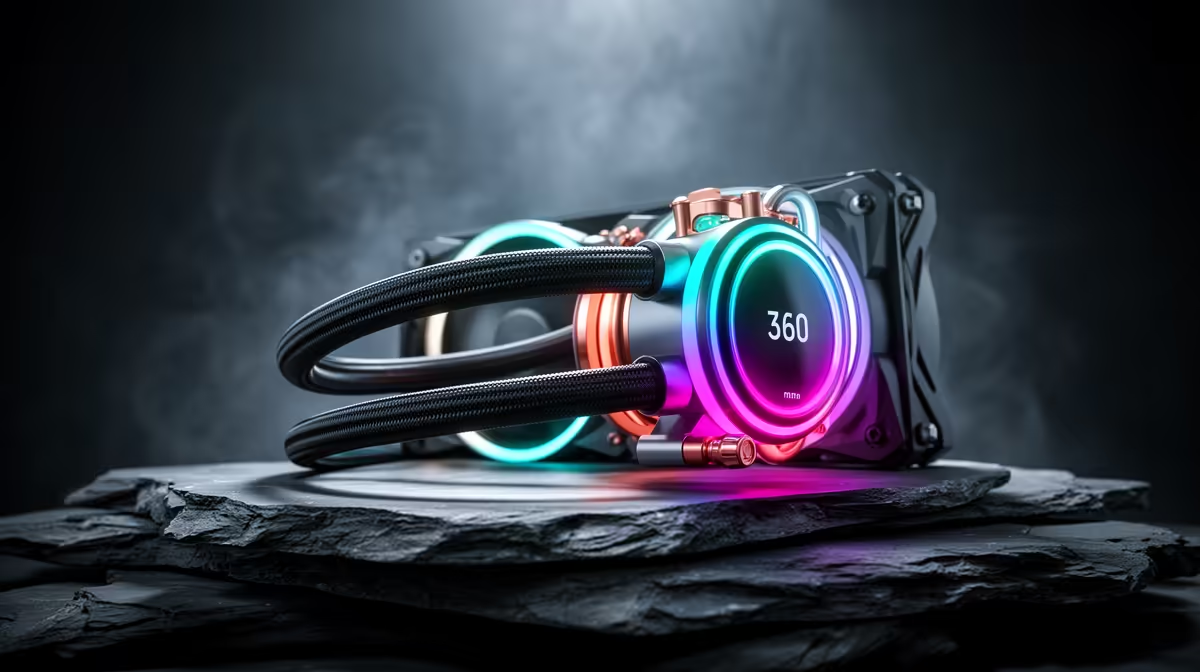
A 360mm ARGB liquid cooler is worth the extra cost when your CPU has a TDP above 120W, you game in an environment above 26 degrees Celsius ambient, or you have a windowed case where lighting integration improves the build's visual appeal. If none of those apply, a quality 240mm AIO or high-end air cooler delivers the same gaming FPS for less.
The Thermal Case for 360mm in SA Climates 🌡️
South Africa's climate is a legitimate hardware consideration for PC builders. Gauteng summers frequently see indoor ambient temperatures of 28 to 34 degrees Celsius in homes without climate control, and Cape Town and Durban have their own warm season peaks. Liquid cooling performance scales inversely with ambient temperature: in a 32-degree room, a Ryzen 7 9800X3D on a 240mm AIO will run 7 to 10 degrees Celsius hotter than in a 22-degree air-conditioned room.
A 360mm radiator has enough additional thermal mass to absorb this ambient penalty and keep the CPU below its 95-degree throttle threshold, where a 240mm unit in the same conditions starts throttling under prolonged workloads. For gamers who play in non-climate-controlled rooms during SA summer, the 360mm extra cost translates to tangible performance stability, not just a spec-sheet number.
When ARGB Adds Real Value 🎮
ARGB lighting on a 360mm AIO adds R300 to R800 to the unit cost at SA retail compared to an equivalent non-ARGB 360mm.
If your case is a solid-panel design without a window, the ARGB premium adds zero aesthetic value. Redirect that R400 to R800 to a better SSD or additional RAM instead.
The Break-Even CPU Tier 💰
The price gap between a quality 240mm AIO and a premium 360mm ARGB model at Evetech is typically R1,200 to R2,500. At what CPU tier does the 360mm earn back this premium through better gaming performance? For a Ryzen 5 7600X at 65W base TDP, the answer is effectively never in pure gaming: the CPU runs cool enough on a 240mm unit that the extra radiator surface is redundant.
The secondary benefit is noise. A 360mm AIO running at 1,200 RPM achieves the same CPU temperatures as a 240mm running at 1,800 RPM. For gamers who prioritise quiet operation, the 360mm delivers roughly 4 to 8 dBA less fan noise at equivalent cooling loads.
Match ARGB Ecosystem Before Buying ⚡
sync only works reliably within the same ecosystem: ASUS Aura Sync, MSI Mystic Light, Gigabyte RGB Fusion, or ASRock Polychrome Sync. If your motherboard is from a different brand than your AIO, check whether the AIO manufacturer supports a third-party sync API before purchasing. Software conflicts between mixed ecosystems can be difficult to resolve and may leave fans cycling random colours.
FAQ
Is there a gaming performance difference between 240mm and 360mm AIO at moderate room temperature?
In a 22 to 24 degree Celsius room, a quality 240mm AIO and 360mm AIO produce nearly identical gaming frame rates on the same CPU. Gaming frame rates are GPU-limited, and a CPU that is 5 degrees cooler does not translate to more FPS. The performance difference only appears in prolonged sustained workloads that trigger thermal throttle.
How much more does a 360mm ARGB AIO cost versus a plain 240mm at Evetech?
The typical SA price gap is R1,500 to R2,500 between a quality 240mm non-ARGB and a 360mm ARGB unit. Specific pricing varies with the rand-dollar exchange rate and stock levels, so checking current Evetech pricing is the most accurate approach.
Can the ARGB fans on a 360mm AIO be replaced with non-ARGB fans?
Yes. 120mm fans are a standard form factor and replaceable. Removing the ARGB fans and fitting quiet, high-static-pressure non-ARGB fans (like Noctua NF-F12) is a common modification for builders who prioritise silence over aesthetics. The pump and radiator function identically with any compatible 120mm fan.
Deciding between 240mm and 360mm ARGB cooling?
Compare the full AIO cooler range at Evetech to find the right balance of radiator size, ARGB lighting, and price for your South African build.