Quick Answer
Refresh rate matters most for gaming fluidity, adaptive sync matters most for eliminating tearing without VSync stutter, resolution matters most for visual fidelity and sharpness, and HDR on most curved monitors under R15,000 matters least because DisplayHDR 400 without local dimming adds little visible benefit. Prioritise in that order unless you have a specific use case.
Refresh Rate: The Foundation of Smooth Gaming 🎮
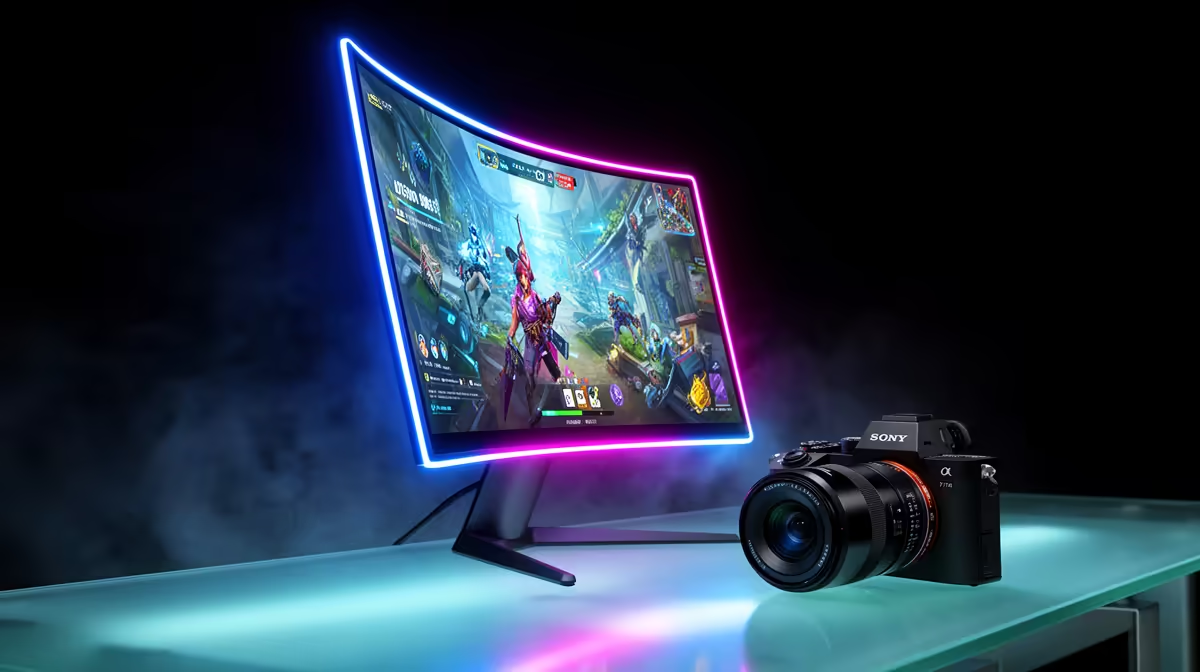
The jump from 60Hz to 144Hz is the most impactful single monitor upgrade you can make. At 144Hz you get a new frame every 6.9 ms versus 16.7 ms at 60Hz, which halves perceived motion blur and improves targeting in fast-paced games measurably. On a curved ultrawide where the field of view is wider and peripheral motion is always visible, smooth refresh feels even more valuable. A 144Hz curved gaming monitor starts from around R9,000 at Evetech for a quality 34-inch or 49-inch model. Beyond 144Hz, the gains narrow: 165Hz and 180Hz are marginal improvements most players cannot distinguish from 144Hz in actual gameplay.
Adaptive Sync: Why FreeSync Matters More Than VSync 🔄
VSync eliminates tearing by capping your frame rate to the display's refresh rate, but introduces input lag and stuttering when fps drops below that cap. Adaptive sync (FreeSync on AMD, G-Sync Compatible on Nvidia) dynamically adjusts the monitor's refresh to match your GPU's actual frame output, delivering tear-free visuals without those penalties. For curved gaming monitors where you are often pushing the GPU hard at wide resolutions, variable frame rates are common. FreeSync Premium certification on a 144Hz curved monitor ensures the sync range is wide enough (typically 48Hz to 144Hz) to cover most real-world frame rate variation. This feature should be non-negotiable on any gaming monitor purchase today.
Resolution vs HDR: Prioritising Wisely 📺
For a curved gaming monitor, resolution (1440p on a 27-inch or 34-inch, DFHD on a 49-inch) improves image fidelity in ways you notice in every gaming session. HDR at the DisplayHDR 400 tier, which is the most common certification on curved monitors in the R9,000 to R14,000 range, offers modest improvement only in specific scenes and often requires you to toggle it on and off per game. Spend the budget difference on resolution or refresh rate before prioritising HDR certification below DisplayHDR 600.
Feature Priority Checklist ⚡
comparing two curved monitors within R1,000 of each other in price, check these in order: higher refresh rate first, then adaptive sync certification, then panel response time rating, then resolution, and finally HDR certification. This ordering reflects the features that deliver the most tangible gaming benefit per rand.
FAQ
Does resolution affect gaming performance on a curved monitor?
Yes, higher resolution requires more GPU horsepower to maintain the same frame rate. A 1440p curved monitor needs roughly 40% to 60% more GPU performance than 1080p at the same settings. Budget your GPU accordingly when choosing resolution.
Is G-Sync worth paying extra for over FreeSync?
For most South African buyers no. FreeSync Premium monitors are more affordable, and Nvidia GPUs from the RTX 20-series onward work with FreeSync via G-Sync Compatible certification. Dedicated G-Sync modules add cost without a proportional benefit at typical PC gaming frame rates.
Do I need HDR enabled all the time on a curved gaming monitor?
No, and most experienced gamers leave it off for desktop use and competitive titles. Enable HDR specifically for single-player games that are well-mastered for HDR, like Horizon or Cyberpunk, and disable it otherwise for accurate SDR colour.
Shopping for a curved gaming monitor with the right spec mix?
Evetech stocks curved gaming monitors from entry 75Hz to high-refresh 165Hz models with FreeSync Premium and adaptive sync, compare the full range today.