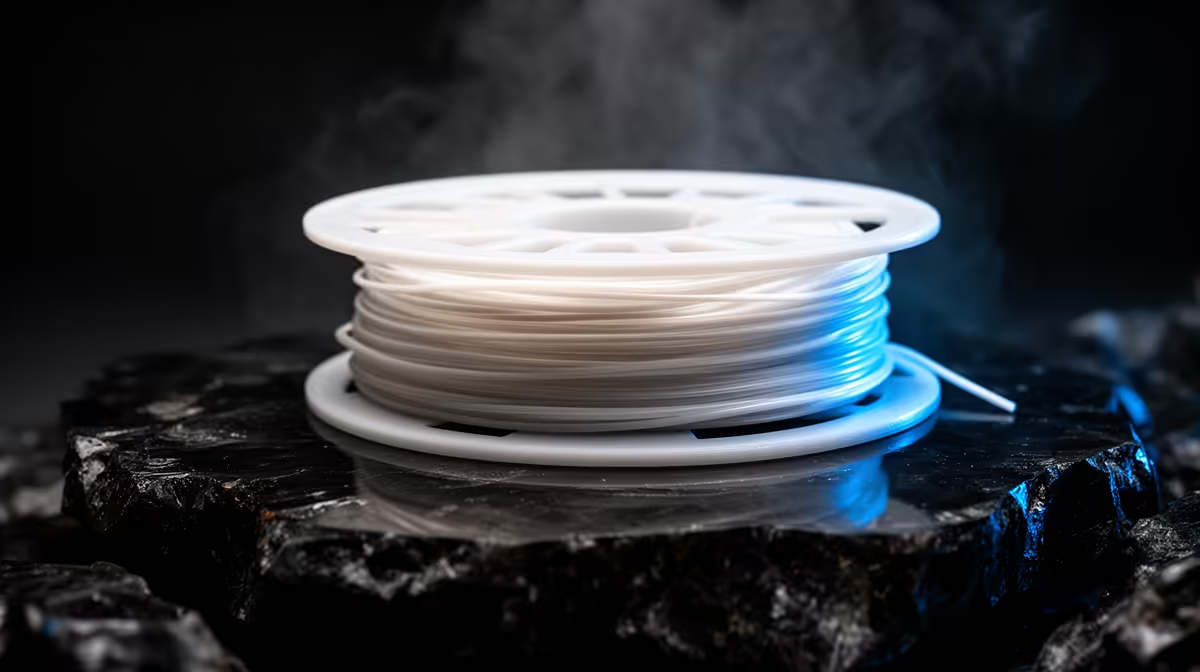
A steep overhang or a part trapped inside a cavity is where breakaway supports let you down, leaving scars you have to sand or a structure you simply cannot reach. Dissolvable supports fix that by washing away instead of snapping off, and the support filament you choose comes down to one decision: water or solvent. PVA melts away in plain water, HIPS needs a chemical called d-limonene, and your printer and your main material decide which one fits.
Quick Answer
PVA dissolves in plain water and pairs with PLA, PETG and similar materials, while HIPS dissolves in d-limonene and is the classic support partner for ABS. Both need a dual-extrusion printer, so your machine's second extruder and your access to the right solvent decide the choice.
How dissolvable support actually works
A dissolvable support is printed from a second material that the main plastic ignores chemically. After the print finishes, you submerge it in the matching solvent, which eats away only the support and leaves the model untouched. The result is clean overhangs and internal channels that breakaway supports could never give you, because there is no physical removal step that risks marking the surface.
The catch is that this only works on a printer with two extruders, since the machine has to lay down two different filaments in the same job. A single-extruder printer cannot use true dissolvable support, which is the first thing to confirm before buying either spool.
PVA: the water-soluble option
PVA is the friendlier of the two to live with, because its solvent is tap water. Drop the finished print in a tub of water, give it a few hours, and the support is gone with no chemicals to buy or dispose of. For large prints it still clears in a matter of hours, and the removal is the easiest of any support method.
It pairs naturally with PLA and PETG because their printing temperatures overlap well with PVA's. The downsides are real but manageable: PVA is more demanding to print than HIPS and absorbs moisture from the air, so it needs to be kept dry in a sealed container or it turns brittle and clogs. It also costs more per spool than HIPS, though water being free offsets that against buying solvent.
When PVA is the right call
Choose PVA if your main material is PLA or PETG, you want the simplest, safest removal, and you can store the filament properly between prints. For models with delicate features or trapped internal geometry, PVA's gentle water bath is hard to beat.
HIPS: the d-limonene option
HIPS is the traditional partner for ABS. Its printing temperature sits close to ABS, so the two cooperate in a dual-extrusion job, and HIPS itself prints more easily than PVA and is less fussy about moisture. That makes it a forgiving support material once you are already printing ABS.
The trade is the solvent. HIPS dissolves in d-limonene, a citrus-based chemical you have to buy, handle carefully and dispose of responsibly, and it works more slowly than water. Large HIPS prints can take a long time, sometimes running into days, to dissolve fully. So while HIPS is easier to print, it is more involved to remove. The filaments and the printer add-ons that go with this kind of work sit alongside the printer accessories that move fastest, worth checking when you stock up.
Getting a clean interface between part and support
Choosing the spool is only half the job; how the two materials meet decides how clean the result looks. The interface layer, where the support touches the model, is where most disappointment comes from. If the support fuses too tightly to the part, even a dissolvable material can leave a slightly rough face once it washes away. The slicer settings that control the gap and the interface density are what tune this, so a little time in the software pays off.
Temperature matching is the other half. Dual-extrusion only works smoothly when the two materials print in compatible temperature ranges, which is exactly why PVA pairs with PLA and PETG and HIPS pairs with ABS. Try to mix a support with a model material whose temperature is far apart and one of them prints badly, since the shared hotend or chamber cannot satisfy both. Sticking to the established pairings keeps the print reliable and the dissolved result clean.
Saving filament with interface-only support
A practical trick worth knowing is to print the bulk of the support in your normal model material and use the expensive dissolvable filament only for a thin interface layer against the overhang. The cheap breakaway bulk snaps off easily because it never touched the model directly, while the dissolvable interface washes away to leave the clean face. This stretches a costly PVA or HIPS spool a long way and is the standard approach for anyone printing dissolvable support regularly, since it cuts the running cost without giving up the clean finish.
Matching the support to your printer and material
The decision is really a chain of three questions. First, does your printer have dual extrusion? If not, neither dissolvable support applies and you are back to breakaway. Second, what is your main material? PLA or PETG points to PVA, while ABS points to HIPS. Third, are you comfortable buying and handling d-limonene, or would you rather work with water only?
For most home setups printing PLA or PETG, PVA and a tub of water is the cleaner workflow despite the higher spool price. For an ABS-focused workshop already set up to handle solvents, HIPS slots in neatly and prints with less fuss. Either way the printer is the gatekeeper, so confirm the second extruder first. The current dual-extrusion machines sit in the 3D printer range, which is where to start matching the hardware to the support workflow you want.
Frequently Asked Questions
Can I use PVA or HIPS on a single-extruder printer?
No. True dissolvable support needs a second extruder to print the support material separately from the model. A single-extruder printer can only do breakaway supports in the same material as the part.
Which dissolves faster, PVA or HIPS?
PVA, by a wide margin. It clears in plain water in a few hours even on larger prints, while HIPS in d-limonene works more slowly and can take a long time, sometimes days, to dissolve fully on big parts.
Why does my PVA keep clogging or going brittle?
PVA absorbs moisture from the air. If it has been left out, it swells and turns brittle, which causes clogs. Store it in a sealed, dry container with desiccant and dry it before printing if it has been exposed.
Is d-limonene safe to use at home?
It is a citrus-based solvent that needs careful handling, adequate ventilation and responsible disposal. It is workable at home with basic precautions, but it is the reason many people prefer PVA's plain-water removal.
Which support filament pairs with PETG?
PVA. Its temperature range overlaps well with PETG and PLA, and it removes cleanly in water. HIPS is matched to ABS instead, so it is not the right partner for PETG prints.
Clean overhangs and trapped cavities start with the right printer and the matching support spool. Confirm your machine can run two materials in the Evetech 3D printer range, then choose PVA or HIPS to suit your main filament.