


PCIe 5.0 vs PCIe 4.0 for Video Editing in 4K in SA
PCIe 5.0 and PCIe 4.0 differ most in lane support, compatibility, and upgrade value for video editing in 4k. SA buyers should match the choice to their actual hardware and games.
Read moreDiscover why 24GB VRAM for rendering is the new standard for 3D artists. From massive texture packs to complex simulations, high memory ensures smooth workflows and prevents crashes. 🚀 Upgrade your creative rig today! 🎨

Staring at a render progress bar is a special kind of pain. In the world of high-end gaming, the debate rages over 12GB vs 16GB of VRAM. But for South African creative professionals, architects, and data scientists, that conversation is just the starting point. When your livelihood depends on complex 3D scenes and massive datasets, the real question becomes: is it time to step up to a GPU with 24GB of VRAM? Let's dive in.
Before we talk numbers, let's quickly demystify VRAM (Video Random Access Memory). Think of it as your graphics card's ultra-fast, dedicated workspace. Every texture, 3D model, lighting effect, and piece of geometry for your project gets loaded into VRAM. The more you have, the bigger and more complex the scene your GPU can handle smoothly.
When you run out, your system is forced to use slower system RAM, causing stuttering, crashes, and those dreaded "out of memory" errors. The importance of 24GB VRAM for rendering isn't just about speed; it's about stability and enabling projects that are simply impossible on less capable hardware. While many of the best gaming PC deals feature impressive specs, professional workloads operate on a whole different level.
So, who actually needs this much graphical memory? It’s not about future-proofing for a game that might come out in five years. It’s about tackling today’s most demanding professional tasks without compromise. 🚀
While our budget gaming PCs are perfect for getting started, and even some powerful rigs under R20k can handle creative tasks, heavy rendering is a different beast entirely.
The biggest benefit of having ample VRAM isn't just shaving minutes off your final render. It's about transforming your entire workflow. Imagine manipulating a massive, fully-textured scene in real-time without a hint of lag. That’s the freedom that a 24GB GPU provides.
You can work with uncompressed, high-resolution assets, see changes instantly, and iterate faster. This smooth, interactive experience is something you have to feel to believe. It allows you to stay in the creative zone instead of constantly fighting your hardware. This level of performance is typically found in professional workstations, like the systems you'll find in our PCs above R20k selection.
Even with a powerful GPU, good habits help. In 3D software like Blender, use instanced objects instead of duplicates wherever possible. Instancing references a single piece of geometry multiple times, saving a massive amount of VRAM compared to creating unique copies of the same object. This is crucial for scenes with lots of trees, rocks, or repeating architectural elements.
Let's be clear: not everyone needs 24GB of VRAM. If you're primarily a 1440p gamer or a video editor working with 1080p footage, you can absolutely get by with less.
However, if you're a professional or serious hobbyist whose projects are constantly hitting memory limits, if your software is crashing during complex renders, or if you're simply tired of compromising your artistic vision to fit within hardware constraints, then the answer is a resounding yes. Investing in a system with sufficient VRAM for rendering is an investment in your productivity and creative freedom.
For those who want a powerful, tested machine straight out of the box, exploring our current pre-built PC deals is a great place to find a rig that meets these demanding specs.
Ready to Unleash Your Creative Power? The difference between a good render and a great one often comes down to the hardware. If you're tired of waiting and ready to create, it's time for a real workstation. Explore our range of Professional Workstation PCs and find the machine that won't hold you back.
It allows you to load massive 8K textures and geometry without swapping to slower system RAM, preventing crashes and significantly speeding up viewport performance.
Only for 4K gaming with max settings and heavy ray tracing. While overkill for most, 24GB VRAM future-proofs your rig for upcoming AAA titles.
Top-tier cards like the NVIDIA GeForce RTX 3090, RTX 3090 Ti, and the powerful RTX 4090 currently offer 24GB VRAM for enthusiast performance.
Complex simulations store particle data and physics calculations. Insufficient memory causes bottlenecks; 24GB ensures smooth real-time playback without lag.
16GB is decent for mid-level work, but for professional tasks, 24GB VRAM for rendering large scenes is superior to avoid frustating out of memory errors.
Indirectly. While CUDA cores drive speed, ample VRAM prevents slowdowns caused by system RAM swapping, keeping the GPU fed with data constantly.
PCIe 5.0 and PCIe 4.0 differ most in lane support, compatibility, and upgrade value for video editing in 4k. SA buyers should match the choice to their actual hardware and games.
Read more
ATX 3.1 and ATX 3.0 differ most in connector handling and GPU power design. For SA gamers, the choice comes down to your graphics card, PSU quality, cable clearance, and whether a newer 12V-2x6-ready unit makes sense for the build.
Read more
80+ Platinum or 80+ Titanium for cinematic should be shortlisted around the job it must do. South African buyers should compare fit, performance, compatibility, and upgrade room, warranty path, and upgrade room before treating any pick as best.
Read more
AM5 and AM4 can both work for competitive esports, but the real-world difference is platform headroom. SA players should compare CPU choices, memory speed, latency goals, monitor refresh, and future upgrade plans.
Read more
LGA 1851 and LGA 1700 differ most in CPU support, compatibility, and upgrade value for couch co-op gaming. SA buyers should match the choice to their actual hardware and games.
Read more
DLSS 4 and DLSS 3 differ most in game support, compatibility, and upgrade value for streaming on twitch and youtube. SA buyers should match the choice to their actual hardware and games.
Read more
RTX 5090 on a 1200W PSU has usable headroom when the supply is strong and the build is measured. For SA gamers, OC potential depends on CPU draw, cooling, cabling, stability targets, and how much safety margin you keep.

How to fix low FPS on gaming laptop starts with power mode, drivers, heat, and game settings. Use this South Africa-focused checklist to confirm charger use, GPU selection, RAM pressure, and cooling before changing parts or tweaking every setting.
Real world difference between b850 b650 mmo live service games sits in stability, networking, storage, and upgrade room. SA players should compare LAN quality, USB layout, RAM support, and SSD slots for always-updated games.

Dead Pixel on Wi-Fi 7 Router is likely a display-path or source-title issue, so check the screen, cable, driver state, and related system symptoms before blaming the device itself.

Put the headphones in pairing mode, open Bluetooth and devices in Windows 11, then add the headset. If it fails, remove the old pairing and check charge, range and drivers.

Microsoft says upcoming Windows 11 work will target memory use on 8GB PCs and improve boot and sign-in responsiveness. There is no public release date or measured uplift yet.
Windows 11 does not show CPU temperature in its standard Settings pages. Use your CPU maker's supported utility or a trusted monitor, then read idle and loaded temperatures in context.
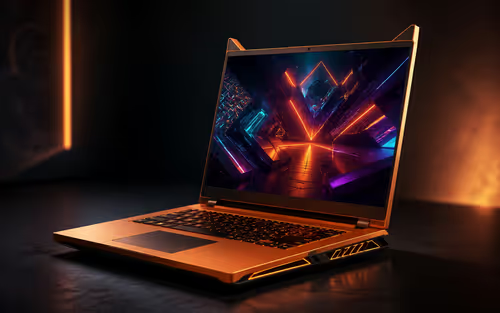
The Colorful MEOW X16 Pro pairs a Ryzen 7 8745HX with a 115W RTX 5060 Laptop GPU. It is a China-only launch for now, so local RTX 5060 pricing is the practical benchmark.
Industry reports point to another roughly 10 percent Intel processor increase from 5 October, but Intel has not published a consumer price list confirming the scope. South African buyers should treat it as a risk signal, not a guaranteed Rand change.

Tests reported audio capture and local-network scanning on a specific LG television with its screen off. LG says supported standby modes can keep voice and connected-device features active, so owners should review model-specific settings.
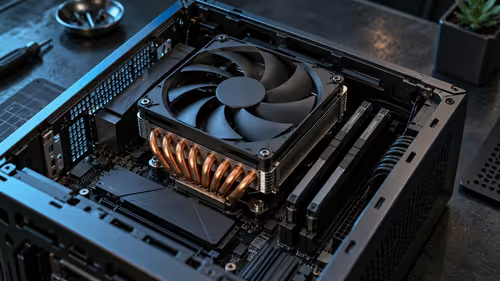
Thermalright's AXP120-X77 is a 77 mm top-down cooler with six heatpipes and a slim 120 mm fan. Local availability is not confirmed, so compact-PC builders should verify case height, memory clearance and socket support before comparing it with stocked coolers.

One-sided sound can come from balance settings, a dirty or loose connector, Bluetooth pairing data, firmware, the source device or a failed cable or driver. A short swap test isolates the cause before you reset software or replace the headset.