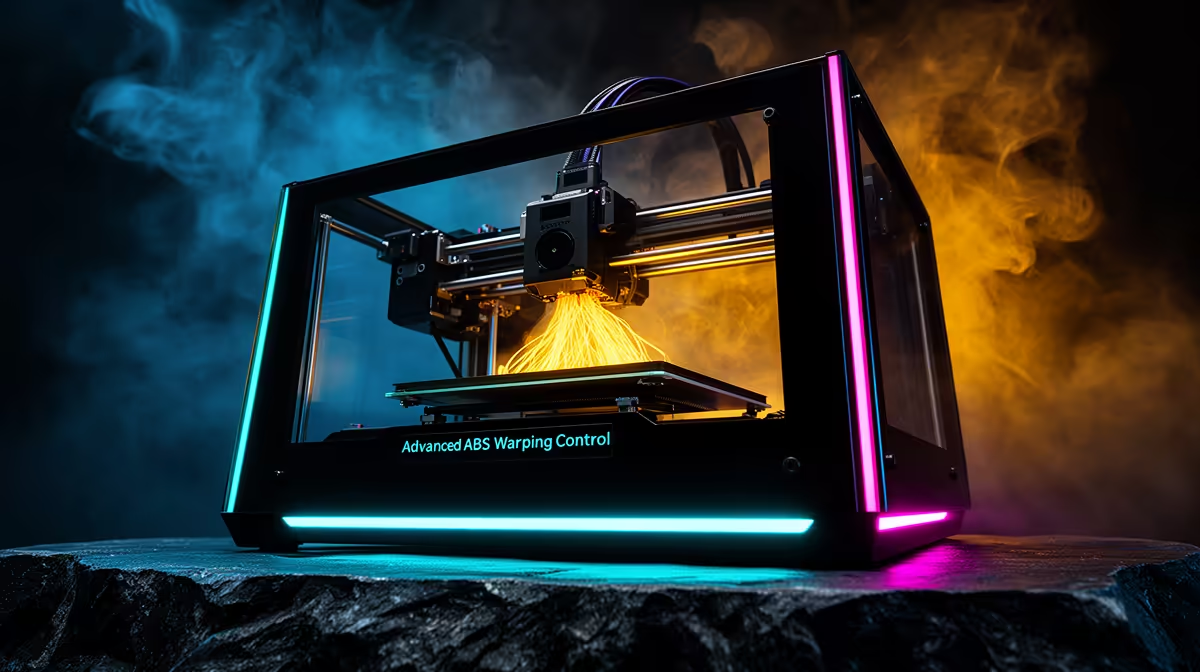
An open-frame printer happily lays down PLA all day, but switch the spool to ABS or ASA and you start fighting corner lift, mid-print cracks and a faint chemical smell that lingers in the room. An enclosed 3D printer solves both problems at once: it traps the heat the bed throws off so the chamber stays warm and the plastic shrinks evenly, and it contains the styrene the filament gives off so you can route it through a filter or out a window. For engineering-grade printing it is the single upgrade that turns a frustrating material into a reliable one.
Quick Answer
Enclose the printer if you print ABS or ASA. A sealed chamber holds the warm air at roughly 40 to 50 degrees C, which cuts warping and layer cracking dramatically, and a carbon filter on that chamber cuts airborne VOCs by around 80 to 90 percent versus printing in the open. PLA and PETG do not need it.
Why heat is the real fix for warping
ABS and ASA shrink as they cool. When a fresh layer cools far faster than the layer below it, the part contracts unevenly, lifts off the bed at the corners and sometimes splits clean through a wall. A cold draft from an open window or an aircon vent makes it worse in seconds.
An enclosure does not need its own heater to help. The heated bed alone pushes warm air upward, and a closed box keeps that air around the part instead of letting it escape. The chamber settles into a stable warm pocket, the temperature gradient across the print flattens out, and the plastic contracts as one mass rather than fighting itself layer by layer.
What chamber temperature does to layer bonding
Warm surrounding air also keeps each layer slightly softer for longer before the next one lands, so the two fuse properly instead of sitting on top of each other. That is why ABS parts printed in a stable enclosure are noticeably stronger along the Z axis than the same part printed in open air. For functional brackets, FPV drone frames and anything that takes a mechanical load, that bond is the difference between a part that survives and one that delaminates.
The fume side of the equation
Styrene is the compound responsible for that sharp smell, and it is classed as a probable carcinogen, so it is not something to breathe in a closed study or bedroom. ASA emits it too, despite being the friendlier outdoor filament. The fumes come in two forms: ultrafine particles and volatile organic compounds, and both are released the moment hot plastic extrudes.
Sealing the chamber does not make the fumes disappear, it concentrates them in one controllable space. From there you have two sensible routes. The first is active filtration, where a fan pulls chamber air through a HEPA-and-carbon stack that traps the particles and adsorbs much of the VOC load. The second is direct extraction, ducting the chamber out through a window or wall vent so the styrene never enters the room. Many serious setups run both.
What an enclosure does not do
An enclosure is containment, not a cure. A box with no filter and no vent still leaks styrene every time you open the door, and a sealed chamber with poor airflow can let particles build up. Treat the enclosure as the first stage and pair it with a filter or a vent. If you print ABS regularly in a small room, ventilation is not optional.
Choosing or building the right setup
You have three broad paths. A printer that ships fully enclosed from the factory is the simplest, with the chamber, filtration mounts and sometimes a heater already integrated. A fabric or acrylic aftermarket tent fitted over an open-frame machine is the cheapest jump and works well for warping, though you will usually add filtration yourself. A custom cabinet built from an IKEA-style unit gives the most room for a filter, a vent and the spool, at the cost of a weekend of work.
Whichever route you take, prioritise a chamber that actually seals, a clear door so you can watch the first layers, and somewhere to mount a fan and filter. If you are kitting out a print station, the printers and add-ons in the 3D printer range at Evetech cover both enclosed machines and the open-frame bases people tent later.
What to budget for beyond the enclosure
The enclosure itself is only part of the investment. An inline extraction fan and a length of flexible ducting are the next purchase for anyone printing ABS or ASA with any regularity. A 120mm fan pulling through a duct to a window insert will maintain negative pressure inside the box so fumes flow toward the exhaust rather than through every gap into the room. Budget an additional R400 to R800 for decent fan-and-duct hardware depending on how permanent you want the installation. For the fans, ducting connectors and small print-station accessories, browsing what other SA makers are picking up from the accessories best sellers gives a practical view of which components see the most repeat orders.
Frequently Asked Questions
Do I need an enclosure for PLA?
No. PLA prints best with good airflow and even benefits from a cooling fan, so an enclosure can actually cause heat creep and clogging. Reserve enclosures for ABS, ASA, nylon and polycarbonate.
Does an enclosure remove the smell completely?
On its own, no. It contains the styrene in one space, but you still need a carbon filter or a vent to actually remove or neutralise it. Opening an unfiltered enclosure releases a concentrated puff of fumes.
What chamber temperature should I aim for with ABS?
A stable pocket of roughly 40 to 50 degrees C is enough to curb warping for most ABS parts. You rarely need an actively heated chamber at this level, since the heated bed and a sealed box usually get you there.
Can I print ASA without an enclosure?
You can, and ASA tolerates open printing better than ABS, but you will still see warping in a draughty room and you will still breathe styrene. A simple tent plus ventilation makes ASA far more reliable and safer indoors.
Is a fabric enclosure as good as a rigid one?
For trapping heat, a well-fitted fabric tent performs surprisingly close to acrylic. Rigid cabinets win on durability, on mounting a proper filter and vent, and on keeping a stable chamber for tall prints.
Printing ABS or ASA without fighting warped corners and chemical air starts with the right machine and the right extraction. Browse the 3D printers at Evetech to find an enclosed setup that suits your bench and your budget.