

Storage Specs Explained for Beginners
Storage Specs Explained for Beginners. Plain-English explanation of what it means, why it matters & how it affects your buying decisions in SA.
Read moreWhy are gaming monitors so expensive? This deep dive breaks down the manufacturing, R&D, and marketing costs that drive up prices. 🖥️ Understand what you're paying for, from panel technology to refresh rates, and learn if premium features are worth the investment. 💰
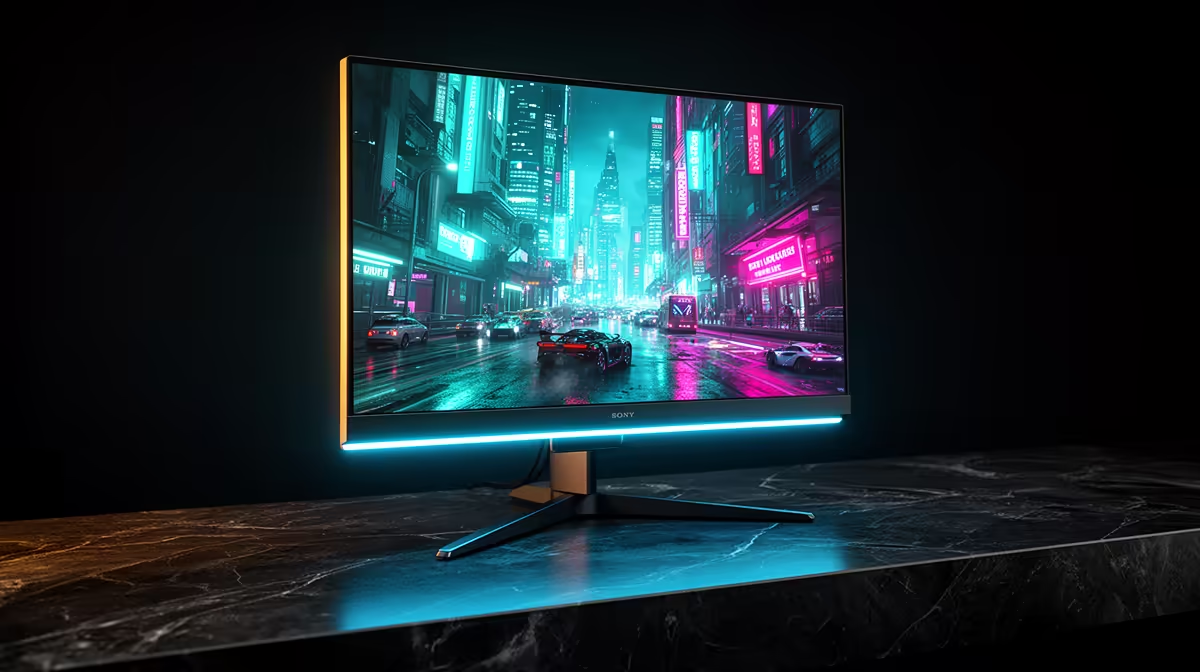
Staring at your brand-new PC, a powerhouse of graphics and speed, but it’s plugged into your old office screen? The bottleneck is real. You start browsing for an upgrade and... yoh, the prices! It’s a common shock for many South African gamers. So, why are gaming monitors so expensive compared to standard displays? It’s not just marketing hype; it's a story of cutting-edge tech built for one purpose: to give you the winning edge.
The biggest reason for the high price of a gaming monitor comes down to specialised components designed for speed and responsiveness. A standard office monitor is built for static images and text, while a gaming monitor is engineered to render motion flawlessly.
This is the big one. Refresh rate, measured in Hertz (Hz), is how many times per second the screen can draw a new image. A basic monitor is 60Hz. A gaming monitor starts at 144Hz and can go up to 360Hz or even higher. This creates a much smoother, clearer image, giving you a critical advantage in fast-paced games like Valorant or Warzone.
Response time, measured in milliseconds (ms), is how quickly a pixel can change colour. A slow response time causes "ghosting" or motion blur. Gaming panels use advanced technologies to achieve 1ms response times, ensuring every movement is crisp. This combination of high refresh rates and low response times is a complex engineering feat, and it forms the core of the gaming monitor price breakdown. You can browse a huge variety of displays in Evetech's collection of all gaming monitors to see these specs in action.
Not all screens are created equal. The type of LCD panel used has a massive impact on both performance and cost.
Just a few years ago, 1080p (Full HD) was the standard. Today, the market has shifted, and higher resolutions demand more powerful—and expensive—panel technology.
The jump from 1080p to 1440p (QHD) offers a significant boost in sharpness and is considered the sweet spot for many PC gamers in South Africa. A good 1440p 144Hz IPS monitor can often cost between R6,000 and R12,000, depending on other features.
Pushing further into the world of high-resolution 4K and 5K monitors means cramming over eight million pixels into the screen. Manufacturing these panels with high refresh rates and no defects is incredibly difficult, which is directly reflected in their price. You also need a seriously powerful graphics card to run games smoothly at this resolution, adding to the total cost of your setup.
To unlock the full potential of your high-refresh-rate monitor, make sure you're using the right cable. While HDMI is fine for many, a DisplayPort 1.4 cable is often essential to hit those peak 144Hz+ refresh rates at 1440p or 4K resolutions. Always check your monitor's manual to see which port delivers the best performance. It's a small detail that makes a huge difference!
Beyond the core specs, several "luxury" features contribute to why some gaming monitors are so expensive. These technologies are designed to create a smoother and more visually stunning experience.
Ever seen a "tear" in your screen during a fast camera pan? That's your monitor and graphics card falling out of sync. Adaptive Sync technology solves this.
HDR allows for brighter highlights, deeper blacks, and a wider range of colours, making games look incredibly vibrant and realistic. True, impactful HDR requires the monitor to have a very high peak brightness and local dimming zones, features that are only found on more expensive models. 🚀
The shape of the screen itself can also add to the cost. The manufacturing process for the immersive, wraparound screens found on curved monitors is more complex than for a standard flat panel, bumping up the final price.
For a dedicated gamer, absolutely. The cost of a gaming monitor is a direct investment in your in-game performance and overall enjoyment. A fast, responsive monitor makes you a better player, while great colours and high resolution make your virtual worlds come alive.
While the initial price might seem steep, it's important to see it as a long-term part of your setup. Unlike some components that get outdated quickly, a good monitor can easily last through two or even three PC upgrade cycles. Whether you're looking at mainstream PC monitors for a bit of everything or specialised gear, the value is there.
And the innovation doesn't stop at the desktop. The rise of powerful handhelds and laptops has created a market for high-quality portable monitors, packing gaming-grade specs into a travel-friendly format. Finally, don't forget to budget for essential monitor accessories like a solid monitor arm or calibration tool to get the most out of your purchase.
Ultimately, understanding what makes gaming monitors expensive is the first step to making a smart purchase. You're not just paying for a screen; you're paying for speed, clarity, and immersion.
Ready to Upgrade Your View? Understanding why a gaming monitor is expensive helps you choose the right one for your budget and rig. From lightning-fast esports panels to immersive 4K screens, the perfect display is waiting to unlock your PC's true potential. Explore all our PC components and find the perfect monitor today.
The LCD or OLED panel is by far the most expensive component, often accounting for over 60-70% of the total manufacturing cost due to its complex production process.
Yes. Higher refresh rates (144Hz, 240Hz+) require more advanced panel technology and powerful controllers, which directly increases the refresh rate vs price ratio.
G-Sync monitors include a proprietary NVIDIA hardware module that adds to the bill of materials and licensing fees, unlike AMD's open-standard, royalty-free FreeSync.
For casual gaming, a mid-range monitor often provides the best value. Premium features in expensive monitors are typically geared towards competitive or enthusiast gamers.
Research and development for new technologies like Mini-LED, faster response times, and higher refresh rates are significant upfront costs that get passed on to the consumer.
Absolutely. Established brands invest heavily in marketing, quality control, and warranty support, which contributes to a higher retail price compared to lesser-known brands.
Storage Specs Explained for Beginners. Plain-English explanation of what it means, why it matters & how it affects your buying decisions in SA.
Read more
Will RDNA 5 Use the Same Silicon as the Next. Plain-English explanation of what it means, why it matters & how it affects your buying decisions in SA.
Read more
Google Workspace on Mac: Drive, Docs, Sheets and. Everything you need to know with SA pricing, step-by-step instructions & expert recommendations.
Read more
Back-to-School Parent Guide: Storages. Everything you need to know with SA pricing, step-by-step instructions & expert recommendations.
Read more
to Esports Tournaments. Everything you need to know with SA pricing, step-by-step instructions & expert recommendations.
Read more
Easter Storage Buying Guide. Hand-picked gift ideas at every budget tier. SA pricing & Evetech availability included.
Read more
AMD RX 9050 XT: Rumoured Specs, Price & Release. SA-focused analysis with local pricing data, real-world insights & actionable buying advice.
Can RTX 4080 Super Run AI Workloads for SA Developers Detailed answer with SA data, expert analysis & practical recommendations for local buyers.
Can RTX 4090 Run AI Workloads for SA Developers Detailed answer with SA data, expert analysis & practical recommendations for local buyers.
Top Settings for Intel Arc B580 at Ultrawide 1440p picks evaluated on performance, value & SA availability with current Rand pricing from Evetech.
RTX 4060 CS2 Low Settings at 1080p: FPS Results. Real-world benchmark data, FPS numbers & performance analysis. What SA gamers can actually expect.

Visual Artifacts: Possible GPU Issue Issue #1. Diagnosis steps, proven fixes & when to seek professional help. SA-specific support info included.
Can the RTX 4090 Handle 1440p 144Hz Gaming. Performance testing verdict with real data & practical recommendations for SA buyers.

Top ASUS GPU Under R15000 picks evaluated on performance, value & SA availability with current Rand pricing from Evetech.
GTA 6 Max Settings on RTX 5070. Tested & verified settings for best FPS and visual quality on SA hardware budgets.
Cyberpunk 2077 Max Settings on RTX 5080. Tested & verified settings for best FPS and visual quality on SA hardware budgets.
Starfield Max Settings on RTX 5070 Ti. Tested & verified settings for best FPS and visual quality on SA hardware budgets.
Top RTX 5090 Under R5000 picks evaluated on performance, value & SA availability with current Rand pricing from Evetech.